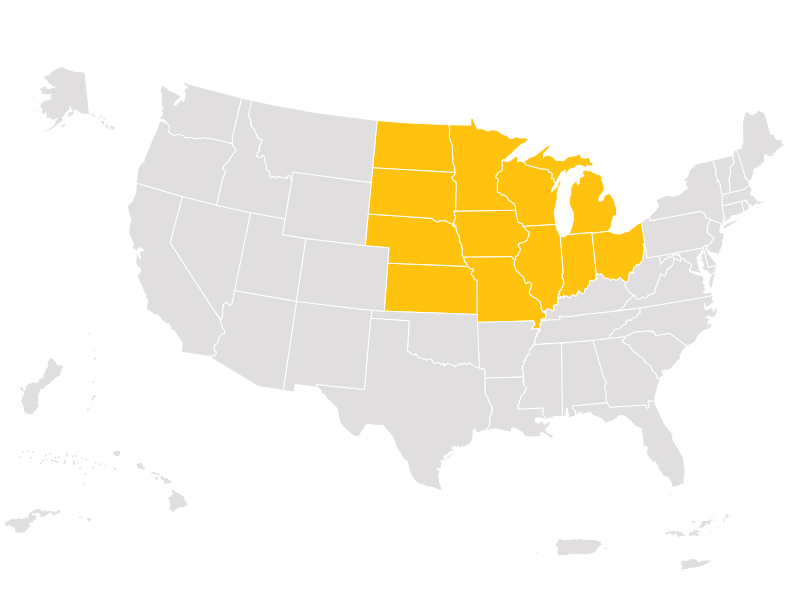
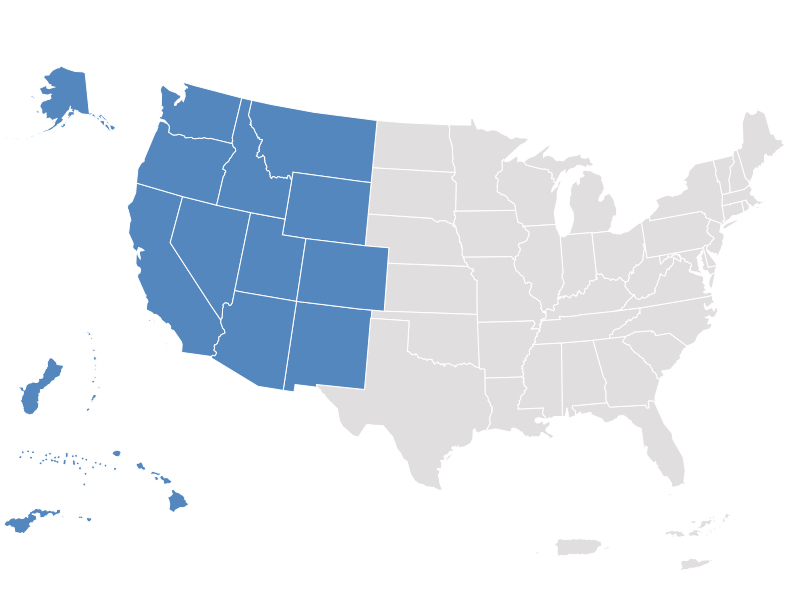
Ag Opportunities Vol 20, No 8/9 August/September 2009 NCR-SARE Announces 2009 Farmer Rancher Grant Call for Proposals The 2009 North Central Region - Sustainable Agriculture Research and Education Program (NCR-SARE) Farmer Rancher Grant Call for Proposals is now available online at http://sare.org/ncrsare/cfp.htm. Farmers and ranchers in the North Central Region are invited to submit grant proposals for projects to explore sustainable agriculture solutions to problems on the farm or ranch. Proposals should show how farmers and ranchers plan to use their own innovative ideas to explore sustainable agriculture options and how they will share project results. Sustainable agriculture is good for the environment, profitable, and socially responsible. Projects should emphasize research or education/demonstration. Grants can range from $6,000 for individual farmers up to $18,000 for groups of 3 or more farmers. NCR-SARE expects to fund about 50 projects in the twelve-state North Central Region with this call. The deadline for proposals is Thursday, December 3, 2009 at 4:30 p.m. The NCR has funded more than 700 farmer rancher grants worth more than $4,300,000 since the inception of this program. Missouri has led the way with the most recent awarded grants in the past several years. To see examples of past projects, go to www.sare.org/projects. Coordinators who can provide information and assistance to potential grant applicants. Interested applicants can contact KB Paul, Lincoln University, 573-681-5584 or Debi Kelly, University of Missouri, 573-882-1905. There will be several grant writing workshops for the SARE Farmer Rancher grants in the near future so be on the lookout for the dates in the next e-newsletter. ********************************************************************** MU AgrAbility Project Grant Renewal to Help Disabled Farmers by Bob Thomas, Information Specialist University of Missouri Cooperative Media Group Source: Willard Downs, 573-882-0094 University of Missouri Extension has received a four-year federal grant to continue the Missouri AgrAbility Project, which helps disabled farmers and their families remain in agriculture. "The project provides on-farm assistance, technical information, referrals and training to disabled individuals who want to continue to farm," said Willard Downs, project director. "Given the right resources, farmers with disabilities can run productive and profitable farms," he said. Services are statewide and no fees are charged to those requesting assistance. Those eligible for services may have any type of disability: physical, cognitive or illness-related. Disabilities may include amputations, arthritis, vision impairments, spinal cord injuries or chronic disease, he said. The program offers referrals to other providers, on-farm technical assessments on adapting farm equipment and help in modifying farm operations and buildings. Farmers and ranchers also can receive agriculture-based education to help prevent further injury and develop peer support networks. Missouri is one of 22 states with USDA-funded AgrAbility programs. Missouri ranks second among states in total number of farms. Missouri AgrAbility has been in operation since 1994. For more information, see www.agrability.missouri.edu or contact the Missouri AgrAbility Project at 573-882-2731 or 1-800-995-8503. ********************************************************************** Food Safety Must Begin on the Farm Small-scale produce growers should do everything possible to sell food that is clean, safe, and wholesome. An outbreak of produce contamination at a farmers market would imperil small farms everywhere, as it could result in federal regulations that will be costly and time-consuming. In an effort to head off federal regulation, growers groups are urging small farmers to self-regulate. They also are developing food safety programs that may eventually be used as a food safety certification, possibly in coordination with organic certification. These programs are similar to the Good Agricultural Practices (GAPS) used by industry groups. They are based on the Hazard Analysis Critical Control Point (HACCP) certification that is increasingly being required by supermarket and other wholesale buyers. But they are more scale-appropriate for small and medium-sized farms. On the East Coast, the Leafy Greens Working Group is a coalition of farming organizations creating a do-it-yourself guide to a HACCP system. On the West Coast, the Community Alliance with Family Farmers (CAFF) has created a set of GAPS for small growers. For more information on these programs, and for some basic advice on ensuring the safety of your produce, please read the detailed article "Food safety: Let’s work on this together!" at www.growingformarket.com. Another useful resource is Cornell’s guide to Good Agricultural Practices for Fresh Fruits and Vegetables, available at http://www.gaps.cornell.edu/Educationalmaterials/Samples/FSBFEngMED.pd f (from Growing for Market) *GAPs: Bringing Good Agricultural Practices to Your Farm* As our food system has become more centralized and industrial, we in America have experienced increased incidences of tainted foods: from meats to raspberries, spinach, lettuce and most recently peanut products. Congress has been reviewing a wide variety of proposed "food safety" laws, mostly to prevent pathogens on fresh fruits and vegetables that could cause sickness or worse. Many of the aspects of GAPs are based in common sense and are not that difficult to implement, although many of us haven’t given much thought to having a specific system in place. Go to http://www.mosesorganic.org/attachments/productioninfo/fsgap.html. Additional GAP resources: *Food Safety Begins on the Farm* - www.GAPs.cornell.edu - as well as sample GAP documentation. *The Guide to Minimize Microbial Food Safety Hazards for Fresh Fruits and Vegetables* www.foodsafety.gov/~dms/prodguid.html - a USDA publication. A listing of USDA GAP inspection offices - www.ams.usda.gov/fv/fpbstates/map.htm. ********************************************************************** Grants and Assistance Good Husbandry Grants for Farmers President of the Animal Welfare Institute Cathy Liss and Animal Welfare Approved Program Director Andrew Gunther are pleased to announce the 2009 Animal Welfare Approved grant cycle. http://www.animalwelfareapproved.org/index.php?page=goodhusbandrygrant s2009&utm_source=Animal+Welfare+Approved+Email+List&utm_campaign=02274 fe2bf-Grants+Announcement&utm_medium=email Grants of up to $5,000 will be awarded for the sole purpose of improving farm animal welfare, with a concentration on three areas: increased outdoor access, improved genetics and improved slaughter facilities. Current Animal Welfare Approved farmers and those who have applied to join the program are eligible, and farmers may apply for certification and for a grant simultaneously. Proposals are due October 1, 2009. Organic Cost-Share Assistance The Missouri Department of Agriculture (MDA) has a cooperative agreement with the US Department of Agriculture National Organic Program (USDA-NOP) to provide cost-share assistance to qualified businesses that obtain organic certification under the NOP. Eligible producers and handlers can be reimbursed at this time for certification costs incurred since October 1, 2008. Payments are limited to 75% of certification costs, up to a maximum of $750 per application. They will be awarded in the order they are received until funds are exhausted or September 15, 2009. Applicants must submit the following items to qualify: Organic Certification Cost-Share Program Application Vendor Input Form Copy of Current Certificate of Organic Operation Copy of Itemized Invoices (showing fees assessed for certification) More details including the two forms are on the MDA website at http://www.mda.mo.gov/abd/organic/certcostshare.php. Small Business Innovation Research Program Grant The Small Business Innovation Research (SBIR) program (http://www.csrees.usda.gov/funding/sbir/sbir.html) at the U.S. Department of Agriculture (USDA) makes competitively awarded grants to qualified small businesses to support high quality, advanced concepts research related to important scientific problems and opportunities in agriculture that could lead to significant public benefit if successful. Topic areas include Forests and Related Resources; Plant Production and Protection - Biology; Animal Production and Protection; Soil and Water Resources; Food Science and Nutrition; Rural Development; Aquaculture; Biofuels and Biobased Products; Marketing and Trade; Animal Manure Management; Small and Mid-Size Farms and Ranches; Plant Production and Protection - Engineering. Proposals are due October 1, 2009. Conservation Program Open For Sign-up Agriculture Deputy Secretary Kathleen Merrigan announced that the U.S. Department of Agriculture (USDA) will begin continuous sign-up for the new Conservation Stewardship Program (CSP) on August 10 with the first signup period cutoff scheduled for September 30. CSP is a voluntary program that encourages agricultural and forestry producers to maintain existing conservation activities and adopt additional ones on their operations. "This program will help the Nation's agricultural and forestry producers reach greater levels of conservation performance, which will help protect our land and water," Merrigan said. "The conservation benefits derived from maintaining and enhancing natural resources will improve the quality of soil and water, assist in addressing global climate change, and encourage environmentally responsible energy production." To find out more information about this program, contact your local county NRCS Office. ********************************************************************** *** In Print/On-Line/In The News *** *Succession Planning for Woodland Owners* examines the legal, financial and interpersonal issues woodland owners will likely confront in succession planning. Topics explored in the guide include: How to assemble a competent team of experts, including an estate-planning attorney, accountant, financial planner and consulting forester Issues such as incapacity of the owner while alive; minimizing estate tax; special family distribution needs; and protecting the woodland from creditors. Legal instruments such as wills, trusts, power of attorney, advance medical directives and conservation easements. Creating a vision statement to serve as a compass for targeting specific goals, such as producing sustainable long-term revenues, providing recreational opportunities and developing habitats for native wildlife. Assessing heirs objectively to determine which are best to manage the forestland and which are possibly better suited for other family assets. The new guide is available for purchase or free download at extension.missouri.edu/publications/DisplayPub.aspx?P=AF1013. *Finding Land to Farm: Six Ways to Secure Farmland* * this publication highlights some common ways to lease or own land. It outlines important considerations about each of these leasing options and paths to ownership. A new publication from ATTRA, go to http://attra.ncat.org/attra-pub/PDF/finding.pdf Emerging issues in the U.S. organic industry is a report issued by USDA’s Economic Research Service in June. The authors explore the effect of the economic downturn on organic sales and how the 2008 Farm Bill has affected the organic industry. Top findings include: Organic sales quintupled since 1997: from $3.6 billion to $21.1 billion in 2008. While U.S. organic acreage has doubled since 1997, rate of transition has slowed in some sectors. Low supply of organic raw materials, particularly of domestically grown feed grain and soybeans, has constrained growth. Organic imports have increased as organic demand has exceeded domestic supply. Organic dairy and soybean production costs are higher than conventional Organic agriculture provides measurable ecosystem services, including reduced pesticide residues in water and food, reduced nutrient pollution, improved soil quality, lower energy use, carbon sequestration potential, and enhanced biodiversity. Frequent organic consumers have not decreased organic purchases but infrequent organic consumers have. The "locally grown" label competes with the organic label for sales though they are not always mutually exclusive. Greene, C., C. Dimitri, B.-H. Lin, W. McBride, L. Oberholtzer, and T. Smith. 2009. Emerging issues in the U.S. organic industry. USDA-ERS Economic Information Bulletin No. 55. Report available online at ERS Emerging Organic Issues. *Organic Curriculum Available Online* Georgia Organics' curriculum on organic and sustainable growing is now free online. Intended for use by university extension agents, master gardeners, and high school educators, the program is the first of its kind in the state. It can be viewed online for free or it costs $10 as CD-rom. http://www.georgiaorganics.org/curriculum/index.html *Iowa Farmers Business and Transfer Plans* Farmers rarely consider full retirement. According to the new publication, by Ethan Epley, Michael Duffy and John Baker of the Beginning Farmer Center at Iowa State University, only 23 percent of Iowa farmers plan on retiring, and 30 percent say they never will. These statistics are part of the findings from the International Farm Transfers Study done in 2000 and 2006. According to Baker, for every 10 farmers that want to get into farming, only one is getting out. Additionally, more than 70 percent haven't identified a successor despite the high interest in the occupation, because for many, farming is more than simply a career. It's a lifestyle that retirement will completely disrupt. To receive a copy go to https://www.extension.iastate.edu/store/ItemDetail.aspx?ReturnTo=0&Pro ductID=13078 Farmers have a new web-based tool to help them set up postharvest handling workflow to ensure food safety and freshness. The Postharvest Handling Decision Tool was developed for the Fruit and Vegetable Working Group coordinated by the Leopold Center and ISU Value Added Agriculture. Look for a link on the Value Chain Partnerships web site: http://www.extension.iastate.edu/valueaddedag/info/postharvesthandling decisiontool.htm *Recreational Access to Private Lands: Liability Problems and Solutions* is now been digitized and is available for downloading. The book addresses the duty of care owed by landowners who allow individuals to enter their lands along with other liability issues that may arise and the recreational use statutes that have been enacted to limit landowner liability. It further discusses insurance policies that may be purchased to protect against liability, and common exclusions and limitations on those policies. Finally, the appendices contain summaries of each states' recreational use statute, along with some sample contracts and a listing of associations, brokers and general agents with information on recreational use policies. While this book is in the process of being updated, it is important to note that the information presently included is current only to the original date of publication. http://nationalaglawcenter.org/assets/articles/copeland_recreationalac cess.pdf NOTE: This is a 145 page pdf form and may take some time to download. *Farm Made: A Guide to On-Farm Processing for Organic Producers* is a new 40-page report published by the Kerr Center for Sustainable Agriculture. It provides an overview of organic certification and food processing, and examines four enterprises: Sorghum Syrup, Packaged Fresh Salad Greens, Jams, Jellies, and Spreads, and Table Eggs. Written by George Kuepper, Holly Born, and Anne Fanatico, who are experienced sustainable agriculture writers and researchers, the report includes information on organic production, processing, and regulations for each enterprise, and has overviews of each enterprise with an overview of organic production and certification, plus extensive resource lists. Go to http://www.kerrcenter.com/publications/FarmMadeReport09.pdf Researchers at Iowa State University have released results of an organic pork production study. Cost of Organic Pork Production reports on a study of two different production systems. It includes the projected costs for two organic pork production systems--a seasonal system and a continuous production system. Read the report at USDA Seeks Comments on Conservation Reserve Program The USDA Farm Service Agency (FSA), on behalf of the Commodity Credit Corporation (CCC), has asked the public for comments on the Conservation Reserve Program and scheduled nine public meetings from Sept. 15 through Oct. 8 to solicit comments on the program. The meetings will be held in Washington, Montana, Minnesota, Kansas, Illinois, Oklahoma, New Mexico, Georgia and Pennsylvania. Topics to be discussed at the public meetings include provisions dealing with cropping history requirements, crop rotation practices, contract incentives, program enrollment terms and the Conservation Reserve Program (CRP) enrollment authority of 32 million acres established for the remainder of the 2008 Farm Bill. You can submit comments online at: public.geo-marine.com or Federal eRulemaking Portal: www.regulations.gov; E-mail comments to: CRPcomments@tecinc.com; Mail or hand deliver comments to: CRP SEIS, c/o TEC Inc., 8 San Jose Dr., Suite 3-B, Newport News, VA 23606; or Fax comments to: (757) 594-1469. Now available a free online course for ag professionals wanting to help clients make better business planning and marketing decisions. Strategic Farm/Ranch Planning and Marketing - produced by SARE - is a self-directed course focused on keeping ag operations sustainable and profitable. The course covers how clients can: critically assess their future set goals find resources to evaluate new ideas develop business and marketing plans think critically and manage risk prepare to meet with lenders and seek financing alternatives transfer farms and understand retirement options Preview the course at http://www.sare.org/coreinfo/ceprogram.htm. Strategic Farm/Ranch Planning and Marketing adds a second course to SARE's National Continuing Education Program. The first course, Sustainable Agriculture: Basic Principles and Concept Overview is also available. Both courses are offered through eXtension's online campus at http://campus.extension.org. While profits and yields often are the bottom line for farmers, a new University of Nebraska-Lincoln tool called the Healthy Farm Index is designed to help farmers take into account the benefits of nature. An integral part of UNL's organic farming project, the tool will help farmers and landowners measure their farm's ecological health and maintain or improve crop productivity. The Healthy Farm Index covers ecological, social and economic factors of farm systems. Current indicators for the Healthy Farm Index include: production: yield, diversification and acres; biodiversity: habitat, birds, crops and livestock; ecosystem services/conservation practices: soil, water and landscape; personal satisfaction with: profit and farm management. Go to http://hfi.unl.edu/hfi.shtml Researchers at the University of Illinois at Urbana-Champaign have just completed a research project called the Illinois Farm Sustainability Calculator. The Calculator is a very extensive Excel spreadsheet designed to calculate fuel consumption and production, greenhouse gas emissions and sequestration, nitrate runoff and capture, among many other things. It was designed to be user-friendly for farmers. Go to http://www.ideals.uiuc.edu/handle/2142/13337 ********************************************************************** *** ON THE CALENDAR *** Sept 4 - Tri-State Local Food Conference, Fairfield, IA. Call 641-472-6177 or www.travelfairfieldiowa.com/food-conference/ Sept 12 - River Hills Fall Poultry Fest, Silex, MO. Call 573-721-6223. Sept 12 - Missouri Nut Growers Association Pre-harvest Meeting, Stockton, MO. Call 417-436-2351. Sept 12 - Northeast Missouri Food Fest, Kirksville, MO. Call 660-665-9866. Sept 14 - 16 - Women In Agriculture Conference, Kirksville Days Inn. Sept 19 - 20 - Aronia Festival,Missouri Valley, IA. Email everhart@iastate.edu Sept 22 - 24 - State Grazing School, Linneus, MO. Call 573-499-0886. Sept 26 - MO Walnut Council Fall Tour, Ashland, MO. Email palmh@missouri.edu or call 573-228-0898. Oct 2 - 4 - Ozark Fall Farmfest, Springfield, MO. Call 417-833-2660. Oct 3 - From Field to Recipe Seminar, Lincoln, NE. Call 402-472-2819 or growers@ksu.edu Oct 10 - Growing Green in the Garden, Springfield, MO. Call 417-862-9284. Oct 17 - 7th Annual Missouri Chestnut Roast, New Franklin, MO. Email rhoadsj@missouri.edu Oct 30-31 - MO State Beekeeper’s Assn’s Fall Meeting Preview, Jefferson City, MO. Call 636-394-5395 or growers@ksu.edu Nov 12 - Cut Flower Workshop, Mountain Grove, MO. Go to http://mtngrv.missouristate.edu/commercial/CutFlower.htm Dec 4-5 - Missouri Livestock Symposium, Kirksville, MO. Call 660-665-9866, www.missourilivestock.com Jan 7-9 - Missouri Governor’s Conference on Agriculture Feb 5 - 6 - Missouri Nut Growers Association Annual Nut Show Evaluation and Annual Meeting, Nevada, MO. Call 417-436-2351. Feb 5 - 12 - North American Farmers Direct Marketing Conference, Lancaster, PA. ---------------------------------------------------------------------- ---------- Green Hills Farm Project Farm Walks Green Hills Farm Project welcomes all families to our open farm walks. Always bring your children! Please call ahead to advise the host family of the number attending and to get directions. The host family provides main meat course and drinks. Please bring lawn chairs and covered dish. Come on out and join us for a great time of fellowship and sharing on our farms! Sept 17 - 5pm Kerry & Barb Buchmayer, Purdin, MO, 660-244-5858 Oct 15 - 4pm Mac & Pat Scottt, New Cambria, MO, 660-226-5351 Nov 19 - 4pm Ben & Nancy Coleman, Callao, MO, 660-768-5743 ---------------------------------------------------------------------- ---------- 2009 Growing Growers Workshops Workshops are open to the general public for a fee. Proceeds help to pay program costs, including apprentice costs and speaker fees. Scholarships are available in case of financial need. Contact Ted Carey, 913-645-0007, tcarey@ksu.edu or Laura Christensen, 816-805-0362, growers@ksu.edu Sept 14 - Fruit Production, Kearney, MO (Farm tour: Prairie Birthday) Oct 17 - New Farms - First steps in planning a farm business, K-State Research and Extension Station, Olathe, KS Nov and Dec - Farm business planning and management course. In conjunction with Growing Growers, The Kauffman Foundation FastTrac program will be holding a multi-week course designed for both current growers looking to refocus and people who are ready to begin their own sustainable farm business within the next few years. Enrollment is limited and Growing Growers apprentices, past and present, will be given priority. ---------------------------------------------------------------------- ---------- 2009 MU Field Days Ag Experiment Stations Date Description Location Sept 10 Ag Education Day Southwest Center, Mt. Vernon Sept 11 Southwest Center Field Day Southwest Center, Mt. Vernon Sept 15 FFA Field Day Bradford Research and Education Center, Columbia Sept 24 Ag Education Day Hundley-Whaley Farm, Albany Sept 25 Ag Education Day Graves Chapple Farm, Rock Port Oct 1 Ag Education Day Wurdack Farm, Cook Station Oct 2 Wurdack Field Day Wurdack Farm, Cook Station Oct 17 Chestnut Roast Horticulture and Agroforestry Center, New Franklin