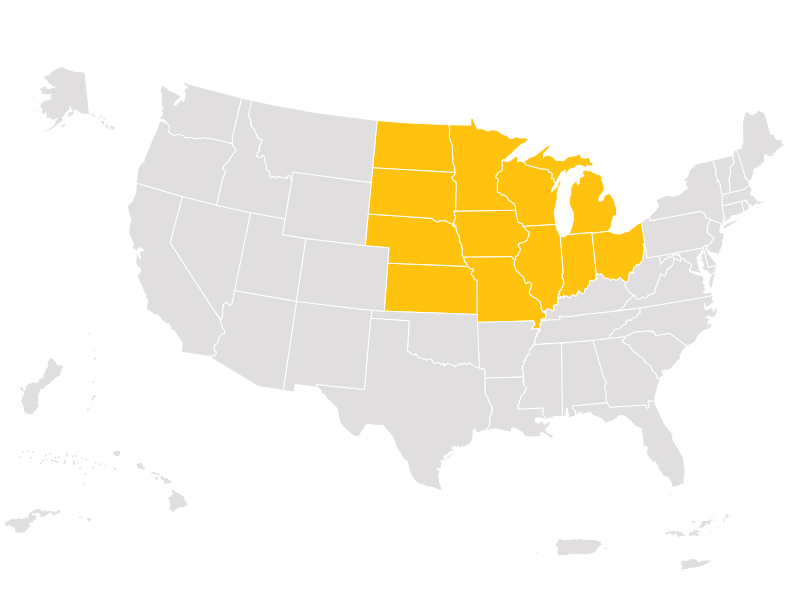
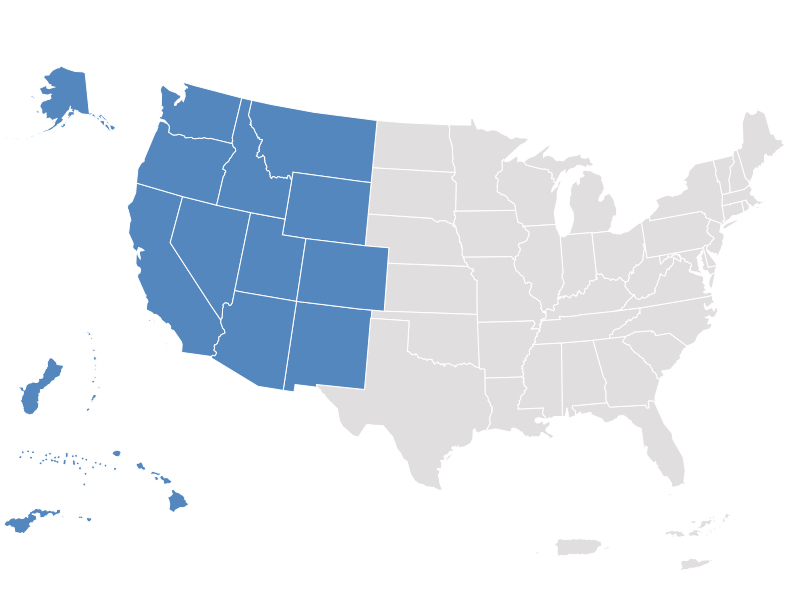
AgOPP Vol 19, No 10 October 2008 From Worms to Llamas: MU Alternatives Center Helps Producers Find Niche Markets By Bob Thomas, Information Specialist, University of Missouri If you want to raise anything from worms to llamas, Debi Kelly can point you in the right direction. As project manager of University of Missouri Extension's Missouri Alternatives Center, Kelly answers thousands of questions and provides information each year to people looking for a special niche market. "I consider myself a clearinghouse or broker of information on alternative forms of agriculture," Kelly said. "A lot of people are looking for ways to diversify their operation," she said. "A majority of people who call want to grow or raise something. They are looking for ideas." Kelly received 718 telephone inquires in 2007. The MAC Web site (http://agebb.missouri.edu/mac/) received almost 2 million hits in 2007. Based on these inquiries, certain trends seem to be emerging from Missouri producers, she said. Information requests for livestock production, marketing/agribusiness decision-making and organic/natural products are the most frequent inquiries. Top requests for information in the last two years have included rabbits, meat goats, smokehouses/smokers, worms, medical herbs, organic farming, alternative field crops and root cellars. Other requests included agritourism, dairy goats, bed and breakfasts, nursery production, ducks, chickens, game birds, ostriches, llamas, elk, bison, wind farming and catfish. "Today, people want information at a time that is convenient to them," she said. The MAC Web site links users with extension guide sheets from many university research centers. Ag Opportunities, a monthly electronic newsletter, includes updates on alternative opportunities, resources that users may not normally find and a calendar of events. You can subscribe to the newsletter and access back issues at http://agebb.missouri.edu/mac/agopp/. People who want to talk to someone directly can call Kelly at 573-882-1905 or 800-433-3704 from within Missouri, she said. "Networking is the key. You never know who has an answer to what you might be looking for. Sometimes it's simply a matter of getting two people together," she said. "One of the best things I can do is to advise the person not to go ahead with an alternative business venture," she said. "The thing that people don't realize is that when going into an alternative enterprise, generally the market is not readily available. Producers should take a hard look at what it would take to market their product. Successful alternative agricultural enterprise producers take to heart their farm goals and how they can utilize their assets and skills in running a business," she said. (Source: Debi Kelly, 573-882-1905) ********************************************************************** SARE Grants Fund Sustainable Agriculture Projects By Bob Thomas, Information Specialist, University of Missouri Farmers and ranchers in 12 north-central states can now compete for federal grants to fund projects in sustainable agriculture. Funding comes from the USDA's Sustainable Agriculture Research and Education (SARE) program. "These grants allow farmers and ranchers an opportunity to test new sustainable agriculture techniques and demonstrate how they can be used over a wider area," said Debi Kelly, Missouri SARE co-coordinator. The SARE program invites farmers or ranchers operating in SARE's North Central Region, which includes Missouri, to submit proposals for projects that test and evaluate adaptable sustainable agricultural practices for their operations. Competitive grants up to $6,000 for individuals or $18,000 for groups of three or more from separate operations are available. Applications are due by Dec. 1, 2008. Eligible states include Illinois, Indiana, Iowa, Kansas, Michigan, Minnesota, Missouri, Nebraska, North Dakota, Ohio, South Dakota and Wisconsin. Missouri leads the region in number of grants won, with 85 since the program started in 1992. Kelly said she would review any grant applications, offering suggestions to increase chances of success. The grants are for sustainable agriculture research and education projects and not for everyday farming expenses. During the past 16 years, these grants have funded a wide array of projects in livestock- and crop-production systems, waste management, weed and pest control, organic farming, marketing, water quality and soil conservation. The grant application can be downloaded at http://www.sare.org/ncrsare/prod.htm . For more information, contact Debi Kelly at 573-882-1905 or kellyd@missouri.edu . Grant co-coordinator K.B. Paul at Lincoln University can be reached at 573-681-5584 or paulk@lincolnu.edu . More information about Missouri SARE is online at http://sare.org/ncrsare. (Source: Debi Kelly, 573-882-1905) ********************************************************************** The Truth About Grants By Tish Johnson Ste. Genevieve County University of Missouri Extension At the Extension office I get asked probably an average of once a week about grants, usually for starting a small business and occasionally for bailing one out of trouble. There are many misconceptions out there, and learning the truth can be discouraging. Don’t despair, for those of you willing to put in the work, there may be real rewards. Grant Myth #1: "The government is giving away billions of dollars in unclaimed grant money." Stop listening to those late night TV infomercials, this is a ridiculous claim, completely untrue. And avoid the web sites offering a free CD for finding government grants, it contains minimal resources and you’ll probably be signed up for an online membership without your knowing. Read the Terms and Conditions very carefully before ordering any book or CD that claims to make it easy to find free money. As Grandpa said, "if it sounds too good to be true..." Grant Myth #2: "You can get a grant to start your business or pay your bills." Sounds great, doesn’t it? So yes, it’s wrong. Since we have a free-market economy, the U.S. government is not interested in helping to start for-profit businesses except under very specific conditions, such as producing some component needed by the military. Grants from private foundations generally only go to registered non-profit corporations. However, you may qualify for low interest loans or other assistance. Contact the Small Business Development Center at Southeast Missouri State University for information: http://www2.semo.edu/sesbdc/ Grant Myth #3: "Grants are completely free money." Not quite true. While grants don’t have to be paid back as long as you follow the rules, many grant programs require that you supply matching funds. The amount, which is stated in the instructions, is usually a percentage of your total project budget. Sometimes the match has to be cash, and sometimes you can include "in-kind" match, such as labor and materials that you’ll be supplying. We all love programs that allow in-kind matching. Grant Myth #4: "Grants programs are broad-based and designed to meet your needs ." No, they’re designed to meet the needs of the funders. They donate grants for one of two reasons: 1) they care about some particular issue and want to affect positive change with that issue; or 2) they will benefit financially, such as corporate grants that create "good will" with a customer base (that doesn’t make corporate grants a bad thing). As such, there may be restrictions on who is eligible to apply for the grant, when and where the project has to be completed, how it is evaluated, and other rules. Grant Myth #5: "Grants are easy to get." OK, no one actually ever says this to me, but it becomes clear that people are looking for easy money. Keeping in mind that you’re going to be serving the purposes of the funder, there are going to be reporting requirements, probably an evaluation of your project required, and the application process may be cumbersome. You have to weigh the anticipated benefit you’ll get from the grant with the work that’s involved Back to Grandpa’s wisdom: "Something worth doing ..." ********************************************************************** Beginning Farmers and Ranchers Loans The Farm Service Agency (FSA) provides direct and guaranteed loans to beginning farmers and ranchers who are unable to obtain financing from commercial credit sources. Each fiscal year, the Agency targets a portion of its direct and guaranteed farm ownership (FO) and operating loan (OL) funds to beginning farmers and ranchers. A beginning farmer or rancher is an individual or entity who 1. has not operated a farm or ranch for more than 10 years; 2. meets the loan eligibility requirements of the program to which he/she is applying; 3. substantially participates in the operation; and, 4. for FO loan purposes, does not own a farm greater than 30 percent of the median size farm in the county. (Note: all applicants for direct FO loans must have participated in business operation of a farm for at least 3 years.) If the applicant is an entity, all members must be related by blood or marriage, and all stockholders in a corporation must be eligible beginning farmers. For more information go to http://www.fsa.usda.gov/Internet/FSA_File/beginloans.pdf ********************************************************************** 16th National Small Farm Trade Show and Conference Nov 6-8, 2008 Columbia MO Boone County Fairgrounds This year’s conference will have 150+ exhibitors, 18 seminars, 5 three hour short courses, 50+ Farmers Forum talks, demonstrations, association meetings, farm tour and more. Cost: Entrance to Seminars, Exhibits, Demonstrations and Assn Meetings One day $7/after Oct 27-$10 Two day $12/after Oct 27-$15 Three day $15/after Oct 27-$20 Entrance to Short Courses: $25 each/after Oct 27-$35 each For more information or to register call 800-633-2535. Thursday Seminars: *Surviving the Next Farm Financial Crisis *Survival Gardening for Profit *Poultry 301 *Walnuts and Walnut Production *High Tunnels Short Courses: *SPINing (Small Plot INtensive) and PLANting *Small Farm Equipment Farmers Forum: *River Hills Purebred Poultry Marketing Alliance *Producing and Marketing Shrimp *Organic Farming Update *Building the Ozark Seed Bank *Peony Flower Insurance for Early Market Blooms: the High Tunnel *How to Write a Food Defense Plan *Grass-Hay Alley Cropping with Organic Nuts *High Tunnel Ag *Highly Nutritious Staple Food Crops Friday Seminars: *Organic Berry Possibilities *My Life as a Farm Marketer *Compost is a Process *Rare Breeds *Alternative Crops *Logging with Draft Animals *How to Get Your Kids to Stay on the Farm Short Courses: *Biodiesel *SPINing (repeat) Farmers Forum: *The Value of Mint: Preserving Historical Mint Fields with Windbreaks *SSAIM (Site Specific Apple Insect Monitoring) *Establishing a Complimentary Honeybee Enterprise *Raising Heritage Breed Hogs *Veggies and Chick Pea *Innovative Field to Market Processes for Small Produce Farms *Aronia Berry Industry *Farmer-led Networking Groups for Vegetable Growers *Ultra High Stock Density Grazing *Bulldog Biodiesel *Poppy’s Pumpkin Patch: Agritourism Education Upgrade Saturday Seminars: *Make Money with Your Sawmill *Relating Compost, Humus, and Soil Fertility *Hair Sheep Intensive Grazing and Marketing *How to Write a Food Defense Plan *Your Poultry Business *Small Farms in the Year 2050 Short Courses: *Management Intensive Grazing Farmers Forum: *Marketing an Organic CSA *Equine Forestry *Alpaca Farm, Fiber Day Camps and Workshops *Feed and Management Alternatives for Natural Livestock Production *Sustainable Production of Tibetan Goji Berry in Central MO *Producing and Marketing Medicinal Herbs as Alternative Cash Crops *Improving Forests Through Better Logging: Why Rob the Bank You Own? *Heirloom Vegetable Production Strategies via the Internet *Association Meetings on Saturday: *Rare Breed Swine Initiative Meeting *MO Organic Assn Meeting *Red Wattle Hog Assn Meeting ********************************************************************** *** In Print/On-Line *** *Missouri Residential Energy Efficiency* website offered by the Missouri Department of Natural Resources has info on making your home or building as energy-efficient as possible is better for the environment, saves you money on utilities, increases resale appeal of your home, and increases the comfort level of your home; http://www.dnr.mo.gov/energy/residential/residential.htm. *Woody Ornamentals for Cut Flower Producers* Woody ornamentals can be some of the best plants for extending the cut-flower growing season and filling out bouquets. This publication covers getting started in growing woody ornamental plants, including what to plant, harvest and post harvest strategies, and marketing channels. It also offers sources of further information. Available from ATTRA at http://attra.org/attra-pub/woodyornamentals.html *Midwest Cover Crops Council Website* at www.mccc.msu.edu The website features: Individual State pages, Cover Crop Resources, Cover Crop Selector (based on the developing Matrix), Cover Crops Survey, Crop-by-crop Info, Extension Materials, Publications and Links. *Farmstead Energy Audit* produced by North Dakota State University Extension, offers tips on ways to reduce on-farm energy use. Go to http://www.ag.ndsu.edu/pubs/ageng/structu/ae1366.pdf Sustainable Farmer is a new e-magazine that is dedicated to providing information about how to raise food and fiber mindfully, paying attention to the needs of the environment, especially the plants and the animals that sustain us. Our goal is to harness the power of the Internet to build a community online, where people can exchange ideas and innovations. We also promise cutting-edge multimedia packages on the latest research, and tips and techniques, as well as profiles of people involved in the sustainable agriculture movement. Check it out at http://www.sustainablefarmer.com/ ********************************************************************** *** IN THE NEWS *** Aronia berries are becoming popular for their health benefits, having a high antioxidant power that may help reduce risk for cancer, heart disease, inflammation and diabetes. For more information about them to go to: http://www.extension.iastate.edu/news/2008/jul/423102.htm Farm Aid announced the launch of its web-based Farmer Resource Network to help farmers answer the consumer call for more quality family-farmed foods. Across the country, more people are reaching for local, organic and sustainably grown food from family farms. Farm Aid's Farmer Resource Network links family farmers to new and innovative ideas to help them meet this rising consumer demand. The Farmer Resource Network also contains tools to help put new farmers on the land. http://www.farmaid.org/site/c.qlI5IhNVJsE/b.4375765/k.71EA/Farmer_Reso urce_Network.htm The USDA just made $22 million available to the states to defray the cost of organic certification for organic producers. This is good news--the certification cost is not a deal-breaker for most growers, but this helps reduce that. This program should not be confused with any of the conservation programs that are coming down the pike, such as Environmental Quality Incentive Program (EQIP) or Conservation Stewardship Program (CSP), that may provide cost share to farmers transitioning to organics (EQIP), or provide farmer with "green payments" for the good conservation practices they're already doing (CSP). Be on the lookout for information from the Missouri Department of Agriculture soon. With funding from Sustainable Agriculture Research and Education program, and the USDA Risk Management Agency, NESFP, in conjunction with the Northeast Network of Immigrant Farming Projects (www.nnifp.org), developed a series of farming guides geared towards low-literacy populations. These guides provide clear, simple, and more accessible text for readers, to help reduce misunderstandings, errors, enquiries, and overall lack of comprehension. Plain language emphasizes cultural relevance; i.e., reaching culturally diverse audiences with appropriate messages and materials. Guides include: *Plain Language Guide to Starting a Value Added Food Business *Plain Language Guide to USDA's NASS End of Season Fruit and Vegetable Survey *Plain Language Guide to Harvesting Your Crops *Plain Language Guide to Managing Risks on the Small Far *Plain Language Guide to Applying for a Farm Service Agency Loan *Plain Language Guide to Selling at the Farmers Market *Plain Language Guide to Exploring Your Small Farm Dream Full copies of the guides can be found at www.nnifp.org ********************************************************************** *** ON THE CALENDAR *** Oct 18 - 6th Annual Missouri Chestnut Roast, University of Missouri Horticulture and Agroforestry Research Center, New Franklin, MO. Visit www.centerforagroforestry.org, Rhoadsj@missouri.edu or call 573-882-3234. Oct 31 - Nov 1 - MO State Beekeepers Conference, Lake Ozark, MO. Call 636-394-5395. Nov 5-Stock Dog Clinic, Columbia MO. Call 800-633-2535. Nov 6-8 - 16th National Small Farm Trade Show & Conference, Columbia, MO. Call 800-633-2535, smallfarm@socket.net, www.smallfarmtoday.com/tradeshow. Nov 7 - The Five Practices of Agroforestry, Hardin, IL. Call 217-285-4114 Nov 8-Rare Breed Swine Initiative, Columbia, MO. Call 919-542-5704. Nov 19 - Grow Native! Membership Meeting and Workshop, Jefferson City, MO. Call 573-522-4171, www.grownative@mda.mo.gov Dec 3 - Home Winemaking, Mountain Grove, MO. Call 417-547-7513. Dec 4-6 - 2008 Acres U.S.A. Conference, St Louis, MO. Call 1-800-355-5313 Dec 5-6 - Missouri Livestock Symposium, Kirksville, MO, http://missourilivestock.com Jan 3-6 - Western Nursery and Landscape Association Expo, Overland Park, KS. Go to www.wlna.org Jan 8 - High Tunnels Workshop or Community Supported Agriculture Mini-School, St. Joseph, MO. Go to http://extension.missouri.edu/buchanan/GPVGC.shtml Jan 9-10 - Great Plains Vegetable Conference, St. Joseph, MO. Go to http://extension.missouri.edu/buchanan/GPVGC.shtml Jan 21-24 - 2009 Practical Tools and Solutions for Sustaining Family Farms Conference, Chattanooga, TN. Go to http://www.ssawg.org/conference-.html Feb 1-4 - North American Farmers’ Direct Marketing Association Conference, Savanah, GA. Go to http://www.nafdma.com/ Feb 6 - Missouri Nut Growers Association Annual Nut Evaluation & Show, Nevada, MO. Call 417-436-2351. Feb 7 - Missouri Nut Growers Association Annual Meeting, Nevada, MO. Call 417-436-2351. Feb 16-18 - MO Small Fruit and Vegetable Conference, Springfield, MO. Call 417-547-7533 Feb 20-21 - Grow Native Landscape Design with Missouri in Mind, Kirksville, MO. Call 573-522-4171, www.grownative.org Feb 21 - Missouri Organic Association’s Annual Conference, Jefferson City, MO. Call 800-433-3704. Feb 26-29 - Upper Midwest Organic Farming Conference, La Cross, WI. Call 715-772-3153 or info@mosesorganic.org May 31-June 3 - North American Agroforestry Conference, Columbia, MO. http://www.centerforagroforestry.org/events/afta/index.asp March 6-7 - MO and KS Beekeeping Associations Joint Conference, Overland Park, KS. Call 636-394-5395. ---------------------------------------------------------------------- Field Day Dates Set for MU Ag Experiment Station Oct. 3 - Wurdack Farm, Cook Station, Mo.; field day; Poehlmann Oct. 18 - Horticulture and Agroforestry Research Center (HARC), New Franklin, Mo.; Missouri Chestnut Roast; Nancy Bishop, 660-848-2268 ---------------------------------------------------------------------- 2008 Grazing Schools Oct 21, 22 & 23 (daytime)- Bois d’Arc, MO, MDC Dalton Shooting Range & Outdoor Education Center; Mark Green (417) 831-5246 ext 3 ---------------------------------------------------------------------- Growing Growers Workshops For more information, call 816-805-0362, email growers@ksu.edu or visit http://www.growinggrowers.org/. There is a small fee for each workshop Oct - Business Planning and Management for Small Farms, Kearney, MO Nov - The Organic Certification Process, TBA ---------------------------------------------------------------------- Green Hills Farm Project Farm Walks Green Hills Farm Project welcomes all families to our open farm walks. Always bring your children! Please call ahead to advise the host family of the number attending and to get directions. The host family provides main meat course and drinks. Please bring lawn chairs and covered dish. Come on out and join us for a great time of fellowship and sharing on our farms! Oct 16 - Jordan & Anne Bentley, Brookfield, MO. Call 660-412-3399 Nov 22 - Ben & Nancy Coleman, Callao. MO. Call 660-768-5743.