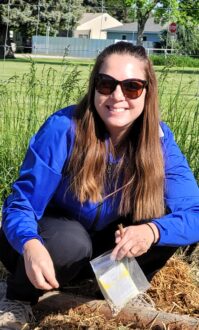
Ag Opportunities Volume 19, Number 4 April 2008 Farmer Grows Fish in Old Hog Barns, Shows Value of Diversifying Farms by Tamsyn Jones Senior Information Specialist University of Missouri Cooperative Media Group Abandoning the hog business to start a fish farm may seem an odd choice in Missouri, but that's exactly what Higginsville, Mo., farmer Ellis Dieckhoff did when he converted his hog barns into a hatchery for bluegill, which he sells as bait fish. The move set Dieckhoff apart from his neighbors, who raise livestock or crops. But diversifying is what farmers should do to safeguard their farms and communities, said Crystal Weber, University of Missouri Extension community development specialist in Blue Springs. Dieckhoff also raises row crops, but they only provide seasonal income and high grain prices have made row crops highly competitive. "Diversifying allows him to get income throughout the year and decreases his level of risk," said Weber, who specializes in local food systems and helping farmers find markets for their products. She has been helping Dieckhoff since 2004, when a former MU Extension livestock specialist referred Dieckhoff to her. After raising hogs on his family farm his whole life, Dieckhoff left the pork industry nine years ago due to low prices. When he took over the farm from his father in 1987, hogs sold for about 40 cents per pound. When he got out in 1999, he sold his sows and fat hogs for just 8 cents per pound. "We just couldn't handle the price anymore," he said. "We thought we could withstand the ups and downs of the cycle, but we couldn't. It never cycled back." Dieckhoff leased his hog buildings for a few years, and then they sat empty for three years. In 2004, Dieckhoff got the idea to raise fish and started researching options. "It's just another thing I was trying to make the building pay for itself and generate some income," he said. Before he knew there was a bait fish industry, Dieckhoff looked at raising fish for food. Weber helped him find potential food fish markets in the Kansas City area. "Crystal got me in touch with chefs in Kansas City who were interested in locally produced fish," Dieckhoff said. Fish raised for food are expensive to produce, however, and he had read that fish could be raised for bait at much lower cost. He learned about bluegill research at Lincoln University and worked with a Lincoln aquaculture specialist to develop indoor hatchery methods. In 2006, Weber helped Dieckhoff apply for a Sustainable Agriculture Research and Education (SARE) grant. The U.S. Department of Agriculture grants aim to promote sustainable farming, foster sustainable communities and preserve rural heritage by helping farmers diversify. Dieckhoff won $6,000, the maximum amount available through the SARE program. The grant covered half his costs and gave him peace of mind because he was not taking a huge financial risk. Weber said Dieckhoff got the grant because fish farming was unique, and the funds would strengthen his family farm. "You don't hear about aquaculture in Missouri, you hear about livestock and grain," she said. "In this part of the state, you don't really see many farmers going outside of traditional livestock and grain ventures." Weber said that grant recipients are expected to share results of their projects with the community. "Since he was going to be one of the only folks in our state who is an aquaculture farmer, there was the hope that he could be a resource for the community," she said. Dieckhoff uses two former hog barns as a nursery, where he spawns the fish, and a hatchery, where he grows the fingerlings to 4 or 5 inches before selling them to the aquarium industry as bait. There have been challenges, but now the market is so good he can't keep up with demand, he said. He initially planned to raise fish all year, but he learned the fish will not spawn between November and March. Raising fish inside fools with Mother Nature, he said. "There are days when all these tubs will be full of spawn, but three days later I come in and three-quarters of them are dead. Like any other new project, there was and still is a huge learning curve that we are dealing with." This spring, Dieckhoff plans to experiment with outdoor ponds, and he still has interest in the food fish market. The biggest obstacles to that are cost and the difficulty of reliably producing a quality product, he said. Weber said Dieckhoff's readiness to try something new should be a model for other farmers. "Ellis is a prime example of what opportunities exist for farmers," she said. "People have land, they have the resources. In Ellis' case, he had all the facilities. He just had to retrofit them. There are a lot of opportunities for someone willing to do something a little bit different." The SARE Farmer/Rancher Grants will be available in August 2008. For more information about the grants call Debi Kelly, MO SARE Co-coordinator at 573-882-1905. Source: Crystal Weber, 816-876-2790 ********************************************************************** Renewable Energy Systems and Energy Efficiency Program Loan guarantees and grants totaling $220.9 million are available to agricultural producers and rural small businesses to purchase and install renewable energy systems or to make energy efficiency improvements. Deadline, June 16, 2008 U. S. Department of Agriculture -Rural Business-Cooperative Service Inviting Applications for Renewable Energy Systems and Energy Efficiency Improvements Grants and Guaranteed Loans AGENCY: Rural Business-Cooperative Service (RBS), USDA SUMMARY: Rural Business-Cooperative Service (RBS), an Agency within the United States Department of Agriculture (USDA) Rural Development, announces it is accepting applications for fiscal year (FY) 2008 to purchase renewable energy systems and make energy efficiency improvements for agriculture producers and rural small businesses in eligible rural areas. Funding will be available in the form of grants and loan guarantees. In addition to stand-alone grants and loan guarantees, applicants may apply for combination loan guarantee and grant funding (combination package). For renewable energy systems, the minimum grant is $2,500 and the maximum is $500,000. For energy efficiency improvements, the minimum grant is $1,500 and the maximum is $250,000. Funding for grant and loan combination packages will be funded from the same allocation as loan guarantees. Fifty percent of the appropriated grant funding will be reserved for the first grant-only competition. Any unused grant only funds from the first competition will be made available for the second grant-only competition. The maximum amount of a guarantee to be provided to a borrower will be $10 million. For FY 2008, the guarantee fee amount is 1 percent of the guaranteed portion of the loan and the annual renewal fee is 0.250 percent (one quarter of one percent) of the guaranteed portion of the loan. For FY 2008, the following are the funds provided by Congress for the Section 9006 program: For grants, $15,888,000, and for loans, $204,953,560. DATES: The USDA will issue one grant solicitation for two separate competitions in FY 2008. Competitive deadlines will occur in accordance with deadlines as follows: Grants: For the first competitive window, complete (see 7 CFR 4280.111) grantonly applications, must be submitted to the appropriate USDA Rural Development State Office no later than April 15, 2008. For the second competitive window, complete (see 7 CFR 4280.111) grant-only applications must be submitted to the appropriate USDA Rural Development State Office no earlier than April 16, 2008, and no later than June 16, 2008. Applications submitted under the first competition at are not selected will automatically be considered under the second competition, using the materials and score from the first competition (i.e., no changes to scored applications will be accepted). It is anticipated that two grant award announcements will be made. The first announcement is anticipated prior to June 16, 2008, and the second, prior to September 16, 2008. Guaranteed Loans: Complete guaranteed loan applications will be accepted and processed, until June 16, 2008, in a rolling application manner. Applications for loan guarantees must be completed and submitted to the appropriate USDA Rural Development State Office no later than June 16, 2008. No application received in the State Office after June 16, 2008, will be considered. Combination Packages: Complete combination packages will be accepted and processed, until June 16, 2008. Once funds become available, combination packages will be evaluated on a bi-weekly basis. Combination applications must be completed and submitted to the appropriate USDA Rural Development State Office no later than June 16, 2008. No application received after June 16, 2008, will be considered. Any unused funding as of August 15, 2008, may be pooled and revert to grant money. All submissions must be received at the applicable office by 4:30 p.m. local time on the deadline date. The application closing deadlines for grant, loan guarantee, and combination packages are firm. USDA Rural Development will not consider any application that is received after the closing deadline. In addition to the application requirements stated in 7 CFR part 4280-B, a complete application will include all environmental review documents with supporting documentation in accordance with 7 CFR part 1940 subpart G. The application must be complete before the State Office forwards the application to the National Office for funding consideration. For additional info contact: Missouri State Rural Development Matt Moore 601 Business Loop 70 West Parkade Center, Suite 235, Columbia, MO 65203 (573) 876-9321 ********************************************************************** **IN PRINT/ON-LINE** *Farmers Market Coalition Newsletter* Late last month, the Farmers Market Coalition launched a listserv designed to meet the specific networking needs of farmers market managers, farmers market organizers, and farmers market vendors. FMC would like to invite those of you interested in joining this on-line community of colleagues to subscribe through its web site at www.farmersmarketcoalition.org/newsletter, where you can also subscribe to FMC's quarterly on-line newsletter.ÿ *Farm Internship Curriculum and Handbook* These were designed to be used by individual farmers during the course of the workweek. Ideally, a farmer will use the In-Field Curriculum when he or she is demonstrating a new task to interns. Its companion Handbook details successful methods of recruitment, hiring, negotiating with, training, and managing interns. This project was funded by a grant from Sustainable Agriculture Research and Education (SARE), Western Region. http://attra.ncat.org/intern_handbook/ *Clean Energy Farming: Cutting Costs, Improving Efficiencies, Harnessing Renewables* features innovative SARE-funded research and examples of farmers who are improving energy efficiency while saving money, implementing farming practices that both save energy and protect natural resources, and producing and using renewable fuels. Online at http://www.sare.org/publications/energy/energy.pdf *HACCP Model Plans* helps small scale beef, pork and poultry producers meet USDA/FSIS and state inspection expectations. Developed by Dr. Steve Ingham, University of Wisconsin Center for Meat Process Validation, these models have been widely used in Wisconsin. They are posted in Word format so that users can adapt them to their own situations. http://www.meathaccp.wisc.edu/ *The Organic Opportunity: Small Farms & Economic Development* a short video that tells the story of Woodbury County, Iowa's innovative economic development campaign centered on the development of local, organic agriculture. This film is designed to be used with Chambers of Commerce, economic development organizations, elected officials, farmers and consumers -- anyone interested in discovering the positive impact a local food system grounded in organic agricultural practices can play in a community's economic, environmental and physical health. "The Organic Opportunity" is a great story that demonstrates how local communities can create a different food system which provides its citizens with wonderful food, and makes it possible for young farmers to improve the community economy by continuing to farm. The 26 minute film may be purchased for $30 at: http://www.localharvest.org/store/item.jsp?id=9394 ********************************************************************** **IN THE NEWS** This data set provides farm gate and wholesale prices for select organic and conventional fruits and vegetables, wholesale prices for organic and conventional poultry (broilers) and eggs, as well as f.o.b. and spot prices for organic grain and feedstuffs. Prices are based on those reported by USDA Agricultural Marketing Service Market News, Organic Food Business News, and USDA National Agricultural Statistics Service. http://www.ers.usda.gov/Data/OrganicPrices/ USDA's Agricultural Marketing Service (AMS) released a draft Business Plan to further the implementation of the National Animal Identification System (NAIS). AMS encourages participants in voluntary marketing programs such as the USDA Process Verified, the Quality Systems Assessment and the Non-Hormone Treated Cattle Programs to meet the inherent animal identification requirements by using NAIS. Currently, all AMS partners that have approved marketing programs are actively encouraging the use of premise registration and NAIS compliant Animal Identification Numbers for these marketing program participants. Using NAIS, producers would at the same time meet the requirements for animal identification and traceability for these AMS marketing programs. The draft is online at http://animalid.aphis.usda.gov/nais/naislibrary/documents/plans_report s/NAIS_Business_Plan.pdf (Weekly Harvest Newsletter) A new study, led by Ohio State University, Iowa State University, and the University of Wisconsin, is providing information on performance of organic corn varieties. The study is evaluating organic corn hybrid performance trials to compare the performance of organic corn hybrids, open-pollinated varieties and conventionally produced corn hybrids (untreated seed). The two-year study, which began last year, is being funded by a North Central Region Sustainable Agriculture Research and Education (SARE) grant and is supported by the Organic Crop Improvement Association (OCIA). Ohio Ag Connection reports researchers analyzed the performance of nearly two dozen organic corn hybrids from seven seed companies at three locations in each state, focusing on such characteristics as grain quality, seed germination and yield potential. Results conducted in Ohio can be found by logging on to http://agcrops.osu.edu/corn (Weekly Harvest Newsletter) Purdue University is joining Michigan State University, University of Illinois, and Ohio State University to offer an interactive organic and sustainable agriculture videoconference series presented by researchers, organic farmers, and extension educators. The series is sponsored by Cooperative Extension Services at Purdue University, University of Illinois, The Ohio State University, and Michigan State University, and also supported by funding from USDA's North Central Region Sustainable Agriculture Research and Education Program (NCR-SARE). The first installment in the series is "Hoophouses and High Tunnels," which will air with live streaming video on the evening of March 20. The conference will be archived online and available for free viewing for several weeks after the program. http://www.tristateorganic.info/ The Organic Farming Research Foundation (OFRF) has issued its Request for Proposals for organic research and education projects for Fall 2008 grants. OFRF offers funds for research on any topic that will improve organic production systems, and for education and outreach projects to share organic farming information with current organic producers and to farmers and ranchers considering transitioning their operations to organic. Proposals may request awards of up to $15,000 per year ($20,000 for fruit projects). Multi-year funding will be considered for fruit projects. Applications are online at http://ofrf.org/grants/apply.html or email jane@ofrf.org. Proposals are due July 15, 2008. ********************************************************************** ON THE CALENDAR April 22-MO Vegetable Growers Association Farm Tour-Ivan Stoilov Farm, Dittmer, MO. Call 573-448-9324 or 573-529-1525. April 24-Albrecht-Earth Day Lecture - Dr. Fred Kirschenmann, Leopold Center for Sustainable Agriculture, Columbia, MO. Call 573-882-7045. May 2-Strawberry Hoop House Tour, Jamesport, MO. Call 660-663-3232. May 3-MO National Nut Growers Annual Grafting Day, Lathrop, MO. Call 816-740-4282. May 6-Tree Grafting Workshop, Mt. Vernon MO. Call 417-466-2148 May 17-MO Walnut Council Spring Tours. Contact palmh@missouri.edu or 573-882-1402 May 17-19-Conference Celebrating 30 Years of Missouri Fiber Artists, Fayette, MO. Call 573-443-1731. May 20-Biofumigation for Strawberry Production, Mountain Grove, MO. Email PMayer@missouristate.edu May 22-Manure Entrepreneurs: Turning Brown to Green, Columbia, MO. Call 573-884-6572. June 3-Plant Propagation Workshop, Mountain Grove MO. http://mtngrv.missouristate.edu/homegardeners/ June 5-MO Vegetable Growers Association Farm Tour-Fahreier Farm, Lexington, MO. June 26-Bobwhite Quail and Native Plant Field Day, Columbia, MO. Call 573-884-7945 or 573-882-4337. Aug 3-5-MO Young Farmers/Young Farm Wives Summer Tour, Kirksville, MO. Call 660-626-1476. Aug 7-17-2008 Missouri State Fair, Sedalia, MO. Sept 9-Ozark Rain Gardens Field Day, Mountain Grove MO. Email PMayer@missouristate.edu Oct 18-6th Annual Missouri Chestnut Roast, University of Missouri Horticulture and Agroforestry Research Center, New Franklin, MO. Visit www.centerforagroforestry.org, Rhoadsj@missouri.edu or call 573-882-3234. Dec 4-6-2008 Acres U.S.A. Conference, St Louis, MO. Call 1-800-355-5313 Dec 5-6-Missouri Livestock Symposium, Kirksville, MO, http://missourilivestock.com Field Day Dates Set for MU Ag Experiment Station June 26 - Bradford Research and Extension Center, Columbia; Quail and Native Plant Field Day; Tim Reinbott, 573-884-7945 June 27 - Bradford; Weed and Pest Management Field Day; Kevin Bradley, 573-882-4039 Aug. 7 - Greenley Memorial Research Center, Novelty, Mo.; field day; Randall Smoot, 660-739-4410 Aug. 26 - Graves-Chapple Farm, Corning, Mo.; field day; Jim Crawford, 660-744-6231 Aug. 27 - Hundley-Whaley Farm, Albany, Mo.; field day; Bruce Burdick, 660-726-5610 Sept. 2 - Delta Research Center, Portageville, Mo.; field day; Jake Fisher, 573-379-5431 Sept. 4 - Bradford, Columbia; Tomato Festival; Reinbott Sept. 12 - Southwest Research Center, Mount Vernon, Mo.; field day; Richard Crawford, 417-466-2148 Sept. 18 - South Farm, Columbia; Beef Production Field Day; Bob Weaber, 573-882-5479 Sept. 27 - South Farm, Columbia; Showcase; John Poehlmann, 573-882-4450 Oct. 3 - Wurdack Farm, Cook Station, Mo.; field day; Poehlmann Oct. 18 - Horticulture and Agroforestry Research Center (HARC), New Franklin, Mo.; Missouri Chestnut Roast; Nancy Bishop, 660-848-2268 Growing Growers Workshops For more information, call 816-805-0362, email growers@ksu.edu or visit http://www.growinggrowers.org/. There is a small fee for each workshop. May 5-Equipment and Drip Irrigation for Growers, Olathe, KS June 16-Harvesting and Post-Harvest Handling for Maximum Quality and Nutrition, Osceola, MO July 14-Taste & Nutrition of Local Vegetables, Lawrence, KS Aug 17-Pests, Disease and Weeds, St Joseph, MO Sept 15-Tree Fruit Production, Williamsburg, KS Oct-Business Planning and Management for Small Farms, Kearney, MO Nov-The Organic Certification Process, TBA Green Hills Farm Project Farm Walks Green Hills Farm Project welcomes all families to our open farm walks. Always bring your children! Please call ahead to advise the host family of the number attending and to get directions. The host family provides main meat course and drinks. Please bring lawn chairs and covered dish. Come on out and join us for a great time of fellowship and sharing on our farms! Aug 21-Tom & Paula Parker, Richmond, MO at 5pm. Call 816-470-3276. Sept 18-Doug & Diane Peterson, Ridgeway, MO at 5 pm. Call 660-824-4276. Oct 16-Jordan & Anne Bentley, Brookfield, MO. Call 660-412-3399. Nov 22-Ben & Nancy Coleman, Callao. MO. Call 660-768-5743.