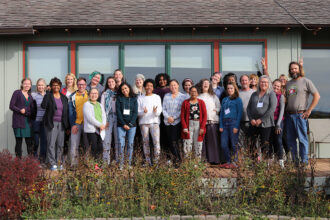
Ag Opportunities Volume 17, Number 7 July 2006 Tours Highlight Rural Attractions and Businesses in Osage County By Chuck Adamson, Senior Information Specialist, Extension and Agricultural Information Lori Lauberth began her candle pouring business 18 months ago as a way to earn a living and stay home with her children. She found her customers by studying a Missouri map, finding back roads and then driving them in search of mom and pop retailers who would buy her scented candles. Last year Lauberth sold 10,000 of the candles she pours into Kerr canning jars. Some have typical candle scents, like baking or floral aromas. Others have less well-known candle scents, like fresh cut grass or tack room leather. The candle company was one of several small rural businesses a group of three dozen retirees visited in June as part of a series of tours being put on by the Osage County Agritourism Council. The all-volunteer council, which partners with the University of Missouri Extension, is made up of local business owners, farmers and Osage County residents. It highlights not just farms, but any smallto medium-sized rural businesses in the area. Mark Stewart, University of Missouri Extension livestock specialist, said longterm economic development comes in small pieces. "Is agritourism going to keep a lot of people in business? No," Stewart said. "Is it going to help some stay in business by adding a few dollars to their profits? Yes. We’re trying to convince folks that they can be a small piece of local economic development, and in doing so, help themselves and their community." Lauberth started the business in her basement, but the smell became overwhelming, and she moved her pouring work into a small building next to her home. It pays the bills but comes at a price. "I don’t burn them anymore because I’m sick of the smell," she said. "I smell like candles all the time." The touring retirees went to family-operated Dudenhoeffer Countryside Garden & Nursery and Krautman’s Korner Café, a 19th-centuryera tavern that advertises "air-conditioned dining" on its sign. They walked through the Dauphine Hotel, established in 1840, which now serves as a bed and breakfast. The group visited a 100-year-old Catholic church and a private home that once served as a convent for the nuns. "There are a lot of things not far from home that we’ve never seen before," Mary Kay Linsenbardt said. She was with the Learning in Retirement group, a program out of Jefferson City, Mo., organized by Lincoln University. The Osage County Agritourism Council, founded in March 2003, hosts tours upon request and organizes its own tours, called Be a Tourist In Your Own County. "We like to have people call us and say ‘can you help us see Osage County?’" said Kay Schwinke, tour coordinator for the Agritourism Council. "We try to focus on agriculture and also bring in history." "This is economic development. The bottom line is that we want to bring more revenue into Osage County and showcase what we have here," Schwinke said. "We have no paid employees. We do this because we want this to work." Other partners in the Osage County Agritourism Council include Three Rivers Electric Cooperative, Legends Bank, Linn State Technical College and Osage County Farm Bureau. For more information on the council, go to www.welcometoosagecounty.info For information on agritourism, go to MAC website at http://agebb.missouri.edu/mac and click on "Link List--Extension Information on Alternatives," click on the letter "A" for agritourism. Just a few of the many publications you will find are: * Farm and Ranch Alternative Enterprise and Agritourism Resource Evaluation Guide (NRCS) * Agricultural Tourism: Emerging Opportunities for Family Farmers and Rural Business (University of California) * Strategies for Monitoring Tourism in Your Community’s Economy (University of Arizona) * Entertainment Farming & Agritourism (ATTRA) * Liability for Visitors to Farm Property (Ohio State University) * Tourism and Retail Development: Attracting Tourists to Local Businesses (University of Wisconsin) ************************************************************************ Biological control of flies--does it work? by Amie Schleicher, Livestock Specialist, University of MO Extension, Atchison County You may have heard of releasing parasitic wasps to control certain fly populations. These tiny parasitic wasps lay their eggs in the immature stage of certain fly species; the wasp larvae feed on the host and kill it. When the wasp emerges as an adult, it seeks out additional hosts. The wasps do not sting or bite other insects, animals, or humans. There are parasitic wasps on the market sold for use against house flies and stable flies. The wasps are released before and during the fly season. The number released depends on your livestock numbers. Wasps have provided effective fly control in some poultry houses but their effectiveness has not been proven for feedlots or dairies. Pasture pests like face flies and horn flies are not controlled by parasitic wasps. Use of parasitic wasps will not totally solve the fly problem. Most manure and mixtures of straw and feed or manure must be removed to eliminate fly breeding areas. However, some must be left in place so that parasites can increase in numbers. On the other hand, excessive amounts of manure will allow fly production that can overwhelm the wasps. Wet manure and mixtures of manure, feed, and straw are essential for fly development. Regularly check for broken or overflowing waterers. Dry manure and wastes will not produce large numbers of flies so fly problems can be greatly reduced if there are few ideal breeding sites. Weeds around buildings and pens will hide manure and spoiled hay or feed. They will also allow areas to stay wet longer and may prevent areas from being cleaned thoroughly. Weed control affects fly control. At this point, there is no clear answer to the effectiveness of using parasites to reduce fly populations. Chances for success are greatest when coupled with waste and water management, and chemical control as needed. Chemical controls should be limited to fly baits (for house flies), sprays or other application techniques that will not come in contact with manure and kill the parasites. Wasp releases are needed each year; do not count on establishing a population on your farm. (Information from "Biological Control of Flies" by Lee Townsend, Extension Entomologist, University of Kentucky College of Ag) **************************************************************************** *** In Print/On-Line *** Agriculture and sustainable agriculture programs at several universities have recently made example budgets available for a wide range of specialty crops and alternative agricultural enterprises. http://coststudies.ucdavis.edu/ has recent cost studies for pears, grapes/ raisins, orchard grass hay, and organic beef posted online; http://extension.agron.iastate.edu/sustag/enterprisebudgets/default.htm offers numerous enterprise budgets online in the categories of vegetables, field crops, aquaculture, fruits and berries, and livestock. www.cias.wisc.edu/archives/2006/04/04/enterprise_budgets_helpfarmers_plan_for_profits has also posted enterprise budgets for poultry, dairy sheep, dairy goats, and specialty foods. *Grower to Grower: Creating a Livelihood on a Fresh Market Vegetable Farm* is a publication available from University of Wisconsin. It is the final report of a Sustaininable Agriculture Research and Education research project that involved 19 vegetable growers who collected and shared data on their sales, labor and other business aspects. They used the data to create financial ratios that allowed them to compare small (less than 3 acres of active production), medium (3-12 acres of active production) and large (more than 12 acres) operations in a way that respected individual confidentiality. Comparisons were made on: * gross sales/acre * net cash income/acre * net cash income plus farm reinvestment/acre * net cash to gross * net cash income plus reinvestment divided by gross sales * hourly wage for owner * labor hours per acre * labor performed by farm owner * payroll expenses as a % of gross income * net cash income hourly wage * gross sales or net cash income to * equipment value * equipment value per acre The report included complete descriptions about each of these plus a worksheet to help other farmers perform similar calculations. The report's full text is available on line at www.cias.wisc.edu and then click on Report Helps Fresh Market Vegetable Growers Understand and Share Finances. Scroll to the bottom of that page where you can select the full report or a summary. *Production of Vegetables, Strawberries, and Cut Flowers Using Plasticulture* ($24.00) and *Forest Landowner’s Guide to Evaluating and Choosing a Natural Resourcebased Enterprise* ($20.00) and *Horse Facilities Handbook* ($35.00) are available from University of Missouri Extension Publications, 800-292-0969. Fencing duties and boundary locations have been the subject of quarrels between neighbors for centuries. Now there is a publication inintended to answer Missouri farmers' and rural landowners' questions regarding such duties and rights. The solution to most fencing problems lies in a cooperative attitude with neighboring owners. Where an honest difference of opinion exists, this publication may help to resolve it. However, this is not intended as a substitute for an attorney's skill and advice. When a dispute arises or seems likely to arise, consult with your attorney. The entire publication can be found at http://extension.missouri.edu/explore/agguides/agecon/g00810.htm ************************************************************************ *** IN THE NEWS *** The USDA Food Safety and Inspection Service (FSIS) announced a groundbreaking initiative May 31 to provide the assistance necessary for small and very small meat, poultry and egg product plant owners to further improve their establishments' food safety programs. The program will feature a toll free number and web page to assist small plants, and better access to technical resources, including scientific validation materials and education and training information, delivered in new and innovative ways. Additional aspects of the program will include utilizing FSIS employees to meet proactively with small and very small plants to get more details about their specific needs and provide joint training sessions for small and very small plants and FSIS employees. www.fsis.usda.gov/Science/Small_Very_Small_Plant_Outreach/index.asp USDA has just released "Energy Estimator for Irrigation," a Webbased calculator tool designed to help producers manage their irrigation water resources more efficiently. This is the third tool USDA has developed as part of its overall energy strategy to reduce the impacts of high energy costs and develop long-term solutions for agricultural producers. The "Energy Estimator for Irrigation" evaluates opportunities to save on energy costs and improve efficiency of irrigation management. It allows producers to estimate the energy cost of pumping water for irrigation on their farm. Producers enter information about their irrigation system and crops, then receive an analysis of current water use, the reduced water use associated with various treatment options, as well as the energy costs and savings of these treatment options. Go to http://ipat.sc.egov.usda.gov/ A new report from the UW-Madison Center for Integrated Agricultural Systems and Program on Agricultural Technology Studies compares production systems, technology, labor, performance, and satisfaction with quality of life on grazing dairy farms and more conventional dairy farms. Grazing in the Dairy State says farmers using managed grazing make more money per cow and have less debt than other dairy farmers. www.cias.wisc.edu/archives/2006/04/06/report_shows_that_managed_grazing_dairies_succeed_statewide/index.php The storage life of garlic was enhanced significantly when bulbs were stored at 32 degrees F, rather than 68 degrees, Mexican researchers found. The results, reported in HortIdeas, showed that ‘Perla’ garlic cloves lasted 150 days at 32 degrees but only 60 days at 68 degrees. Storage life was determined by internal sprouting in the cloves, which reduces weight and firmness and changes the color. (Growing for Market, June 2006.) Research conducted on Long Island by Cornell University has shown that resistant varieties provided better control of powdery mildew than that obtained with fungicides applied to standard varieties. Squash varieties with powdery mildew (PM) resistance include Butternut types: Betternut 401 and Bugle. Green acorn squash types: Autumn Delight, Royal Acorn PM, Sweet REBA, Table Star and Taybelle PM. Specialty types: Bush Delicata--elongated green fruit with white stripes; Celebration--gold striped acorn; harlequin--green striped acorn. There are tables showing cucumber, melon, pumpkin and squash varieties with resistance to PM and other vegetable diseases at http://vegetablemdonline.ppath.cornell.edu/Tables/TableList.htm (Growing for Market, June 2006) ************************************************************************ *** ON THE CALENDAR *** July 6-8 - MO Dairy Grazing Conference, Mt. Vernon, MO. Call 417-466-2148. July 9-10 - Specialty Cut Flower Tour and Meeting, Lawrence, KS. Call 319-987-3130, flowerladi@iowatelecom.net July 12-14 - Grant II Writing Workshop, Springfield, MO. Call 417-732-6485. July 12-13 - Greening St Louis: Sustainable Landscape Development, St Louis, MO. Call 573-522-4170. July 20-22 - Grazing America: The American Grassfed Assn’s Annual Conference, Colorado Springs, CO. Call 303-243-4300, www.americangrassfed.org/index.html July 22-23 -- Chestnut Growers of America Meeting, Macomb, IL. Visit www.nutgrowing.org or tuckerh@epix.net July 28-29 - MO Christmas Tree Assn Summer Meeting, Holt, MO. Call 660-457-3834. July 28-Aug 9 - Ozark Empire Fair, Springfield, MO. Call 417-833-2660, www.ozarkempirefair.com Jul 29-30 - Ozark Renewable Energy & Sustainable Living Expo, Hermann, MO. Call 314-993-9047, http://ozarkre.org. July 30 -- Annual Walnut Council Meeting, Nebraska City, NE. Call 765-583-3501. Aug 3 - Alternative Fruit Crops Field Day, Mountain Grove, MO. Call 417-547-7513. Aug 4-6 - Camelid Community, Kansas City, MO. Call 715-246-5837, bsfugina@pressenter.com Aug 9-11 - Grant III Writing Workshop, Springfield, MO. Call 417-732-6485. Aug 10-20 - 2006 MO State Fair, Sedalia, MO Aug 15-17 - 5th National SARE Conference, Oconomowoc, WI. Go to www.sare.org/ Sept 22-23 - Native Plant School, Kingsville, MO. Call 573-522-4170. Oct 7-8 - MO Botanical Garden’s Best of Missouri Market, St. Louis, MO. Oct 14 - 4th Annual Missouri Chestnut Roast, New Franklin, MO. Call 573-882-3234, rhoadsj@missouri.edu; www.centerforagroforestry.org Aug 18 - From Recipe to Reality, Lincoln, NE. Call 402-472-2819. Aug 29 - Forest Tax Planning Confernece, Springfield, MO. Call 417-732-6485 Oct 26-29 -- Assn of Specialty Cut Flower Growers Annual Conference, San Jose, CA. Call 440-774-2887, www.ascfg.org Oct 27-28 - MO State Beekeepers Assn Fall Meeting, Jefferson City. MO. Oct 30 - From Recipe to Reality, Lincoln, NE. Call 402-472-2819. Nov 2-4 - National Small Farm Conference and Trade Show, Columbia, MO Call 1-800-633-2535. Nov 10-12 - Raising Vegetables and Civic Values : CSA in the 21st Century, Tustin, MI. Call 877-526-1441, or www.csafarms.org Dec 1-2 - MO Livestock Symposium, Kirksville, MO. Call 660-665-9866 or http://missourilivestock.com Dec 10-13 - 3rd National Conference on Grazing Lands, St Louis, MO. Call 303-986-3309, www.glci.org/3NCGLindex.htm Jan 12-13 - Landscape Design with Missouri in Mind, Springfield, MO. Call 573-522-4170. Feb 3-5 -- Midwest Wine & Grape Conference, Tan-Tar-A, MO. Call 1-800-392-WINE. MU Ag Experiment Station Field Days July 11 - Turfgrass & Ornamental Field Day, South Farm, Columbia, MO. Call 573-442-4893 July 12 - Weed/Integrated Pest Management Field Day, Bradford Center, Columbia, MO. Call 573-884-7945 July 25-28 - Crop Injury and Diagnostic Clinic, Bradford Center, Columbia, MO. Call 573884-7945 Aug. 3 - Greenley Memorial Research Center Field Day, Novelty, MO. Call 660-739-4410 Aug. 22 - Graves-Chapple Farm Field Day, Corning, MO. Call 660-744-6231 Aug. 26 - Bobwhite Quail Management Workshop and Field Day, Bradford Center, Columbia, MO. Call 573-884-7945 Aug 31 - Delta Research Center Field Day, Portageville, MO. Call 573-379-5431 Sept 6 - Hundley-Whaley Center Field Day, Albany, MO. Call 660-726-5610 Sept. 8 - Southwest Center Field Day, Mount Vernon, MO. Call 417-466-2148 Sept 16 - South Farm Showcase, South Farm, Columbia, MO. Call 573-882-7488 Sept 26-28 - Beginning Grazing School,Forage Systems Research Center, Linneus, MO. Call 660-895-5121 Oct. 5 - Wurdack Farm Field Day, Cook Station, MO. Call 573-882-4450 Oct. 14 - Chestnut Roast, Horticulture and Agroforestry Research Center, New Franklin, MO. Call 573-882-3234. Green Hills Farm Project 2006 Farm Walk Schedule July 20-5 pm, ****CANCELLED**** Matt & Tina Reichert, Brunswick, MO, 660-548-3283 Using MIG methods to manage their cattle and goats, the Reichert family has worked hard these past years to convert brushy hill ground into great grazing pastures. The Bed and Breakfast and youth camps are continuing to grow. Bring lawn chairs and a covered dish. Aug 17-5 pm John & Rose Blaszak, Polo, MO, 660-354-3438 John & Rose and their growing family are like many of us who pursue careers off the farm and have that dream of a farm on a little acreage. Raising chickens for meat and a garden is a great way to bring that dream to reality. Bring lawn chairs and a covered dish. Sept 21-5 pm, Jordan & Anne Bentley, Brookfield, MO, 660-388-6825 City Slickers think'n they're going to homestead!? Jordan & Anne have bought just less than 40 acres with nothing but a pond on it. They have been raising chickens, turkeys and lambs for the past six years on rented ground. They will begin raising the same this spring on the new home place. All pastured meats are direct marketed locally or in Kansas City. They have not built a home as of the first of the year, but they will be living there this spring. This is a dream come true for the Bentleys! Contact them early this spring for directions or call Barb Buchmayer. Their contact information will change this spring! Bring lawn chairs and covered dish. Oct 19-4 pm, Doug & Diane Peterson, Ridgeway, MO, 660-824-4276 Doug and Diane raise cattle and use MIG methods. "We have a cattle only operation at this time. We have expanded quite a bit in the last few years and are still trying to get everything figured out. We will try and look at one or two different grazing systems. One will be fairly large with 200 cows being run together as one herd. This large of a herd have some very unique benefits and problems. Because we expanded our grass base faster than we wanted to purchase cows we run a combination of our own cows plus some contract cows for other people. We have also started selling a limited amount of grass fed all natural beef to customers in the Kansas City/St. Joe area. We are a family operation." Bring lawn chairs and covered dish. Nov-Workshop/Seminar will be announced 2006 Market Gardening Workshops Growing Growers Program For more information on each of these workshops, call 913-488-1270, growers@ksu.edu July 10 - The Taste and Nutrition of Local Vegetables Workshop, Lawrence, KS. Aug 27 - Pests, Diseases and Weeds, Independence, MO. Sept 25 - An Integrated Farm, Higginsville, MO. Oct 21 - Business Management for Small Farms, TBA. ************************************************************************