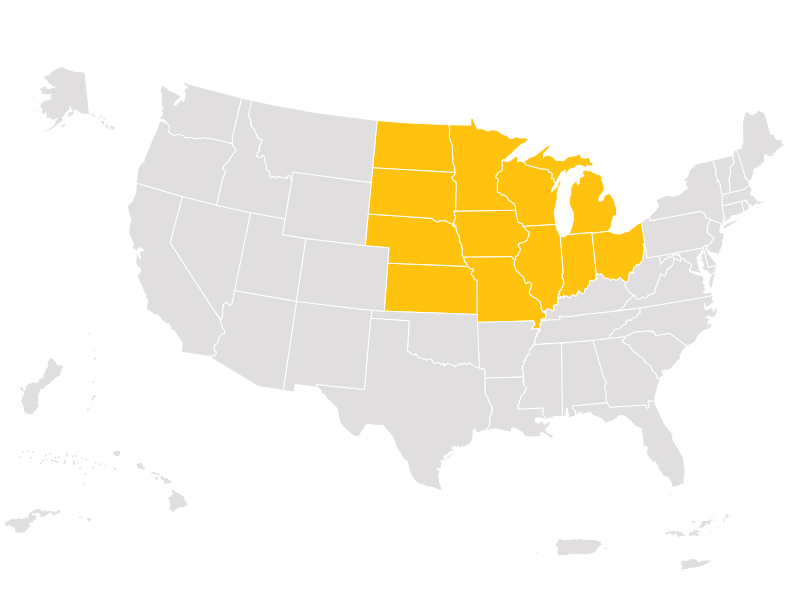
Ag Opportunities Volume 17, Number 1 January 2006 Sunflower farming to continue growing in Missouri By Chuck Adamson Senior Information Specialist Extension & Ag Information Missouri farmers nearly doubled the acreage of sunflowers planted and harvested this year over last to a total of more than 10,000 acres. Rob Myers, executive director of the Columbia-based Thomas Jefferson Agricultural Institute and adjunct professor at the University of MO-Columbia, sees the increase as part of a national trend that will continue. "It's a crop that keeps going up every year," Myers said at the University of Missouri Crop Management Conference held in Columbia on Dec. 14. The US planted more than 2.5 million acres of sunflowers this year, its only native commercial oilseed or grain crop. A large portion of the crop is planted in North Dakota and South Dakota, but as demand has increased, production has been spreading throughout the Midwest. Myers recommends sunflowers as a rotation crop and a way to spread out labor between planting and harvesting times. Missouri has a near-perfect climate to grow sunflowers, which can be planted from April through July, he said. Sunflowers are drought tolerant. "Usually the profits are comparable to soybeans," Myers said. "In a dry year, it will be better. In a wet year, it will be about the same." The state imported 10 times the amount of sunflower seeds that it produced last year, all purchased by birdseed packaging companies. Other major users of the seeds are snack producers and cooking oil makers. The plants thrive in most soils, although they grow poorly in water-saturated soils near creeks and rivers. Myers said there are more than 50 commercial varieties, and picking the right type is a key to successful growing. He said to avoid planting the flowers in bird-roosting areas, but that plots of 40 acres or more are less vulnerable to significant bird damage. "We all know that birds love sunflowers, but I have yet to hear a farmer in Missouri tell me they lost their crop to birds," Myers said. Starting in January, food processors will be required to begin printing trans fatty acid amounts on retail food labels. That will increase manufacturers' incentive to use healthier sunflower seed oil, Myers said. Alan Weber has been growing oilseed sunflower varieties on his family farm for seven years. Weber, a marketing consultant with the Thomas Jefferson Agricultural Institute, said he plants the NuSun variety. Seeds from the variety have high amounts of oleic acid, giving the processed seed oil a longer shelf life without having to be partially hydrogenated. Weber said sunflowers are one of his family's most profitable crops. "Here in Missouri, the opportunity for birdseed is significant," Weber said. "Obviously there is a lot of potential for us to grow." For more info on sunflower farming, call Myers at 573-449-3518. ******** Annie's Project teaches women farming business basics By Chuck Adamson Senior Information Specialist Extension & Ag Information Karisha Devlin is giving a group of 10 working and aspiring farmers a lesson on futures markets, hedging crop sales and how to understand commodity market fluctuations. This isn't your usual 10 farming students. They're all women. "They typically have been an underserved group in the past," Devlin said. "There is no other farm program in the state that is doing this, that is just focused on women." Devlin, a University of MO Extension specialist and wife of a farmer, is one of several agribusiness specialists in the state teaching the course called Annie's Project. It's attracted widows, young farm wives and single women wanting to start farms. It's Devlin's favorite course to teach. "They're like sponges who soak up the information. They ask a lot of questions," Devlin said. Linda Bertram, of Luray, MO, is a lifelong farmer in her fifties who went through Annie's Project to learn how to incorporate spreadsheets into her bookkeeping and how to plan her estate. "Some people don't want to hear this, but women need to be more involved in farming," Bertram said. For Jessy Cobern, of La Plata, MO, she decided to enroll in the six-part course because she's marrying a farmer. The self-proclaimed "city girl," previously of Mississippi, said she wants to help out with what will be her family business. "I want to understand where he is coming from and what to do," Cobern said. Annie's Project was created by Illinois Extension educator Ruth Hambleton and named in honor of her mother, Annette Fleck. Fleck married a farmer in 1947 and helped run the family farm until her death in 1997, according to the Iowa State University Extension Annie's Project Web site. Fleck ran much of the business side of the operation that in its early years staggered with low profits. Ultimately, under Fleck's guidance, the farm was a success, and she died a wealthy woman. The business-focused program is now being taught in nine Midwest region states. Marla Elder and her husband own 150 acres in Greentop, MO and rent another 70 acres for their cattle farm. The course helped her understand the loan process when she went to her bank to refinance a farm loan. For one thing, she knew to ask if there was a mortgage insurance policy on the loan they originally signed 10 years ago. Elder thought there was, but as it turned out it had expired nine years earlier. Now she and her husband are seeking out new insurance. "I think the best part of this course is knowing you're not alone," Elder said. "You have questions you thought were stupid and then you realize everyone is asking the same questions." The first phase courses are starting again in January and February in the following Missouri locations: Mountain Grove, Mexico, Carrollton, Fulton, Hermitage, Neosho, Nevada, Savannah and Bethany. The first phase of Annie's Project is six weeks of general agricultural education. Topics include risk management, record keeping software, property ownership, insurance, financial statements, spreadsheets, business plan writing, estate planning, leases, communication issues, personality traits and marketing. The MO course costs $50. It includes the six weeks of classroom instruction, books, financial software and access to a Web-based course on ag economics hosted by Iowa State Univ. Devlin is already planning a second phase of Annie's Project focused on grain marketing. For more info on Annie's Project or to register for classes see the Calendar of Events in this newsletter. (Devlin, 573- 633-2640 or Mary Sobba, 573-581-3231) ******** Interested In Working On A Farm And Learning About Farming? "Growing Growers" is a new program in Kansas City to train farmers in local food production. The goal is to increase the number and effectiveness of small farms that grow food organically and/or sustainably in the Kansas City metro area. The program offers Apprenticeships on Local Farms. Apprentices get hired to do an average of 20 hours a week of field work on farms in the Kansas City metropolitan area, attend 10 classes in basic farming practices (Soil Management for Organic Growers, Plant Production, Pests, Diseases and Weeds, and so on), and also receive one-on-one training from their Host Farmer. Most of the apprenticeship positions begin in March. For more info, visit http://www.growinggrowers.org/apprentice.htm or call Katherine Kelly at 913-488-1270. Growing Growers is primarily funded by a grant from the USDA Sustainable Agriculture Research and Education Program through K-State Research and Extension and the University of Missouri, partnered with the Kansas Rural Center and the Kansas City Food Circle. ******** *** In Print/On-Line *** *Manage Insects on Your Farm* outlines the principles of ecologically based pest management and illustrates the strategies used by farmers around the world to address insect problems. Download a complete copy of at www.sare.org/publications/insect.htm. To order print copies ($15.95 plus $5.95 s/h) call 301/374-9696 or send check or money order to Sustainable Ag Publications, PO Box 753, Waldorf, Maryland 20604-0753. The University of Wisconsin has published a new resource for Midwestern farmers who are thinking about starting or modifying a poultry operation. Poultry Your Way is a free, 124-page book that provides an overview of poultry production systems for meat and eggs, including breed selection, marketing, and processing alternatives. It also describes various management options, including organic, semi-confinement, day-range pasture, pasture using movable pens, and industrial. To receive a copy of this publication send a check for $3.00 made payable to 'UW Madison - CIAS' along with a note letting CIAS know which publication you are requesting and the address where you would like the publication sent. Mail this to UW Madison - CIAS / 1535 Observatory Drive / Madison WI 53706. The book is also available online http://www.cias.wisc.edu/pdf/poultryway.pdf. ******** *** IN THE NEWS *** The University of Missouri Bradford Research and Extension Center and the MO Dept of Conservation agreed to develop native plant plots and demonstration sites on the Bradford Farm east of Columbia. The Bradford Farm has access to specialized agronomic equipment that will allow improved seed harvest and plot maintenance of native plants and will help MDC further its efforts in developing seed for the MO Ecotype Program. The Bradford Farm is also working toward a larger goal of becoming a nationally recognized native plant research center. (Native Warm Season Grass Newsletter, Fall 2005) Bison ranchers will enjoy strong prices for a while. Carcass prices on young bulls have again inched over $171/cwt, highest average this decade. Even old bison are fetching $110-$120. The US herd has stabilized comfortably over 250,000, and many ranchers are retaining heifers for reproduction. The strongest market signal: Prices for young and old bison increased this fall, a time of the year when they normally fade as sales of aged and pastured animals pick up. With most bison grain-fed now, lower feed costs also help bison ranchers. Sales of bison meat are going up in food stores and restaurants in the US, helping absorb recent surges in bison production. (Kiplinger Ag Letter Vol 76, No 24) A banner crop of sunflowers will mean lower prices for growers. t looks as if US yields may average 1600 lb/acre, a record 100 pounds more than USDA estimated in Oct, enough to double 2005 output over 2004. Even with the brisk health foods demand for sunseed oil, the huge volume from US and Canadian acres eroded oil sunseed prices to near $10/cwt. They’ll be mostly $9-$10 for months before returning to an $11-$12 range. (Kiplinger Ag Letter Vol 76, No 24) Missouri native seed producers and industry partners gathered on Nov 10 to begin the official organizing process for the Missouri Native Seed Assn. Grow Native!, a joint program of the MO Dept of Ag and MO Dept of Conservation, the meeting identified goals of the organization to partner with state and federal government agencies to increase the use of Missouri source identified seed and develop policies for the use of native seed. For more info about the native seed association, contact grownative@mda.mo.gov. For more info about the Grow Native! program, visit www.grownative.org. Fifteen Ohio ranchers formed a cooperative in 2001 to market their beef locally, reports Reuters. Since then Ohio Family Farm Beef Industry Network has grown into a statewide enterprise with two branded products, Ohio Signature Beef and Ohio Heritage Beef. The brands showcase premium beef products from family farms, and highlight that the animals are raised humanely and without hormones or antibiotics. The Ohio cooperative has been able to tap into increasing consumer demand to know where their meat comes from and how it was produced. This market climate has encouraged the development of several branded beef products that are winning producers price premiums. (Weekly Harvest Newsletter, Nov 23, 2005) Strawberry growers: Double-cropping is possible in mid-latitudes. USDA labs find that they can harvest standard June-bearing varieties by cutting runner tips in early July, rooting them, and then transplanting in early Sept. The result is a crop harvested in Dec. or even later. Farmers must devise frost protection where risk of freezing is high. The method appears successful so far in Maryland, Florida, Oklahoma and Tennessee. (Kiplinger Ag Letter, Vol 76, No 26) The total number of American farms is headed back up after falling sharply through the 1960s...gradually since then. But an increasing share of the farms will be part-time operations. More small farms will emerge over the next 13 years or so, according to projections by the American Farm Bureau Federation, which turns 100 years old in 2019. Many of them find profitable niches in local markets for fresh produce, organic foods and other items. But midsize and large farms will continue to consolidate. The 140,000 farms yielding 75% of farm output will decline in number, but most will expand to compete in a world demanding low-cost output. Surviving farms will give up even more of their independence. Typically, they’ll be integrated into food production systems much like livestock and poultry farms are today. They’ll produce to specifications made by US food makers or foreign buyers. And more and more farmers will depend on off-farm income to supplement their living and farming expenses. That’s in contrast to years when farmers and rural towns relied on farm income alone. Off-farm income already provides 84% of average farm household income, and that share will grow with the number of small, part-time farms. (Kiplinger Ag Letter, Vol 76, No 26) Agricultural Research Service scientists in New England have developed a new tool to help potato producers develop profitable crop rotations. Their "Potato Systems Planner" software incorporates all of their research findings on possible crop rotations for potatoes, looking at factors such as yield, level of nitrogen recycling, soil microorganism activity, disease, and economic feasibility. Crops in the Brassica genus have shown particular promise because they produce natural sulfur compounds that help combat common potato diseases, such as the fungus that causes stem canker and black scurf. Growers interested in receiving copies of the Potato Systems Planner software may call 207-581-3363. (Weekly Harvest Newsletter - Jan 4, 2006) ******** *** ON THE CALENDAR *** Jan 13-14- MO Aquaculture Assn Annual Meeting and Banquet, Jefferson City, MO. Call 573-526-6666. Jan 13-14- North American Farmers’ Direct Marketing Conference and Trade Show, Austin, TX. Call 413-529-0386 or www.nafdma.com Jan 16- Annie’s Project, Fulton, MO. Call 573-581-3231. Jan 17-10- Mid-America Fruit Growers Tour and Conference, Excelsior Springs, MO. Call 785-242-5511, www.midamericafruit.org Jan 17-19- Illinois Specialty Crops Conference, Springfield, IL. Call 309-557-2107 or handley@ilfb.org Jan 20- From Recipe to Reality: Understanding the Basics of Starting a Food Business, Lincoln, NE. Call 402-472-2832. Jan 20-21- Heartland Agriculture & Natural Resources Expo, Poplar Bluff, MO. Call 573-686-8064. Jan 21- Calving Clinic, Linneus, MO. Call 660-895-5121. Jan 21- Forging a Link between Consumers and Producers, Linneus, MO. RSVP necessary for lunch 660-963-2685 or atpowell@mcmsys.com Jan 21- MO Christmas Tree Association Meeting, Jefferson City. Call 573-243-5501. Jan 24- Annie’s Project, Savannah, MO. Call 816-324-3147. Jan 26- Flax Production and Marketing, Ottumwa, IA. Call 515-294-0588, Schultz@iastate.edu Jan 26- Is Organic Farming Right for Me? Ottumwa, IA. Call 515-294-0588, Schultz@iastate.edu Jan 27-28- MO Farmers Union 7th Annual Convention, Wright City, MO. 573-659-4787, missourifarmersunion.org Feb 1-3- MO Natural Resources Conference, Lake Ozarks, MO. www.mnrc.org Feb 1- Direct Sales from the Farm to the Customer: What You Need to Know and More..., Topeka, KS. Call 785-296-3034. Feb 1- Hobby Greenhouse Workshop, Nevada, MO. Call 417-448-2560. Feb 2- Flax Production and Marketing, Corning, IA. Call 515-294-0588, Schultz@iastate.edu Feb 2- Is Organic Farming Right for Me? Corning, IA. Call 515-294-0588, Schultz@iastate.edu Feb 3-4- MO Nut Growers Association Nut Show & Annual Meeting, Nevada, MO. Call 417-436-2351. Feb 4- Landowner Prescribed Burning Workshop, Carthage, MO. Call 417-629-3423. Feb 4-5- MO Young Farmers/Young Farm Wives Annual State Convention, Lake Ozark, MO. Call 573/751-8467. Feb 4-6- MidAmerica Grape and Wine Conference, Lake Ozark. MO. 800-392-WINE. Feb 6- Annie’s Project, Urbana, MO. Call 417-745-6767. Feb 6- Annie’s Project, Neosho, MO. Call 417-455-9500. Feb 6- Annie’s Project, Nevada, MO. Call 417-448-2560. Feb 10- MO Livestock & Poultry Health Council Meeting, Columbia, MO. Feb 10-11- Missouri Annual Organic Association Conference, Jefferson City, MO. Call 660-427-5555, sue@onecert.net Feb 17-18- Sustainable Agriculture Conference, Manhattan, KS. For more info www.dce.ksu.edu/dce/conf/hfhfconf/index.shtml Feb 17-18- Women Managing the Farm: A Comprehensive Program for Farm Owners, Partners and Rookies, Wichita, KS. Call 1-866-327-6578, www.k-state.edu/farmksu/wmfconf.htm Feb 17-19- Specialty Mushroom Grower Workshop, Columbia, MO. Call 573-882-3234, www.centerforagroforestry.org Feb 18- Landowner Prescribed Burning Workshop, Lamar, MO. Call 417-629-3423. Feb 18- Landowner Prescribed Burning Workshop, Macon, MO. Call 660-385-2616 x 3. Feb 20-22- Missouri Small Fruit and Vegetable Conference, Springfield, MO. Call 417-547-7500 or mtngrv.missouristate.edu/MSFVC.htm Feb 23-25- Upper Midwest Organic Farming Conference, LaCrosse, WI. www.mosesorganic.org/umofc/umofc06intro.htm Feb 24-25- Missouri Tree Farm Conference, Columbia, MO. Go to www.moforest.org Feb 25- Landowner Prescribed Burning Workshop, Moberly, MO. Call 660-385-2616 x 3. Feb 25-26- Missouri Equine Council 16th Annual Equine Education Celebration, Columbia, MO. Call 800/313-3327. Feb 25-27- Western Farm Show, Kansas City, MO Feb 28- 22nd Annual Spring Forage Conference. Contact your local SWCD. April 1- Farmers Exhibition 2006, Shawnee, KS. hartwood2@mindspring.com April 8- Farmers Exhibition 2006, Kansas City, MO. hartwood2@mindspring.com April 19-20- Agri-Marketing Conference & Trade Show, Kansas City, MO. 913-491-6500 March 3-4- MO State Beekeepers Assn and Kansas Honey Producers Assn Joint Spring Meeting, Overland Park, KS. Call 913-831-6096. March 3- Bridging the Gap - Selling Food to Distributors, Fairgrounds, Fairfield, IA. Call 515-294-0588, Schultz@iastate.edu March 8- Bridging the Gap - Selling Food to Distributors, Fairgrounds, Atlantic, IA. Call 515-294-0588, Schultz@iastate.edu March 25- Beginning Beekeepers Class, Union, MO. Call 573-764-2922. June 28-30- Grant I Writing Workshop, Springfield, MO. Call 417-732-6485. July 12-14- Grant II Writing Workshop, Springfield, MO. Call 417-732-6485. July 30- MO Young Farmers/Young Farm Wives Annual Summer Tour, Chillicothe, MO. Call 573/751-8467. Aug 9-11- Grant III Writing Workshop, Springfield, MO. Call 417-732-6485. Aug 10-20- 2006 MO State Fair, Sedalia, MO Aug 15-17- 5th National SARE Conference, Oconomowoc, WI. Go to www.sare.org/ncrsare/2006_nationl_conference.htm Green Hills Farm Project 2006 Farm Walk Schedule Jan 21- Green Hills Farm Project Annual Winter Seminar Richard Hebron of Vandalia, MI will speak at the Linneus Community Centre. Hebron and his wife have started a unique marketing system of natural farm products in the MI and IL area. By establishing a Buyers Club which services over 200 families, the Hebrons, along with other producers, sold 29,000 dozen eggs, 3000 broilers, 250 turkeys, 88 beeves, 150 hogs, and 40 lambs during 2003 in the Ann Arbor, Chicago, and Detroit areas. Deliveries and educating the consumer are big selling points for their products. One big stumbling block for local producers is letting consumers know about their businesses and, as Hebron says it 'building bridges between the country and the city.' This seminar is open to both producers and consumers alike. Cost is $20 per family for Green Hills Farm Project members and $40 per family for non-members. Non-members are invited to join at that price if interested. The cost includes lunch. Please RSVP to Tauna Powell, 660-963-2685 or atpowell@mcmsys.com so we will prepare enough food for all. Feb 11-Green Hills Farm Project Annual Winter Seminar Bill Casey will be at Forage System Research Center Linneus, MO. Registration will start at 10am with a carry in potluck meal served at noon. Registration-$20. Topics-Cattle cycles and Cattle Marketing. GHFP has had Bill speak to us for two days on Holistic Resource Management back in 1998. Bill is an outstanding educator. Contact Allen Powell, 660-963-2685. March 18-10 am, Greg & Jan Judy, Clark, MO, 573-874-1816 Rancher-Author, Greg Judy tells a great story in his book "No Risk Ranching: Custom Grazing on Leased Land" about making money with no fixed assets. If you have read the book now you can see the Judy farm at this farm walk. Here is just a sampling of the projects the Judy farm has: St. Croix hairsheep, Southpole cattle from the Bent Tree Farms, custom grazing, Tamworth grazing pigs, boar billygoats on spanish meat goats, Great Pyrenees guard dog and much more! Bring a covered dish and appetite. April 22-11 am, Kerry & Barb Buchmayer, Purdin, MO, 660-244-5858 This organic dairy family is well known for their tasty milk and eggs but their tenacity for marketing has carried them towards success! Come and see the processing plant where the milk is processed and bottled in glass. The Buchmayer's also churn butter! They have pastured layers and katahdin sheep, working dogs and an Akbash guard dog. Bring the checkbook and take home some samples! Bring a covered dish and lawn chairs. May 20-3 pm Ray & Susan Stropes, Chilhowee, MO 816-653-4467 We always enjoy visiting the Stropes Farm. Their lovely home sits right on a small lake where one can look over the vast pastures and cattle. Come see how Ray & Susan manage their cattle. Ray always has a new idea he is working on. Bring a covered dish and lawn chairs. June 15-5 pm, John & Jackie Woods, Smithville, MO, 816-532-3795 This farm has been in the family for many generations. Raising Cattle and goats using a MIG, the Woods continue to farm despite the growing urban sprawl around them. Having a farm so close to the urban area presents great opportunities and challenges. Bring lawn chairs and a covered dish. July 20-5 pm, Matt & Tina Reichert, Brunswick, MO, 660-548-3283 Using MIG methods to manage their cattle and goats, the Reichert family has worked hard these past years to convert brushy hill ground into great grazing pastures. The Bed and Breakfast and youth camps are continuing to grow. Bring lawn chairs and a covered dish. Aug 17-5 pm John & Rose Blaszak, Polo, MO, 660-354-3438 John & Rose and their growing family are like many of us who pursue careers off the farm and have that dream of a farm on a little acreage. Raising chickens for meat and a garden is a great way to bring that dream to reality. Bring lawn chairs and a covered dish. Sept 21-5 pm, Jordan & Anne Bentley, Brookfield, MO, 660-388-6825 City Slickers think'n they're going to homestead!? Jordan & Anne have bought just less than 40 acres with nothing but a pond on it. They have been raising chickens, turkeys and lambs for the past six years on rented ground. They will begin raising the same this spring on the new home place. All pastured meats are direct marketed locally or in Kansas City. They have not built a home as of the first of the year, but they will be living there this spring. This is a dream come true for the Bentleys! Contact them early this spring for directions or call Barb Buchmayer. Their contact information will change this spring! Bring lawn chairs and covered dish. Oct 19-4 pm, Doug & Diane Peterson, Ridgeway, MO, 660-824-4276 Doug and Diane raise cattle and use MIG methods. "We have a cattle only operation at this time. We have expanded quite a bit in the last few years and are still trying to get everything figured out. We will try and look at one or two different grazing systems. One will be fairly large with 200 cows being run together as one herd. This large of a herd have some very unique benefits and problems. Because we expanded our grass base faster than we wanted to purchase cows we run a combination of our own cows plus some contract cows for other people. We have also started selling a limited amount of grass fed all natural beef to customers in the Kansas City/St. Joe area. We are a family operation." Bring lawn chairs and covered dish. Nov-Workshop/Seminar will be announced Regional Beekeeping Club Meeting Information Jefferson County Beekeepers Assn-2nd Tues each month at Jefferson County Extension Center in Hillsboro, 636-285-7295 Midwestern Beekeepers Assn-3rd Wed each month at YMCA in Raytown, 816-358-3893 Eastern MO Beekeepers Assn-1st Thurs each month at Kirkwood Community Center, 636-946-5520 Beekeeper's Assn of the Ozarks-4th Tues of each month at The Library Center in Springfield, www.ozarkbees.org South Central MO Beekeepers Assn-call 417-256-9447 MO Valley Beekeepers Assn-3rd Mondays each month at Scenic Regional Library in Union, 573-764-2922