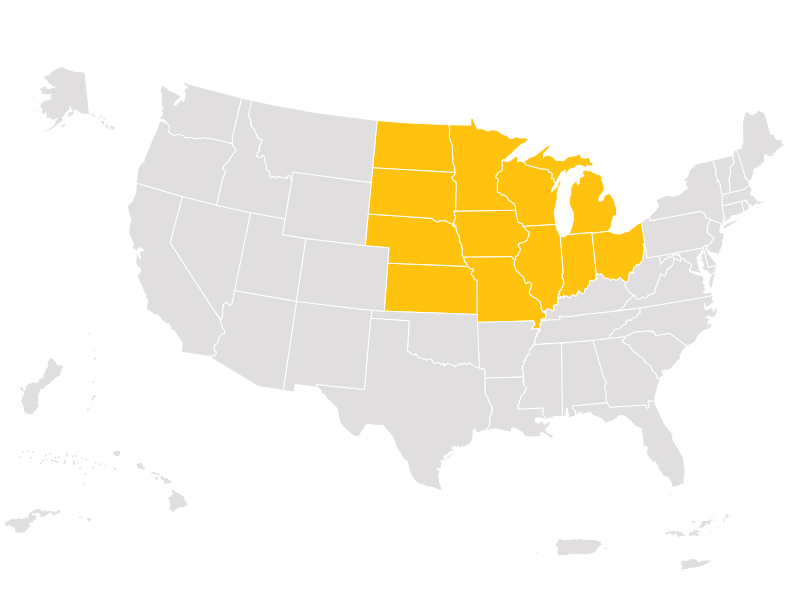
Ag Opportunities Volume 16, Number 1 July 2005 A Key to Successful Marketing Strategies: And We All Have It! By Judith A. Barry, Extension Associate Dept of Applied Economics and Management, Cornell University Here is a riddle. Within it contains one of the secrets to successful marketing strategies. When you are born, you have lots of it. As you get older, it seems that you use it at a more rapid rate. Some people are good at keeping it; others are definitely not. Whether you are a good marketer or a bad marketer, you are likely to claim you never have enough of it. What is it that I am talking about? The answer of course is time. Successful marketing strategies require wise use of time. Every commercial farmer is both a producer and marketer. Whether you are selling your vegetables at a farmers market or your milk to a dairy cooperative, your product must be marketed off the farm. How important it is to have detailed-planned marketing strategies will vary from farm to farm, but as every farmer knows, to produce and successfully market a product requires smart use of time. Here are some points to help you question your use of time and assess whether you are getting as much as you can out of your marketing strategy: * Time costs money. As one of the most costly inputs into any business, the value of time is often underestimated and incorrectly predicted in a business plan. Whether the owner is paying him/herself or an employee, the business should be delivering adequate returns on time invested. If it is not, is the use of time being distributed in the correct areas of your business? * Assess your skills. Successful marketers do not have more time than unsuccessful marketers, but the use of their time may be managed in a more effective and efficient way. Every person on this earth has his or her unique set of skills and personalities. Some extrovert personalities are great at facing people all day long and actually feel that doing so, it charges their batteries. Introvert personalities, in contrast, are sapped of energy when they are with people all day but are energized when they are working on more solitary jobs. We all have skills and different personalities. Identifying those skills and the skills of others in the business can utilize people more efficiently and help give the highest return on time investment. Brainstorming and sharing ideas with family and co-workers will probably confirm what is already known, but may also help to recognize how the skill sets within the business can be better applied to operations. * Come in the middleman! Recognizing the use of external people and their individual skills in your business may save money and time in the long run. Delegating tasks and concentrating on areas of competency may achieve a higher return on business time invested. * "Time costs money, but my time is free". Families in farm businesses frequently misconstrue this concept as it shies away from the real costs of doing business. It becomes a problem when the person with the "free" time is incapable of working (illness, injury) causing costs to be incurred to pay someone else to do the job and bringing in some very real costs to the bottom line. People's time is the essence of successful marketing and should not be undervalued when calculating profitability. It is important to remember of course, some return on time invested might not have a $ value. Lifestyle factors do not have a price tag but can certainly provide a positive return on time invested. *Where can I get more time? It is probably safe to say that everyone needs more time. Food and product quality is increasingly in demand. However quality production typically commands more time and energy. Many producers find that after producing the finest quality, they have insufficient time to actually get the product from farm to the consumer. Successfully marketing a quality product to the consumer, is no doubt an extremely time consuming task. Strategic planning is a useful tool that can help allocate time and people to implement a marketing plan. Doing this establishes the feasibility of the marketing task with the skills and resources available. Producing and marketing a product to meet the demands of the consumer need to go hand in hand, but if there is not the time or resources to achieve both, the strategy may not be profitable. * All of this said, we all have 24 hours in a day. Some sleep less, some eat for less, but to be a producer AND a marketer it is necessary to make "Smart" use of your time to succeed in managing your smart marketing strategies. ("Smart Marketing" is a monthly marketing newsletter for extension publication in local newsletters and to place in local media. It reviews the elements critical to successful marketing in the food and agricultural industry. Articles are written by faculty members in the Dept of Applied Economics and Management at Cornell Univ) Agroforestry: 5 Practices The Center for Agroforestry recently completed a DVD integrating the four previously produced videos on the agroforestry practices of alley cropping, windbreaks, riparian forest buffers and silvopasture with the fifth practice, forest farming. The new section shows examples of successful forest farming practices, including shiitake mushroom production, pine straw, woodland wildflowers, medicinal plants, high value wood blanks and tips for marketing forest farming products. Each DVD features all five agroforestry practices: * Riparian Forest Buffers--Riparian Forest Buffers are natural or re-established streamside forests made up of tree, shrub and grass plantings. They buffer non-point source pollution of waterways from adjacent land, reduce streambank erosion, protect aquatic environments and enhance wildlife. Learn the basics of establishing a riparian buffer practice and how profitable products, like decorative woody florals, can be implemented into the buffer. * Alley Cropping--In alley cropping, an agricultural crop is grown simultaneously with a long-term tree crop to provide annual income while the tree crop matures. Fine hardwoods like walnut, oak, ash and pecan are favored species in alley cropping systems and can potentially provide high value lumber or veneer logs. Learn how nut crops can be another intermediate product and see examples of successful alley cropping practices. * Silvopasture--Silvopasture is the intentional combination of trees, forage and livestock managed as a single practice. In this segment, see examples of profitable silvopasture practices, including cattle with pecans. Considerations for establishing a successful silvopasture practice are also offered. * Windbreaks--Windbreaks are planned and managed as part of a crop and/or livestock operation to enhance production, protect livestock and control soil erosion. The beneficial interactions of windbreaks upon crops and cattle are presented in this segment. * Forest Farming--In a forest farming practice, high-value specialty crops are grown under the protection of a managed forest canopy that has been modified to provide the correct shade level. The practice also includes the production of non-timber forest products for specialty markets. In this segment, examples of successful forest farming operations, including shiitake mushrooms, pine straw, woodland wildflowers, medicinal plants and high value wood blanks are presented, along with tips for marketing forest farming products. Each DVD is $10. To order: Univ of MO Center for Agroforestry, ATTN: DVD Request, 203 ABNR, Columbia MO. 65211, http://www.centerforagroforestry.org/pubs/dvdorderform.asp Market for Natives is Thriving: Study Identifies Industry's Impact and Needs The Grow Native! Program has received the results from its Phase I Market Research Study. The study determined that MO plant industry contributes approximately $120 million to the state's economy. Compared to other agricultural output sectors, the industry ranks seventh, as measured by cash receipts. The native plant industry has experienced tremendous growth, almost doubling over the last five years, and is expected to continue to grow at approximately 12% per year for the next ten years. Sales of native plant materials for conservation programs, bioengineering projects and large-scale landscaping projects represent the majority of native plant sales. Native plant materials are also emerging as a fuel stock for renewable energy. The study revealed tremendous market potential for MO's native plant industry and identified critical needs for the industry's continued growth, including the development of a cooperative exchange mechanism and expansion of Grow Native's! efforts into regional markets. These suggestions could provide industry participants with improved market information, clearly defined product standards and a convenient transaction platform that would expand market opportunities for industry participants. The Phase I Market Study was completed by Ann Wilkinson, PhD, an agricultural economist who specializes in evaluating niche markets. For copies of the study email awilkinson@kc.rr.com. (Mo Dept of Ag) Finally ... Help Choosing an Organic Certifier Over a year ago The New Farm, an on-line magazine, began working with the Organic Farming Research Foundation to survey organic certifiers in the US. What was their fee structure? What types and sizes of farms did they typically serve? What special services did they offer? What states did they cover? They took the answers to these questions and developed The New Farm Guide to US Organic Certifiers ( http://www.newfarm.org/ocdbt/). About two-thirds of US certifiers are now listed in the Guide, which is the only qualitative guide to certifiers in the country. You can browse all certifiers, compare two certifiers side by side, or search for certifiers by particular criteria. Certifiers vary widely in their service area, the collective expertise of their staff members and inspectors, and in the kinds of services they provide. Some focus their work in a single state, while others work globally. Few farmers can afford to investigate each potential certifier. They may have historic connections with one certifier, but wonder how it stacks up against a newer organization. Livestock and crop producers need to decide what strengths they most value in a certifier, and then analyze information on certifiers to allow them to make an informed choice. Information supplied by the certifiers provided the working foundation for this guide. Some certifiers have provided new data in recent weeks, and this updating continues. You can check the freshness of the information by the "last updated" date at the end of each profile and profile summary. How to Use This Guide Browse all certifiers Short summaries Alphabetical order Certifier Profile Format Clear view of all five sections: Essentials (full contact info) Clients Fees Services/Affiliations Staff/Inspectors Compare 2 Certifiers Select two certifiers for side-by-side comparison Good operational description Minimal contact info Search Certifiers by Attributes Find all certifiers that meet criteria your selection. NOTE: Since the closing of the MO Dept of Ag's Organic Certification Program, there is now a new group with whom farmers can certify in MO -- OneCert Missouri. One Cert Missouri is an accredited USDA-NOP; ISO 65, EU, and Japanese accredited certifying agent. Functions include answering questions, reviewing the forms before the inspections, doing the inspections and just generally being the contact person for the MO entities. We have worked hard to set our prices very competitively with all the other certifying agents, including developing new market growers pricing for the 2 lowest gross income brackets. Sue Baird, who was with the MO Dept of Ag's Organic Program, will lead OneCert Missouri. She can be reached at: toll free 866-587-5716; cell 573-619-9139; email sue@onecert.net CSA in the Midwest US: A Regional Characterization In this study conducted for the Leopold Center for Sustainable Agriculture and written in Jan 2005, researchers Erin Tegtmeier and Michael Duffy conclude that the overall picture [of CSA in the Midwest] is one of viability and commitment. Farmers in IA, IL, KS, MI, MN, MO, ND, NE and WI filled out surveys in spring, 2002 to form the basis of the study, which also compares its results (where feasible) with those of research in the Northeast US and the entire US. Many, though not all, of the comparisons with other studies are consistent with each other. Some of the study's conclusion include: * the typical upper Midwestern CSA farmer is about 45 years of age and has 14 years of farming experience. * Most likely both the farmer and his or her partner are college graduates. * In just over half the cases, the farmer is a woman and she has probably farmed for about eight years. * The farmer's primary motivations to start a CSA operation were environmental and social values. * These CSA farms have been in operation for more than five years, on average. * When determining share price, these CSA farmers consider what they believe to be consumers' willingness to pay rather than the market price. A majority do not believe they offer inexpensive produce, which may indicate that they feel they charge relatively high prices. The average net return per acre for these CSA farmers is $2,467. This is quite high when compared to return per acre of corn ($172.11), soybeans ($134.46) and wheat ($38.10) in the United States. The average total net return is $6,643, which is lower than the northeastern results ($8,820) but greater than one- to nine-acre farms according to the USDA 2002 Census of Agriculture ($5,873). The study concludes that: "There are, of course, a number of ways to consider the average return and income figures resulting from this survey. Returns per acre from these CSA operations are high when compared to return for the region's commodity crops. But this does not consider differences in labor requirements and opportunity costs... Using the average CSA total net return of $6,643 and the average CSA income as a percentage of family income (28.27 percent), we can calculate a mean annual family income of approximately $23,500 for these Midwestern farmers. This...is 53 percent of the average of median household incomes for the nine states surveyed: $44,568. But, these are farmers choosing to farm. And they have chosen the CSA model as a primary focus or as a complement to other agricultural enterprises. They are highly educated and younger than farmers nationally. For many respondents, their CSA operations were beginning their sixth season at the time of this survey and had grown in membership and land area since inception. The overall picture portrayed by this survey is one of viability and commitment. Although more than half of respondents do not feel their share price provides them with a fair wage, almost all claim to be satisfied at least most of the time with their operations. Nearly all of these farmers anticipate continuing their CSA operations and over half expect the operations to expand. It may be that the intangibles of environmental stewardship and community involvement continue to sustain the outlook of these farmers. And, the average financial return from a CSA presents an attractive option as well. The survey results recommend actions that may improve viability in the long run. Regarding share price, what are members really willing to pay? Other studies indicate that there may be room to increase share price... It would be constructive for each CSA farmer to try to determine willingness to pay by using surveys and studies to calculate the market value for their share bundle. Most farmers already survey customers and should be aware of market prices for their products. So, these are doable activities. ...Increasing membership count, member retention, members per acre and CSA land area may improve financial return. The farmers themselves identified causes of dissatisfaction for CSA members. To improve retention, concerns with too much produce, too much preparation time and lack of choice should be addressed. By definition, the CSA model creates a community of members who share in the harvest. This requires behavioral change on the part of members in regard to food choice and produce preparation. So, there are limits to how individualized each member's experience can be. But, there may be creative ways to address these issues without adding greatly to the workload of the farmer... CSA in the Midwest is growing and continued creativity and flexibility by CSA farmers will improve their financial health and help to sustain their ethical aspirations." A Research Brief on CSA in the Central Coast by the Center for Agroecology and Sustainable Food Systems, UC-Santa Cruz. http://zzyx.ucsc.edu/casfs/about/brief4_CSAgrower.pdf or call 831-459-3240 Conclusions quoted with permission. The 23 page report is available at www.leopold.iastate.edu/pubs/staff/files/csa_0105.pdf (reprinted with permission from The Community Farm, Spring Issue, 2005) *** In Print/On-Line *** *The Community Farm* A newsletter dedicated to preserving small farms and building community from the perspective of community supported agriculture (CSA). Contact for a sample, subscriptions $20 per year. 3480 Potter Rd., Bear Lake, MI 49614, csafarm@jackpine.net, www.csafarms.org *The Social Implications of Management Intensive Rotational Grazing: An Annotated Bibliography* is now available on the web at: www.cias.wisc.edu/bibliog2.php The bibliography presents: * a comprehensive literature review of social issues of managed grazing, including a summary and analysis of future research needs. * Over 100 abstracts covering economic, social, and general reports on grazing. Links to full web documents provided. * More than 30 abstracts covering the agronomic, environmental, human nutrition, and grazing "how-to" literature. * Additional information sources are also identified. This publication is part of a comprehensive study of grazing being carried out by the Center for Integrated Agricultural Systems. For information about the bibliography and the ongoing social research on grazing contact Sarah Lloyd, Research Assistant, Center for Integrated Agricultural Systems Univ of Wisconsin-Madison 1450 Linden Dr Madison, WI 53706 tel. 920 210 7335, slloyd@ssc.wisc.edu The Univ of Nebraska has developed the Internet Center for Wildlife Damage Management. This useful website http://www.icwdm.org/ serves as a clearinghouse for wildlife damage research, information, as well as technical bulletins, proceedings, Extension fact sheets, guides and programs. *Resources for Beginning Farmers: Building a Sustainable Future* includes over a hundred books, publications and websites on setting goals, business planning, farming and production knowledge, access to financing, and transitioning into farming. Available in print for $4.00 plus $1.00 shipping from the Minnesota Institute for Sustainable Agriculture, 800-909-6472. Full text is on-line at www.misa.umn.edu. www.e-cooperatives.com is a new service from the National Farmers Union. The site allows consumers to locate quality products and services from family-farm producers, their co-ops and other rural businesses. The site maintains a growing, searchable database listing farmer controlled businesses categorized by general products, location, growing practices, specialty products and niche items. The Northeast Organic Farming Association announces the completion of the NOFA Organic Principles and Practices Handbook Series; ten handbooks that present the most proven and successful practices of organic farmers around the region. The series was funded by the NOFA Interstate Council, NOFA/Mass and SARE. All ten handbooks, illustrated and 60 - 110 pages in length, are written by talented farmer-writers for serious gardeners and commercial growers. Pre-publication review by farmers and scientists with relevant backgrounds has assured that each covers up-to-date experience and research. The handbooks include tables, references and farm profiles and are fully indexed. NOFA and the book ordering page are at www.nofa.org. Suggested retail price is $7.95. Bulk price $4.50 per book (minimum 6 books of any title), $3.50 order fee plus 30¢ per book postage. To order, contact Elaine Peterson info@nofamass.org or 978 355-2853. The ten handbooks are: * Vegetable Crop Health: Helping Nature Control Diseases And Pests Organically * Whole Farm Planning: Ecological Imperatives, Personal Values And Economics * Compost, Vermicompost & Compost Tea: Feeding The Soil On Organic Farms * Crop Rotation & Cover Cropping On The Organic Farm: Soil Resiliency & Health * Marketing And Community Relations: The Organic Farmers(TM) Guide * Humane And Healthy Poultry Production: A Manual For Organic Growers * Organic Dairy Production * Organic Seed Production And Saving: The Wisdom Of Plant Heritage * Organic Weed Management * Organic Soil Fertility Management *Management of Barber Pole Worm in Sheep and Goats in the Southern US* This parasitic nematode can lead to disease and death of sheep and goats, particularly in hot, humid climates during the summer months. The parasite has been developing resistance to pharmaceutical dewormers. Burke's research looked at alternatives for management of the parasite, including selective treatment of herds to reduce development of resistance, forage choice and supplemental feeding, and improved drenching practices when chemical dewormers are used. http://attra.ncat.org/downloads/goat_barber_pole.pdf *** IN THE NEWS *** Insurance a Challenge for Agritourism Ventures--Farmers who enter the growing field of agritourism may face challenges in obtaining insurance coverage, according to an Agrinews article. Experts recommend meeting with insurers to discuss details of the operation, as specific practices and precautions taken on the farm can make the difference between obtaining coverage and not obtaining coverage, or pricing the insurance out of range. The article provides several examples of agritourism operators who found ways to reduce their liability so that they qualified for coverage or reduced the amount of coverage necessary. The cost of coverage can vary greatly with the type of activity involved and the scale of the operation. http://www.agrinewspubs.com/Main.asp?SectionID=1&SubSectionID=207&ArticleID=8447 Producers are seeing demand for their organic, pasture-raised, local meats rising, says the Roanoke Times. Yet they are experiencing a bottleneck in meeting this demand: a lack of small meat processors. In order to be sold to the public, meat must be processed at a federally inspected facility. Increasing regulations and costs, not to mention the demanding nature of the work, have reduced the number of small processors who can serve niche producers. Many producers have to drive several hours to reach a processor who can slaughter and cut their meat for sale. Even at that, small processors charge more and may not be familiar with turning out a standard product for retail sale. Grower groups who have looked into starting their own processing facilities find the costs prohibitive in many cases. One promising option may be mobile slaughter facilities. These inspected and approved trailers can be moved from one producer to another, for on-farm processing of poultry, hogs, lamb or beef. The Columbia Missourian recently ran a feature on Ozark Forest Mushrooms, highlighting the sustainable practices used by growers Nicola Macpherson and Dan Hellmuth. Ozark Forest Mushrooms produces shiitake mushrooms on oak wood harvested from their own land. Some trees are cut each year on the property, as part of an agroforestry plan. The logs are sold and the branch wood is used to grow mushrooms. When the logs can no longer grow mushrooms, they are used as fuel to heat a greenhouse that helps extend the farm's mushroom-producing season. The farm is certified organic. http://columbiamissourian.com/taste/story.php?ID=13831 Guaranteed All Naturally Grown (GANG) is a new alliance that seeks to unite non-certified organic growers, processors and groups. Many growers use organic methods, but are unwilling to certify under the USDA regulations. Ned Johnson, president of Highland BioProduce, Inc (a growers co-op made mostly of non-certified organic growers in TN and VA) decided that it was "high time we began" a grass roots movement to organize these growers nationwide. Currently there are several, mostly regional, non-certified organic groups. Perhaps most well know n is the Certified Naturally Grown group, with over 300 members nationwide. Founder Ron Khosla welcomes a national alliance. The overall goal is to provide a "way that's readily recognized by American consumers to assure them we do [grow organically]," according to Johnson. Membership is free (though they request a $20 donation), but open only to US and US Territories producers "who'll honestly live up to the guarantee that you meet all naturally grown standards," Johnson said. For a complete packet of materials, including camera ready GANG labels, business cards, brochures, posters and other promotional materials, send your $20 donation (refunded if you decide not to join) to National GANG Alliance, 340 Hicks Hollow Rd, Kingsport, TN 37660. Call Ned Johnson at 423-288-4117 for information. World Ark, a periodical from Heifer International, reports in the Mar/Apr 2005 issue that nearly half of the US harvest goes to waste. Univ of AZ anthropologist Dr Timothy Jones has been measuring food loss for the last 10 years. Loss can occur at retail stores, warehouses, farms and at the dining table. Among his findings: An average family of four tosses out $590 per year in meat, fruits, vegetables and grain products. Household food waste nationwide adds up to $43 billion annually. Americans discard about three times as much food today as they did 20 years ago. Biofungicide Registered for Rust Control on Organic Soybeans--AgraQuest, Inc. has announced the launch of Ballad(TM) Biofungicide for control of Asian soybean rust on organic soybeans and other legumes, according to a PR Newswire press release. Ballad is based on a naturally occurring patented strain of the bacterial species Bacillus pumilus, which produces natural pesticidal compounds that destroy the cell walls of the rust pathogen. Ballad is AgraQuest's first entry into the large-acreage row crops. To date, the company has targeted high value fruits, nuts, vegetables, and home gardens. While there are several chemicals that are approved or under emergency exemption for control of soybean rust in conventional soybeans, Ballad is currently the only product approved for organic soybeans. http://www.agraquest.com The New Agriculture Network's on-line newsletter gives seasonal advice for field crop and vegetable growers interested in organic agriculture. New information is posted twice a month during the growing season and less frequently during winter. Our on-line newsletter features crop updates from organic growers and articles from university specialists about a variety of practices and new findings useful for organic growers. The info serves those interested in transitioning to organic as well as those currently practicing low-input or organic agriculture. Directions to subscribe for the free listserve: 1) Send the following one line e-mail message to listserv@list.msu.edu SUBSCRIBE NEWAGNETWORK You will receive a confirmation e-mail asking you to reply in order to complete your subscription. *** ON THE CALENDAR *** July 11 - Tree Fruit Production and Eco-Tourism Workshop, call 913-488-1270 or growers@ksu.edu July 23 - Wine Grape Field Day, Stillwater, OK. Call 918-647-9123 or easpeaker@kerrcenter.com July 29-Aug 7 - Ozark Empire Fair, Springfield, MO. Aug 4 - Greenley Memorial Research Center Field Day, Novelty, MO. Call 660/739-4410. Aug 11-21 - MO State Fair, Sedalia, MO. Aug 18 - Turkey Field Day, Stillwater, OK. Call 918-647-9123 or easpeaker@kerrcenter.com Aug 21 - Pests, Diseases and Weeds Workshop, call 913-488-1270 or growers@ksu.edu Aug 23 - Graves Chapple Memorial Research Plots Field Day, Rock Port, MO. Call 660-744-6231. Aug 27 - Goat Day, Jefferson City, MO. Call 573-681-5545. Aug 31 - Delta Center Field Day, Portageville, MO. Call 573/379-5431. Sept 8 - IL Pumpkin Field Day, SIU Belleville Research Center. Call 618-453-3446 or awalters@siu.edu Sept 8-9 - Southwest Center Education Field Day, Mt. Vernon, MO. Call 417-466-2148. Sept 23-24 - Midwest Forest Industry Show, St Louis, MO. Call 573-634-3252 Sept 27 - Integrating Meat and Dairy into Vegetables Workshop, call 913-488-1270 or growers@ksu.edu Oct 6-7 - Wurdack Youth Field Day, Cook Station, MO. Call 573-743-3301. Oct 22 - Farm Beginnings(TM) Course, West Plains, MO. Call 417-256-2391. Oct 22 - Business Management, Basics of Farm Business Management Workshop, call 913-488-1270 or growers@ksu.edu Oct 29 - 3rd Annual Chestnut Roast, New Franklin, MO. Call 573-882-3234, www.centerforagroforestry.org Oct 29-30 - MO State Beekeepers Assn Fall Meeting, Lake of the Ozarks, MO. Call 636-394-5395 Nov 3-5 - National Small Farm Trade Show & Conference, Columbia, MO. Call 800-633-2535. Dec 2-3 - 2005 MO Livestock Symposium, Kirksville, MO. Call 660-665-9866, missourilivestock.com Dec 3 - Rural Life Day, Jefferson City, MO. Dec 11-13 - MO Governor's Conference on Ag, Osage Beach, MO. Jan 9-16 - North American Farmers' Direct Marketing Conference and Trade Show, Austin, TX. Call 413-529-0386 or www.nafdma.com Jan 17-19 - IL Specialty Crops Conference, Springfield, IL. Call 309-557-2107 or handley@ilfb.org Feb 17-19 - Specialty Mushroom Grower Workshop, Columbia, MO. Call 573-882-3234, www.centerforagroforestry.org Green Hills Farm Project 2005 Farm Walk Schedule Green Hills Farm Project welcomes all families to our open farm walks. Always bring your children! Please call ahead to let the host family know how many to expect. The host family provides the main meat coarse and drinks. It would be appreciated if all members and guest bring a side dish and service set for each participant. Bring Lawn Chairs. Some Farm Walk host will have a special guest speaker. Many past walks have had a variety of guest speakers from our State University Extension, MO Dept of Ag, special interest groups, and specialist from our own communities. Our farm walks are very social, but also a time of sharing information and learning. Come on out and join us for a great time on our farms! For more information about Green Hills Farm Project please contact: Jordan Bentley jbentley@cvalley.net ; Allen Powell at powell@mcmsys.com July 14- 5pm Doug & Diane Peterson, Ridgeway, MO, 660-824-4276. Cattle and MIG. "We have a cattle only operation at this time. We have expanded quite a bit in the last few years and are still trying to get everything figured out. We will look at one or two different grazing systems. One will be fairly large with 200 cows being run together as one herd. This large of a herd have some very unique benefits and problems. Because we expanded our grass base faster than we wanted to purchase cows we run a combination of our own cows plus some contract cows for other people. We have also started selling a limited amount of grass fed all natural beef to customers in the Kansas City/St Joe area." Aug 18- 5pm TBA Sept 15- 5pm Allen & Tauna Powell, Laclede, MO, 660-963-2685. See a short presentation about ranching and traveling in Australia and then sample a staple of Australian fare - vegemite! I do have some interesting information on what Australia is doing as far as value adding beef products. Of course we'll show you cattle, sheep, chickens, and gardening. Allen will take those interested to the far reaches of our operations to give you an idea of how spread out we are and how those are managed a bit differently because of the distance from our home place. Oct 20- 4pm. Matt & Tina Reichert, Brunswick, MO, 660-548-3283. "MIG Cow/Calf operation and Boer African Meat Goat brush and weed control project that is being expanded. See how the "$500" ponds have worked out which were built last summer. We are expanding our Bed and Breakfast to include some youth camps this summer as well as family camps." Nov 18 - Tentative Dinner in Brookfield, MO Grazing Schools across the State Northwest Central Region Sept 14-15 - Thompson Farm, Spickard. Call Sarah Clark, 660-359-5685 x 3, sarah.clark@mo.nacdnet.net or Scott Roy, 660-359-5685 x 3, scott.roy@mo.nacdnet.net Sept 21-22 - Guilford. Call Debi McKay, 816-232-6555x3, debi.mckay@mo.nacdnet.net or Curt Walker, 816-232-6555x139, curt.walker@mo.usda.gov Central Region Sept 21-22 - Waynesville. Call Pamela Cornelius 417-532-6305 x 3 South Central Region Sept 22-24 - Willow Springs. Call Randy Saner 417-256-2391, SanerR@missouri.edu or David Harrison 417-256-7117, david.harrison@mo.usda.gov Southwest Region Aug 9, 11, 16, 18 (evenings) and Aug 13 (daytime) - Carthage. Call Mark Starnes 417-358-8198 x 3, mark.starnes@mo.usda.gov Aug 23, 24, 25, 30, Sept 1 (evenings) and Aug 27 (daytime) - Bradleyville. Call Shelia Braden 417-546-2089, shelia.braden@mo.nacdnet.net Oct 25-27 - Bois D'Arc. Call Mark Green 417-831-5246 x 3, mark.green@mo.usda.gov Oct 27-29 - Marshfield. Call Mark Emerson 417-468-4176 x 3, mark.emerson@mo.usda.gov Southwest Central Region Sept 7-8 - Hermitage. Call David Wright 417-745-6613 x 3 Sept 20-21 - Butler. Call Diane Bradley 816-884-3391 x 3 Oct 13-14 - Brumley. Call Lisa Tellman 573-392-5667 x 3 Northeast Region Aug 26-27 - Macon. Call Mark Collins 660- 385-2616 x 3 or Charles Chaney 660-385-2173 Linneus Schools Sept 27-29 - Beginning Grazing School, Linneus. Call Joetta Roberts 573-499-0886, mfgc@mchsi.com