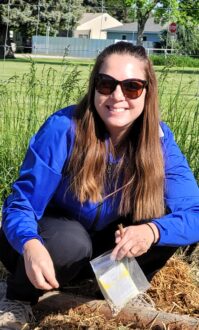
Ag Opportunities Volume 15, Number 5 March-April 2005 ********** For veteran nurse, farm apprenticeship proved "rich, rewarding, and amazing" by Forrest Rose MU Information Specialist After 20 years as a registered nurse in St Louis, Denise Canfield-Seay was, in her own words, "burning out bad." "I was ready to do something different," said Canfield-Seay, 50. "I’ve just been a backyard flower gardener, maybe with a few tomato plants. I wanted to learn to be an organic gardener." She became an apprentice in the Growing Growers Program, a joint effort by the University of Missouri and Kansas State University to address the growing demand for fresh foods in the KC area — and a growing shortage of people to produce it. Canfield-Seay spent May through mid-October of 2004 at Bear Creek Farms, near Osceola, MO. Days, she worked alongside owners Jim and Robbins Hail; nights, she slept in their "’77 vintage Winnebago trailer." "It was just an amazing experience," she said. "The whole idea is to learn organic farming. I’m so grateful I got to jump in feet first, right into the real deal." Robbins Hail, who runs the six-acre organic vegetable farm with her husband, said Canfield-Seay "will be a better farmer than I’ll ever be. She got to experience farming before it was her dollar involved, and now she knows how to do things it took me five or 10 years to learn how to do." The Growing Growers apprenticeship program was established "to train produce growers in the Kansas City area," said Lewis Jett, University of Missouri extension horticulturist. "There’s such a high demand that we just don’t have enough growers. And there are a lot of people who want to farm, but they just don’t know how to get started." Apprentices are expected to work a minimum of 20 hours per week for regular wages during the growing season, plus take classes on topics such as soils, weed management and marketing. Volunteer apprentices must work at least four hours per week. The money wasn’t great: about $300 a month for Canfield-Seay in addition to the modest lodgings. She doesn’t care. "It was a rich and rewarding experience. You can read all the books in the world about organic farming, but you don’t know what it’s all about until you do it." At first, she said, "I was amazed at how hard the physical work was. We were weeding and crushing bugs, not just spraying everything, so we were standing, squatting, walking, bending, reaching, lifting and climbing. "But lo and behold, in a few weeks I could do it, I could endure the physical labor." She acquired much more than strength and stamina, she said. "There’s so much to the marketing. I hadn’t realized the importance of the presentation of the product, being knowledgeable about the varieties and how to cook with them." Now, Canfield-Seay said, "I’m ready. I put a cover crop in my garden last fall, and I’ll be buying a tractor within the next few weeks. I’m starting with a third of an acre, which looks huge to me, but I learned enough to start." Meanwhile, the Hails and other farmers in western Missouri and eastern Kansas are seeking apprentices for the 2005 growing season. "Primarily, we want to teach people who are interested in becoming farmers," Robbins Hail said. "They’ll be so far ahead, not having to go through 20 years of learn-as-you-go. They’ll learn everything from soil management to transplants to machinery safety, and things like how to market to restaurants: all important things for them to know when they have their own farms." For more information, log onto www.growinggrowers.org/apprentice.htm, or contact Growing Growers Program director Katherine Kelly, 913-488-1270, growers@ksu.edu. Editor’s Note: It is with great sadness, that this lead article will be the last one MAC reprints by Forrest Rose. Forrest unexpectedly passed away March 20th. His writings for the College of Agriculture, Food and Natural Resources and especially those writings of alternative agriculture, sustainable agriculture, small farms and local foods will be greatly missed. ********** Reducing Parasite Problems in Small Ruminants Internal parasites are a major health concern for sheep and goats. The problem is compounded by the fact that the parasites are rapidly becoming resistant to de-worming medications. Therefore, management must be the primary method for sustainable control of internal parasites You can reduce parasite problems by having a low stock density and rotating your animals to different pastures. All parasite infestations occur when the animal ingests the infective larval stage in contaminated pasture, hay, or living quarters. The larvae develop from eggs that were passed from an animal through its feces. Because the larvae do not climb up very high on grass blades, removing animals from pastures before the plants are grazed shorter than four inches will help prevent infestations. Letting animals browse on vines, shrubs, and woody plants will also help. Including cattle and poultry in your rotation is a good idea, since they ingest the parasites of sheep and goats without harm, removing larvae from the pasture. Symptoms of a parasite problem include weight loss, rough coat, depression, and anemia (evidenced by pale mucous membranes, especially in the lower eyelid or gums). It is important to realize that heavily infected animals are "seeding" the pastures with parasite larvae. Culling severely affected animals will decrease the herd's problems by reducing pasture contamination and by selecting for parasite-resistant animals. A clinical on-farm system called FAMACHA© was developed in South Africa to classify animals based upon level of anemia. This is done by comparing the color of the lower eyelid to a special colored card. The system recommends de-worming or culling the most susceptible animals. FAMACHA© is only useful in detecting animals infected with barber-pole worms (Haemonchus contortus), the primary problem in goats and sheep. To learn about FAMACHA©, visit the website of the Southern Consortium on Small Ruminant Parasite Control, www.scsrpc.org, and then enlist the help of your veterinarian. (ATTRA News, Vol 13 No 1) *********** Owners of Small Acreages Should Follow a Process to Decide How to Use Their Land by David Burton, Civic Communications Specialist New residents with homes on small acreages often ask the same question to Dr. Gordon Carriker, Univ of MO Extension agriculture business specialist in Christian County. "I hear the question a lot. "I just moved here and bought a small acreage. What can I do with it?" My response - "It depends" - may not be the answer many are looking for but as far as I'm concerned it is the only correct answer," said Carriker. That is because Carriker believes there is a process that owners of small acreages should follow before they decide what they will do with their acreage. First, small acreage owners need to decide if they intend on making a living off their acreage or if they are looking for a hobby. "If they intend to pursue a business, the clear objective is to make a profit. If they intend to pursue a hobby, the main objective is to enjoy their acreage, perhaps generate some revenues, and most importantly, not adversely affect their lifestyle," said Carriker. When any hobby becomes too expensive and threatens the financial health of the household, it becomes a liability rather than enjoyment. Second, small acreage owners need to identify activities they know they will enjoy. "If someone doesn't like the idea of being around livestock, then raising meat goats or a few cows on their acreage may not be heading in the right direction," said Carriker. This decision, according to Carriker, may be the most important for small acreage owners because if they do not enjoy what they are doing, they may quit and then they will have wasted valuable time and resources. Third, small acreage owners need to decide whether their interests are short or long term. They also need to consider how much time they are willing to work in developing their venture before it matures and they realize their objective. For example, a vegetable operation will produce results sooner than a small fruit orchard. "Again, if expectations are for early results and the venture an owner undertakes does not produce accordingly, the likelihood of disappointment and disinterest is higher and valuable time and resources may be wasted," said Carriker. One of the most important steps small acreage owners should take is doing a resource inventory. This involves identifying the land resource itself (soil type, water availability, timberland, usable acres), available capital (fencing, buildings, equipment), available labor (own labor, family labor, hired labor), education and experience, and the condition and quality of all these resources. After performing a thorough resource inventory, small acreage owners will be better able to evaluate their venture ideas and move on to the next step, identifying the resources they need. "Will additional capital purchases need to be made? Will outside financing be needed? Will labor, skilled or unskilled, need to be hired? Will additional education be needed and is it available locally? Is there a market for the product? These are all key questions to ask and answer," said Carriker. Prior to undertaking an endeavor, Carriker says a landowner has to decide whether this venture will place a burden on the family or lifestyle. "I would not be doing my job as an agriculture business specialist if I were not blunt about the fact that most start-up ventures place an enormous burden on the family, emotionally and financially. Can the household and family be sustained in light of these additional stresses? If the answer is "no" then something else should be considered," said Carriker. Once these issues have been addressed, small acreage owners can evaluate their options. Carriker suggests putting together a business plan as the first step in getting started in any venture. ********* ***In Print*** *Missouri Bobwhite Quail Habitat Appraisal Guide* The guide is a tool that provides landowners with a systematic process for evaluating the suitability of a particular area on their farm for bobwhites.  It is designed so that landowners can inventory the existing habitat conditions and identify the habitat requirement that might be in shortest supply and that potentially limit quail numbers on their property.  Once these "limiting factors" are identified then the landowner can make the appropriate management decisions and take action to improve the capability of the habitat to support a desired population.  In addition, the guide can be used to evaluate the potential success of the management effort and help the landowner decide whether or not additional management is needed. Available from Extension Publications, 1-800-292-0969. *Using Integrated Pest Management in Greenhouses and Herbaceous Nurseries* A MU Guide (IPM 1026) targeting greenhouse pest management is now available. This 8 page guide stemmed from a 2 year EPA funded outreach project conducted by James Quinn and David Trinklein. A key theme of the guide is how to integrate best pest management practices, beneficial insects (e.g. ladybugs) and biologically based, novel, & reduced risk pesticides. Call 1-800-292-0969, or e-mail extpubs@missouri.edu. *Growing Together Conference for Community Supported Agriculture in Michigan Proceedings* Nov 2004 now available. Transcripts of Elizabeth Henderson’s keynote address, CR Lawn’s closing remarks, and notes from many of the workshops. Printed booklet is 32 pages, $8 postpaid. A CD includes a PDF file of the Proceedings and pictures from the conference, $3.50 postpaid. $10 for both. CSA-MI, 3480 Potter Rd, Bear Lake, MI 49614. Info at 231-889-3216. No credit cards. *Online Workbook Helps Farmers Identify Direct Marketing Strategies* Georgia Organics has released an online workbook to help farmers identify the direct marketing strategies that will best fit their farms. The document seeks to simplify the decision-making process by providing information on four types of direct markets, as well as the barriers to entering those markets, and a way for a farmer to evaluate ability to jump barriers. The workbook focuses on four of the major direct-marketing strategies: farmers' markets, on-farm markets, community supported agriculture, and internet marketing. It provides up-to-date, key information on markets in the South and additional references to successfully meet the challenges and opportunities in direct marketing. www.boannsbanks.com/go/. *Organic Farming Compliance Handbook* offers materials for use by agricultural professionals interested in what methods, materials, and practices are compatible and consistent with organic standards. Materials were assembled from the most current national, regional, and local sources. http://sarep.ucdavis.edu/organic/complianceguide/ *Teaching Direct Marketing and Small Farm Viability: Resources for Instructors* The manual is organized into six units, three focusing on marketing and three covering other topics related to making a small farm economically viable. Included are lessons and resources for running a CSA project, selling at farmers' markets, forming collaborative marketing groups and grower cooperatives, and selling to restaurants. Also covered are strategies to improve small farm planning, including enterprise visioning and market assessment; creating a business plan, including marketing and crop plans; and managing cash flow. Land tenure options such as cash-rent leases from non-profits, shared ownership models, conservation easements, and community land trusts are reviewed as additional mechanisms for addressing the complex issue of the economic viability of small-scale agriculture. This resource also reviews the trends and factors that influence small-scale agriculture's economics, and provides an overview of produce marketing. http://zzyx.ucsc.edu/casfs/training/manuals/tdm/index.html *New Report Offers Guidance on Selecting Veggie Varietals* A new tool offered by Purdue Extension can help vegetable producers in the Midwest select varieties that are most appropriate for local growing conditions. The “Midwest Vegetable Variety Trial Report for 2004” contains information from more than 40 vegetable trials, including several trials involving peppers, pumpkins, sweet corn, tomatoes, and watermelons. According to horticultural extensionist Chris Gunter, coordinator of the report, "Appropriate variety selection can make all the difference when you're trying to maximize production and minimize inputs." The report is available at www.hort.purdue.edu/fruitveg/rep_pres/2004-5/toc_tab04.htm or for $15 by calling Purdue Extension at 888-EXT-INFO. ************** ***IN THE NEWS*** "Plate Tectonics": Do farm-to-school programs shift student diets? Farm-to-school salad bar programs are popping up across the country. Are children's food choices different from the USDA hot lunch? A recent study conducted by SAREP's Gail Feenstra, and Jeri Ohmart, and UC Davis grad student Melissa Salazar took hundreds of photos of school lunches and counted greens and croutons. www.sarep.ucdavis.edu/newsltr/v16n3/sa-1.htm The Organic Center's second State of Science Review concludes that organic farming methods have the potential to elevate average antioxidant levels, especially in fresh produce. The report, Elevating Antioxidant Levels Through Organic Farming and Food Processing, reveals that on average, antioxidant levels were about 30 percent higher in organic food compared to conventional food grown under the same conditions. The report reviews, among other data, 15 quantitative comparisons of antioxidant levels in organic versus conventional fruit and vegetables. Organically grown produce had higher levels in 13 out of 15 cases. On average, the organic crops contained about one-third higher antioxidant and/or phenolic content than comparable conventional produce. Several studies found levels of specific vitamins, flavonoids or antioxidants in organic foods to be two or three times the level found in matched samples of conventional foods. www.organic-center.org/science.html?articleid=54 (Weekly Harvest Newsletter - Feb 9, 2005) Save Our Seed has announced that it will offer a free Certified Organic Seed Sourcing Service in 2005, to support certified organic growers in finding the seeds they need, as well as being clear when the seeds they are looking for are not available. The service accepts lists from organic growers of the seeds they wish to plant and replies with a list of dealers that sell those seeds. Conversely, if no organic seeds are available, the service is able to provide documentation suitable for organic certification agents. The group is also conducting a Certified Organic Seed Availability Survey to find what seeds growers are most in need of. The seed sourcing service currently covers seeds, tubers and rootstocks. www.savingourseed.org/pages/sourcing.htm (Weekly Harvest Newsletter - Feb 2, 2005) Many farmers are seeking to grow hemp. It is grown legally in many countries and imported to the US for use in making textiles, rope, oils, food and cosmetics. It remains illegal to grow in the US because genetic variants of this fibrous plant are grown as marijuana. However, Uncle Sam is proving to be a tough sell. The government is currently blocking five states from implementing laws they’ve passed to grant permits for growing hemp for industrial or research purposes. Congress will need further persuasion before signing off on hemp farming. Still, market pressures may throw open the door in a few years. Canada OK’d hemp in 1998, and 100 farmers in its prairie provinces are now growing the crop and finding a profitable market in the US. (The Kiplinger Ag Letter, Vol 76, No 6) Look for ongoing growth of organic farms in the US and abroad. US retail sales hit $10.9 billion in 2004, up 18% in a year, and global sales surpassed $25 billion in a recent tally for 2003. Worldwide, 65 million acres are devoted to organic crops and livestock. Demand for high-protein organic foods is rising. That underpins a greater need for feed grains and hay to accommodate expanding operations for livestock feeding, poultry and dairy. Organic farming is a long-term venture. You can devote a part of your farm or ranch to organic production and start gradually. You need three years to certify the output. For help on getting started, contact Midwest Organic and Sustainable Education Svc at 715-772-3153 or www.mosesorganic.org. (The Kiplinger Ag Letter, Vol 76, No 6) The MO Dept of Ag has been working with the Miller High School FFA Meat Processing Facility to Provide State Inspection. The department's Meat and Poultry Inspection Program has partnered with agriculture instructors at Miller High School to create new learning opportunities for students. Miller FFA Cardinal Pride Meats trains students in the proper preparation of meat products and develops marketing skills by allowing them to sell local products directly to the public. Items currently available through Miller FFA include summer sausage, smoked pork chops, smoked hams and bacon. Ag Education Instructors, Lyle Whittaker and Jay Shepherd, worked with MDA staff to develop a Hazard Analysis Critical Control Points (HACCP) plan. This plan focuses on the importance of controlling and monitoring food safety and was necessary to gain certification to become state inspected. For more info on the MO Meat and Poultry Inspection Program, visit www.mda.mo.gov/Animals/b6c.htm. To learn more about Miller FFA Cardinal Pride Meats, contact Jay Shepherd at 417-452-3271 or via e-mail at jshepher@miller.k12.mo.us. Applications are being invited for the USDA Rural Development Value-Added Producer Grant program. $14.3 million is available nationally in competitive grant funds to help independent producers, agricultural producer groups, farmer or rancher cooperatives, and majority-controlled producer-based business ventures enter into value-added activities for (1) planning activities needed to establish a viable value-added marketing opportunity for an agricultural product (conduct a feasibility study, develop a business plan, develop a marketing plan); or (2) acquire working capital to operate a value-added business venture that will allow producers to better compete in domestic and international markets. Working capital applications must be subsequent to independently prepared feasibility study and business plan for the value-added marketing venture proposed, and applicants other than independent producers applying for a working capital grant must demonstrate that the venture has not been in operation more than two years at the time of application. The maximum award per grant is $100,000 for planning grants and $150,000 for working capital grants, and matching funds are required. The final application deadline is 4:00 pm Eastern time on May 6, 2005, with submission instructions for paper applications and electronic applications indicated in the Federal Register Announcement for the program. Information and application guides and materials can be found at www.rurdev.usda.gov/rbs/coops/vadg.htm USDA has announced the availability of $22.8 million to support investments in renewable energy systems and energy efficiency improvements by agricultural producers and rural small businesses. Funds will be available to support a wide range of technologies encompassing biomass (including anaerobic digesters), geothermal, hydrogen, solar, and wind energy, as well as energy efficiency improvements. Of the funding, $11.4 million is available immediately for competitive grants. Renewable energy grant applications must be for a minimum of $2,500 and a maximum of $500,000. Energy efficiency grant applications may range from $2,500 to $250,000. The grant request may not exceed 25% of the eligible project cost. Applications must be submitted to the appropriate Rural Development State Office postmarked no later than June 27, 2005. The remaining $11.4 million will be set aside through Aug 31, 2005 for renewable energy and energy efficiency guaranteed loans. www.rurdev.usda.gov/rd/nofas/2005/reeigp032805.html Louisiana State University is doing a beekeeping survey. This particular study concerns the control of varroa mites through various breeding programs. If you are a beekeeper, you may want to fill out the survey - www.agecon.lsu.edu/Paudel/bee%20survey/Beesurvey.htm The Northeast Sheep and Goat Marketing website was created several years ago by the Northeast Sheep & Goat Marketing Project, a USDA-funded project to improve the marketing infrastructure for sheep and goat producers in the twelve northeastern states. The web site has now been redesigned as a national information resource for sheep and goat marketing, with special focus on the marketing of lamb and goat to the ethnic and religious markets. www.SheepGoatMarketing.info and check out its many new capabilities. You can put in your own Market Inquiries, your own Calendar Events, and your own Easter Listings. Cornell sheep and goat specialist Tatiana Stanton says, "Our Producer Directory is still a work in progress. We hope to make it fully searchable so that you can get a quick list of market animals for sale or a quick list of sheep dairies, or whatever you need.  Eventually producers will be in charge of entering their own producer directory information. Where can I find agricultural funding resources? The links provided on this page is for the NAL Rural Information Center’s Funding Resources page which covers Federal, State and private funding resources. Grant writing resources and links to FAQ by applicant types (Small Farmers, Volunteer and Non-profit Organizations) are also provided at the bottom of this page. For more info, www.nal.usda.gov/afsic/funding/funding.htm Research Produces Garlic Bio-Pesticide Research funded by the US Department of Agriculture in Bangladesh has resulted in development of a garlic tablet that acts as a bio-pesticide, says Australia's ABC News. Inexpensive garlic tablets are dissolved in water to create a dip for seeds. Bahadur Meah, head of the Integrated Pest Management Laboratory, reports that "garlic-treated seeds have 95-100 percent germination as against 56-60 percent in untreated seeds." The practice offers an alternative to use of pesticides that can damage soil fertility. www.abc.net.au/news/newsitems/200503/s1318076.htm With agritourism businesses becoming the hottest growing sector in the tourism industry, the AgriMissouri program and the Missouri Travel Council have partnered to offer joint memberships to help these businesses become more successful. "This is a great opportunity for Missouri's agritourism businesses to be promoted through two entities at a reduced cost," says Tony Stafford, director of the MO Dept of Ag Agriculture Business Development Division. "Through this new approach, AgriMissouri and the MO Travel Council are working together to help grow and improve economic opportunities for our state." To learn more about this opportunity, visit www.agrimissouri.com/agritourism.htm or check out www.missouritravel.com. (Weekly Market Summary) At a time when the number of farms is declining, operations run by women are one of the fastest growing agriculture trends in MO and the US according to the recent release of the 2002 Census of Agriculture. Females operate 10 percent of the state's farms, putting Missouri in the top three for farms operated by women. Women operate farms in each county across the state producing $157 million in livestock, poultry and other livestock products with an additional $55 million in crops. (Weekly Market Summary) A study by Mary Hendrickson and William Heffernan, Dept of Sociology at the Univ of MO, indicates livestock market concentration levels continue to rise. The top four beef packers now control 83.5 percent of the market, up 11.5 percent since 1990. The top four include Tyson Foods, Cargill, Swift & Co, and National Beef Packing Co. Things don’t look much better for pork. The top four pork packers control 64 percent of that market, an increase of 24 percent since 1990. The top four include Smithfield Foods, Tyson Foods, Swift & Co, and Hormel Foods. View a copy of the report at www.foodcircles.missouri.edu/CRJanuary05.pdf Since Univ of IL Extension agent Ruth Hambleton began Annie’s Project in 2002, over 300 women in IL have participated in the project and it has spread to IA, WI, MO, and IN. Inspired by her own mother's struggles on the family farm, Hambleton developed the project to assist farm women in adopting new technologies and management techniques. The first phase of the project includes six weeks of general agricultural education that covers such things as financial training, ownership issues, risk management, life and property insurance, and training in Excel. Additional sessions focus on marketing grain and using financial management computer software programs. MO’s class info - www.extension.iastate.edu/Annie/shelbyville.pdf The number of bee colonies has been dwindling nationwide, due largely to problems with parasitic mites. Now the situation is becoming critical for fruit, vegetable and nut producers that depend on bees for pollination. For info about beekeeping possibilities, check out the MAC website at http://agebb.missouri.edu/mac/links Click on the letter “B” for beekeeping. Another resource is the MO State Beekeepers Assn, www.mostatebeekeepers.org/ Potential enterprises are pollinating services, managing beehives in other fields who don’t want to mess with bees but need them for pollinating of crops and of, course, honey. Demand for organic grain is at an all-time high and expected to continue to grow, reports USAgNet. The strong demand from livestock producers and food processors is driving record prices for organic grains, says the story. Organic grain demand is not only strong for conventional corn and soybean crops, but also for specialty crops such as flax and amaranth. Demand for local and organically grown vegetables is skyrocketing, and the number of farmers' markets is on the rise, but there may not be enough farmers to supply them, according to an article from The News-Gazette in Champaign-Urbana, IL, posted on the Environmental News Network. The number of IL farmers' markets could rise this year from 157 to 200, if enough producers can be found to provide them with goods. The amount of produce grown in the state is currently only 3 percent of the amount consumed, according to the state's Dept of Ag. Advocates of increasing local vegetable production say it's a market opportunity for farmers, especially when coupled with agritourism activities. ************** ***ON THE CALENDAR*** April 1-3 - MOPACA Invitational Alpaca Show, Lake St Louis, MO. Call 913/884-5831. April 2 - Spring Horticulture Seminars, Mountain Grove, MO. Call 417-926-4105. April 16 - MO Valley Beekeepers Ass New Beginning Beekeeper Class, Union, MO. Call 636-583-6456 or 573-764-2922. April 30 - Trapping Feral Swarms and Raising Queens from Feral Hives Beekeeping Meeting, Jackson, MO. Call 573-243-6568. May 13-14 - 2005 South Central Spring Farm Festival, Cabool, MO. June 2 - Strawberry Field Day, Mountain Grove, MO. Call 417-926-4105. June 3-5 - MO Forest Products Assn Summer Meeting, Lake Ozark, MO. Call 573-634-3252. June 9 - Grape Field Day, Mountain Grove, MO. Call 417-926-4105. June 22-23 - Grow Native! Native Landscaping Conference, St Louis, MO. Call 573-782-4059. June 30 - Blueberry Field Day, Mountain Grove, MO. Call 417-926-4105. July 7-9 - 4th Heartland Apiculture Conference, Edwardsville IL. Call 217-796-3597. July 29-Aug 7 - Ozark Empire Fair, Springfield, MO. Aug 4 - Greenley Memorial Research Center Field Day, Novelty, MO. Call 660/739-4410. Aug 11-21 - MO State Fair, Sedalia, MO. Aug 23 - Graves Chapple Memorial Research Plots Field Day, Rock Port, MO. Call 660-744-6231. Aug 31 - Delta Center Field Day, Portageville, MO. Call 573/379-5431. Sept 23-24 - Midwest Forest Industry Show, St Louis, MO. Call 573-634-3252. Sept 8-9 - Southwest Center Education Field Day, Mt. Vernon, MO. Call 417-466-2148. Sept 23-24 - Midwest Forest Industry Show, St Louis, MO. Oct 6-7 - Wurdack Youth Field Day, Cook Station, MO. Call 573-743-3301. Oct 29-30 - MO State Beekeepers Assn Fall Meeting, Lake of the Ozarks, MO. Call 636-394-5395 Nov 3-5 - National Small Farm Trade Show & Conference, Columbia, MO. Call 800-633-2535. Dec 2-3 - 2005 MO Livestock Symposium, Kirksville, MO. Call 660-665-9866, missourilivestock.com Dec 3 - Rural Life Day, Jefferson City, MO. Dec 11-13 - MO Governor’s Conference on Ag, Osage Beach, MO. **Green Hills Farm Project 2005 Farm Walk Schedule** Green Hills Farm Project welcomes all families to our open farm walks. Always bring your children! Please call ahead to let the host family know how many to expect. The host family provides the main meat coarse and drinks. It would be appreciated if all members and guest bring a side dish and service set for each participant. Bring Lawn Chairs. Some Farm Walk host will have a special guest speaker. Many past walks have had a variety of guest speakers from our State University Extension, MO Dept of Ag, special interest groups, and specialist from our own communities. Our farm walks are very social, but also a time of sharing information and learning. Come on out and join us for a great time on our farms! For more information about Green Hills Farm Project please contact: Jordan Bentley jbentley@cvalley.net; Allen Powell at powell@mcmsys.com April 23 - 11am. Kerry & Barb Buchmayer, Purdin, MO, 660-244-5858. Come see the new glass bottling plant! The Buchmayers have an organic dairy farm. Complete with a processing and bottling plant. They also raise Katahdin sheep and eggs. Bring a cooler to take home some great milk and butter. May 19 - 5pm. Dennis & Becky McDonald, Galt, MO, 660-673-6508. We will look at managed intensive grazing of mother cows/calves that were born last fall and have wintered on stockpile and supplement hay. 2. Look at bull herd and linear measurement. 3. Feedlot data will be presented comparing cattle back-grounded at a slow rate from 500-800 lb and then fed hard to market weight to those fed hard from 500 lb to market weight. 4. New winter waterer and spring waterer. Email: grazingacres@grundyec.net June16 - 5pm Eric & Hope Bright Farm, Bucklin, MO 660-695-3567. Pastured dairy cattle managed with MIG. See a wide variety of farm projects - greenhouse; apple orchard; berries; vegetables and eggs! Also see. 1. Newly installed solar stock water pipeline system; 2. New dry structure for erosion control in a ditch; 3. Progress on grant received from MDA for economically feasible pasture renovation on a grass-based farm; 4. The latest on the operation of the wood-fired greenhouse; 5. Developments in the grass-based dairy; 6. An overview of pasture renovation completed last fall, including grazing alfalfa. Bring Lawn Chairs. July 14 - 5pm Doug & Diane Peterson, Ridgeway, MO, 660-824-4276. Cattle and MIG. "We have a cattle only operation at this time. We have expanded quite a bit in the last few years and are still trying to get everything figured out. We will look at one or two different grazing systems. One will be fairly large with 200 cows being run together as one herd. This large of a herd have some very unique benefits and problems. Because we expanded our grass base faster than we wanted to purchase cows we run a combination of our own cows plus some contract cows for other people. We have also started selling a limited amount of grass fed all natural beef to customers in the Kansas City/St Joe area. Aug 18 - 5pm TBA Sept 15 - 5pm Allen & Tauna Powell, Laclede, MO, 660-963-2685. See a short presentation about ranching and traveling in Australia and then sample a staple of Australian fare - vegemite! I do have some interesting information on what Australia is doing as far as value adding beef products. Of course we'll show you cattle, sheep, chickens, and gardening. Allen will take those interested to the far reaches of our operations to give you an idea of how spread out we are and how those are managed a bit differently because of the distance from our home place. Oct 20 - 4pm. Matt & Tina Reichert, Brunswick, MO, 660-548-3283. "MIG Cow/Calf operation and Boer African Meat Goat brush and weed control project that is being expanded. See how the "$500" ponds have worked out which were built last summer. We are expanding our Bed and Breakfast to include some youth camps this summer as well as family camps. Nov 18 - Tentative Dinner in Brookfield, MO **************