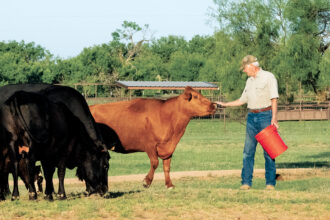
Ag Opportunities Volume 15, Number 3 November - December 2004 ******** Flax Seed in Cattle Leads to More Healthy Compounds in Beef By Forrest Rose MU Extension & Ag Information Flax seed in cattle feed translates to beef that is far higher in two beneficial omega-3 fatty acids, “proving that you can have your steak and eat it, too,” a Univ of MO meat scientist said. Boone County, MO, rancher Don Mayse, who raises “natural” beef – without hormones or chemicals – fed some of his cattle flax seed, then sent beef samples to the MU Meat Science Department for analysis, said Eric Berg, MU associate professor of animal science. “Kansas State Univ is one of the experts in this area of research, so we sent the steak samples to them for fatty acid analysis,” Berg said. Steaks from cattle fed flax seed were compared to steaks from cattle that had not been fed flax. Statistical analysis was conducted to see if flax fed steaks were higher in the three omega-3 fatty acids: alpha linolenic acid (ALA), eicosapetaenoic acid (EPA) and docosahexaenoic acid (DHA). “The fatty acid composition of beef ribeye steaks from cattle fed flax for 70 days had significantly more ALA and EPA than animals not fed flax,” Berg said. “In fact, ALA concentrations were increased by nearly six-fold.” EPA levels were 50 percent higher in the flax-fed cattle, he said, while DHA levels were unaffected. After closely studying the original KSU research conducted by scientist James Drouillard, Mayse “decided to adopt that feeding strategy into my own feedlot.” Mayse, owner of Sho-Me Born Tender Beef, specializes in marketing guaranteed tender cuts. Adding flax seed to the ration will add another dimension to his product, he said. “It’s a perfect fit: Tender beef with the benefit of enhanced omega-3 fatty acids.” Flax seed also makes an excellent supplement to cattle feed because it is “packed with energy protein and fiber” as well as ALA, Berg said. “However, flax is expensive, so the producer should identify buyers willing to pay more for omega-3-enhanced beef.” Omega-3 fatty acids must be consumed in the diet because the body does not create them on its own, he said. “Traditionally, fish has been touted as a good source of essential fatty acids. Now, producers can sell tender beef that has been naturally fortified with heart-healthy fats.” Berg said Mayse’s initiative “is really about real-world application of science. Oftentimes, things that work in a research setting don’t work in the real world.” Source: Eric Berg 573-882-3176; Don Mayse 573-449-4250 ******** MU project increases economic returnon agroforestry through dovehunting By Jason Jenkins, Extension & Ag Information While most MO dove hunters attempt to fill their daily 12-bird limit when afield, a University of Missouri scientist only wants to kill two birds with one new research effort. Josh Millspaugh, MU assistant professor of wildlife conservation, hopes that by attracting mourning doves to agroforestry plantings that include sunflowers, he can provide landowners with an additional income source and enhance hunting opportunities for the state’s 40,000 dove hunters. “Dove hunting is big business in MO, generating more than $5 million annually, and doves are a natural fit for agroforestry,” said Millspaugh, who received a five-year grant from the MU Center for Agroforestry for the project. “As the state’s most abundant migratory game bird, doves offer all landowners an opportunity for lease hunting while waiting for the trees to produce a crop.” He added that the MO Dept of Conservation actively manages more than 85 areas statewide for dove hunting, but that “demand for dove-hunting likely exceeds existing supply in MO.” In spring 2005, Millspaugh and researchers from MDC and the US Forest Service will establish agroforestry plantings at the James A. Reed Memorial Wildlife Area east of Lee’s Summit, MO. Between the rows of nut trees, they’ll seed sunflower plots of various shapes and sizes. “Our goal is to maximize both dove use and the number of hunters a sunflower patch can accommodate,” Millspaugh said. “While we know that sunflowers will concentrate the doves, no one has ever studied exactly how they use these plots.” To quantify dove movement, use of the plots and response to hunting activities, the researchers will surgically implant radio transmitters in doves captured in the study area during the spring, Millspaugh said. “We’ll also capture individuals during the summer and give each a leg band” so that the doves may be identified should they be harvested in the fall. Before the 2005 dove season, which begins in Sept, the sunflowers will be mowed and hunters will be allowed to hunt the study area. MU undergraduate students will staff check stations where they will record the number of hunters, shots fired, birds harvested and leg band information. This data will help the researchers understand more about mourning dove dynamics. “Although we don’t have a program in MO, a state program in KY pays landowners about $2,500 for establishing a 20-acre sunflower patch for dove hunting,” Millspaugh said. “This type of traditional lease, or a system where landowners charge hunters by the gun, would provide many income-generating alternatives, especially as the popularity of dove hunting increases.” The researchers hope the dove-hunting project also provides an additional benefit to the agroforestry planting. “In other agroforestry plantings we have around the state, we’ve encountered winter browsing damage from rabbits that can stunt or even kill the young trees,” Millspaugh said. “Planting sunflowers should choke out natural vegetation that gives the rabbits cover, and once we mow them, the lack of winter cover should discourage browsing.” Source: Josh Millspaugh 573-882-9423 ******** All-Natural Marketing of Feeder Calves Worth Considering By David Burton, MU Civics Communication Specialist Thousands of feeder calves will be sold out of southwest Missouri between now and the end of the year. Eldon Cole, livestock specialist for the Univ of MO Extension, says many of those calves could qualify as all-natural calves and potentially increasing their value as feeders. There are a number of all-natural markets that can be considered according to Cole. “The primary criteria are simple: no growth promoting implants, no antibiotics either fed or injected, no ionophores and no animal by-product feeds,” said Cole. To be considered all-natural, calves must also be identified or source-verified and the owner must be willing to sign paperwork affirming that the cattle are as described. “Individual animals in a group can be treated with antibiotics if necessary, but must be sorted off and sold separately at sale time,” said Cole. According to surveys he has done, Cole says only about 30 percent of the male calves in the area receive implants prior to weaning. They may be placed on a stress fighter feed that contains antibiotics and ionophores if backgrounded. “These practices would restrict their all-natural qualification. But, there are plenty of calves that come right off the cow and hit the sale barns that could meet all the all-natural requirements,” said Cole. All-natural is a growing market and some feedlots see that trend continuing. But, at the same time, there is a price to pay for not using the implants and medications. For example, cow-calf raisers who do not implant, miss out on an extra 20 or 30 pounds of steer calf sale weight. Cattle feeders also report that the cost of gain in the feedlot will be at least $10 per hundred higher on the all-natural pens. At the same time, all-natural feeder calves are commanding a higher price as feeders so the extra cost will be factored into the end product. “If the consumer wants a particular product and the various segments of the beef industry are willing to provide it without sacrificing profitability, compared to the mainstream market, then it bears consideration,” states Cole. Cow-calf growers and backgrounders should check with their markets, feedlots, and even seedstock suppliers to learn more about the specifics of their all-natural interests. “It could be worth the extra paperwork if the feeder calf owner is willing to accept the liability of such a program,” said Cole. For more info on all-natural marketing of feeder calves, or other beef related programs like “Show-Me Select,” contact Univ of MO extension livestock specialists in southwest MO: Gary Naylor, Buffalo 417-345-7551; Eldon Cole, Mt Vernon 417-466-3102; Dona Funk, Stockton 417-276-3313. ******** Solar-powered high tunnel By Forrest Rose Extension & Ag Information When Bryan Boeckmann decided to start cultivating cut flowers, a high tunnel seemed like the natural choice. But he had a problem: He couldn’t always be in Westphalia to make the required adjustments. “I work full time for the fire department in Jefferson City, and the temperature in a high tunnel can change a lot in a 24-hour period,” he said. “I had to have something I could rely on. Fortunately, necessity is where most good ideas come from.” Boeckmann’s good idea was to use solar-powered side curtains that raise and lower automatically to control high-tunnel temperature. His project was funded by a grant from the MO Dept of Ag. High tunnels, also called hoop houses, are Quonset-shaped frames covered by plastic sheeting. They rely on passive solar heat and irrigation and can be built for about one-fifth the cost of conventional greenhouses. But because temperatures in such a structure can easily get too high on a sunny day, the producer must often open the side curtains to allow sufficient ventilation. Jim Quinn, the MU extension researcher who helped with the project, said Boeckmann was inspired by existing technology in poultry barns. “He had seen how poultry curtains work, and he thought, ‘Why couldn’t I do the same thing with a high tunnel and use solar power?’” Quinn said the innovation “is really a nice fit. The times when you need to adjust the curtains are when there’s a lot of sunny weather, and that’s also when the solar power is available.” Boeckmann initially hoped to drive the ventilating panels with conventional electric power, but hooking into the grid was “cost-prohibitive,” he said. He called on MO Valley Renewable Energy (MOVRE), a firm in Hermann, Mo., to design and build a solar unit. Using mostly used parts, MOVRE owner Henry Rentz constructed a small building with two solar panels on the roof and an inverter, batteries and control panel within. “I found some used stuff for Brian because I wanted him to succeed in what he was doing,” said Rentz. “Those batteries alone would have cost $1,600 new. I basically did it to show people something that already works.” The system succeeded beyond their expectations. “In June, when we had that extended period of rain, that system ran for 11 days without sun,” Rentz said. “It’s fairly simple,” Boeckmann said. “Once you’ve initially set it up, typically you don’t have to mess with it. You just have to set the thermostat.” The thermostat in the hoop house senses temperature and, at a set point, triggers a mechanism that very slowly raises or lowers the ventilating curtains. “The reason it moves so slowly is to give the temperature in the building a chance to adjust,” he said. “It takes it 15 minutes to go all the way up. You can do it manually really fast, if a storm is coming.” Boeckmann also uses solar power to drive his irrigation pump--“a little bitty pond pump that doesn’t eat up a lot of juice.” He believes his innovations could boost the already growing interest in high tunnel construction. “There’s good reason for the interest,” he said. “The difference they make is phenomenal, considering it’s just a sheet of plastic stretched over a frame. They just keep improving them.” “I’m pretty new to it, so I’m still learning,” he said. “My situation is like a lot of other people’s: You can’t just jump in full-time. I think for people who are trying to get started, this is a really good system.” For more info, contact Quinn at 573-882-7514 or quinnja@missouri.edu. ******** Specialty Mushroom Workshop Ramada Inn Conference Center, Columbia, MO December 3-4, 2004 Learn the basics of production and/or marketing techniques for specialty gourmet mushrooms including shiitake, oyster, Stropharia and truffles from UMCA research faculty members, professional mushroom growers and marketers. Workshop topics include outdoor log cultivation of shiitake mushrooms; indoor cultivation for winter production of shiitake; and UMCA progress toward truffle cultivation. Exhibitors from the industry will provide information about mushroom production supplies. During the afternoon of Dec 4, attendees will travel to the UM Horticulture and Agroforestry Research Center in New Franklin to participate in a guided tour of the mushroom research and cultivation area and a log preparation demonstration. Cost for the workshop is $59 per person, if received by Nov 1. Workshop fee for registration from Nov 2 through Dec 3rd is $69 per person. An optional Saturday evening MO wine and regional food tasting event at The Wine Cellar and Bistro is offered to the workshop participants for $25 per person. To register, or for more info call Julie Rhoads 573-882-3234, rhoads@missouri.edu. Workshop space is limited to first 100 participants ******** New Roper Survey: Consumers Favor Family Farms For safe and nutritious food, Americans place more trust in small family farms than in large industrial farms, according to a national consumer opinion poll conducted by Roper Public Affairs. A report on the poll is at www.organicvalley.coop Nearly seven in ten Americans (69%) say smaller scale family farms are more likely than large scale industrial farms (22%) to use techniques that won't harm the environment. American consumers want and support family farms. Family farmers can earn premium prices by building new cooperatives to sell those consumers food produced in ways they support. Most consumers find it important to know whether food is grown or produced locally or regionally. Overall, 73% of them find this information important, with 38% saying it is very important. "Small and mid-sized family farmers take great pride in the integrity and quality of the food they produce. We are farming for the next generation and not solely for this year's profits. Highlights of the Organic Valley-Roper Food and Farming Survey include: ** Consumers Will Pay More: Two-thirds of Americans say they would pay more for foods produced without chemicals such as pesticides, antibiotics and hormones. Women (71%) are more likely than men (62%) to say they'd pay more. About half of those surveyed (51%) say they would be willing to pay a premium for foods produced with humane treatment of animals. Four in ten (42%) would not. ** Decline of US Farms is Troubling: The number of farms has been declining for decades, and 330 farmers leave the land every week. The public is troubled by this pattern. Fully 82% say they are at least somewhat concerned with the decline in the number of American farms; nearly half (46%) are very concerned. ** Labels Would Have an Impact: Most Americans (73%) report that having food labels specify whether a product was produced with pesticides, hormones, antibiotics or genetically modified ingredients would have an impact on their product choice ******** *** IN THE NEWS *** Buyers of soy milk can see who grew the soybeans used. Each batch of Organic Valley soy milk is made from one growers’ crop. So consumers can go online to enter the expiration date from the carton to see a photo and info on the farmer and farm responsible for providing the soy milks. (Kiplinger Ag Newsletter, Vol 75 No 21) The state's first MO Dept of Ag/USDA graded goat sale opened in MO this month. The Oregon County Goat and Sheep Market at the Oregon County Buying Station in Koshkonong started the sale to provide new markets for MO producers. Goats will be graded and purchased on the third Thursday of every month. Market information from the buying station will be available from the MO Dept of Ag the day after each sale. Prices will be available in the Weekly Market Summary at www.mda.mo.gov/Market/ pdf/weeklysummary.pdf or on the Market News Hotline at 573-522-9244. The Missouri Energy Center is inviting persons interested in wind energy to become involved in the MO Wind Energy Workgroup. For info go to: www.dnr.stat e.mo.us/energy/renewables/wind-energy.htm. One Pork Chop at a Time: Direct Marketing and Audubon County Family Farms is now available on the FoodMap website www.foodmap.unl.edu/index.asp. This case study, which was prepared for the North Central Initiative for Small Farm Profitability, tells the story of how a group of small Iowa farmers developed and operate a successful direct marketing operation, and the challenges the group has faced in the past and continues to face. The Univ of WI has produced a report that provides background information for farmers who are considering selling their products through retail stores. Is retail the right option for you and your products? How can you prepare yourself and your products for sale? What do buyers need, and what do they like and dislike about locally produced goods? This report can help farmers answer these questions and prepare for retail marketing, or decide if retail marketing is an option they want to pursue. On line at www.cias.wisc.edu/archives/2004/08/11/working_with_retail_buyers/index .php Check with your local USDA-FSA office about cost-share for management activities authorized by the 2002 Farm Bill on existing CRP contracts with grass plantings. Managing your CRP grasses will improve habitat for many grassland birds. Your CRP plan must be modified and you must follow specific dates for management. For cool season grasses: burn March 15 to May 1, light disk Oct 1 to Dec 31, chemically suppress March 15 to May 15 or Oct 1 to Dec 1. For warm season grasses: burn Aug 15 to March 15, light disk Oct 1 to Dec 31, chemically suppress in May and June. If you choose the light disk or chemical management practices, treat no more than 1/3 of each CRP field per year. You can prescribe burn up to 1/3 of your CRP contract acres per year. Cost share is also available for legume and native wildflower interseeding. This practice must be used in conjunction with one of the other practices listed above. Contact your USDA-FSA office well in advance of your planned CRP management activity to allow adequate time to modify your CRP plan. (Winter Covey Headquarters Newsletter) Researchers at Cornell Univ have found beneficial wasps of the variety Trichogramma ostriniae can reduce damage from European corn borers by half. In that study, 6% of the ears were damaged in the fields where wasps were released, while 12% of the ears were damaged in the control fields. Online at www.cips.msu.edu/ncr125/StateRpts2001NY.htm Australian researchers found that adding hydrogen peroxide to irrigation water in heavy clay soils increased yields of zucchini and vegetable soybeans. The hydrogen peroxide increased the oxygen content of the water 5 to 13 times compared to water without hydrogen peroxide. Researchers injected 0.6 pints of 50% hydrogen peroxide per 1,000 square feet in zucchini plots. They also injected at a rate of 0.1% by volume in soybean plots. Both produced yield increases: 29% more zucchini and 82-96% more soybeans. (HortIdeas, July 2004) The Mountain Tailgate Market Association, a group of farmer- and vendor-only markets in western North Carolina, formed in 2002 to promote the local markets, fresh food, and artisan crafts of the area's farmers, artists, bakers, food processors, and other local vendors. The group is now providing its bylaws, rules and regulations online, in order to share its collaborative tools and to promote fresh food and farmer connections. The documents are available as PDF files through the Appalachian Sustainable Agriculture Project Web site. www.asapconnections.org/special/mtma/MTMA.htm The 2002 census of agriculture shows that the numbers of women operating farms and ranches has increased by more than 13 percent since 1997, and that 1/4 of all farms and ranches in the US are now run by women. For more info, www.ag.ncat.edu. The SuperMarketCoop is an organization that can help you market and sell products on-line. They specialize in very small businesses and have a rural service emphasis. www.supermarketcoop.com New cost of production studies for organic broccoli and lettuce grown at the central coast region of CA are now available from the Univ of CA Cooperative Extension. The two studies - Sample Costs to Produce Organic Broccoli and Sample Costs to Produce Organic Leaf Lettuce - are online at http://coststudies.ucdavis.edu. In a long-term study, Iowa State Univ Extension and USDA-ARS researchers found that maize/soybean rotations in transition from conventional to organic management produced similar yields to the conventionally managed controls. In the first three years of transition, they found that soybean yields were not statistically different between conventional and organic, and that organic yellow dent feed corn yields were equivalent in organic and conventional plots. They conclude that the organic crop system is an economically competitive system and should be looked at very positively as an alternative to conventional systems. The results are to be published in the Agronomy Journal. An abstract is at http://agron.scijournals.org/cgi/content/abstract/96/5/1288. Organic culinary oil and essential fatty acid (EFA) dietary supplement manufacturer, Spectrum Organic Products Inc. opened on Oct 12 what the company believes is the world's largest production facility dedicated to organic, plant-based EFA oils, in partnership with BIOWA Nutraceuticals. The new $4 million, 10,000-square-foot plant near Cherokee, IA will be a major boost to flaxseed farming and processing. Flaxseed was formerly a top crop in Iowa five generations ago. Today, a handful of farmers are growing flax again due to successful organic agricultural research trials conducted at Iowa State Univ last spring. Beekeepers will get a new weapon against parasitic varroa mites: A fungus that bees can spread quickly within their hive, killing the mites in days. USDA developed the biological control agent, known as the Metarhizium anisopliae fungus and is now adapting it for commercial applications with the help of a private manufacturer. The new mite-fighting fungus should be on the market in a few years. (Kiplinger Agriculture Letter, Vol 75 No 23) ******** *** In Print *** *Grow Native!/MDA* a joint program of the MO Dept of Ag and the MO Dept of Conservation, is pleased to announce the launching of its eNewsletter for the public, "Native Notes for Home and Farm." Each quarter, Grow Native! will bring timely information and fresh ideas about native plants and landscaping, call your attention to interesting events and highlight native projects of note around MO. Sign up for free subscription at www.grownative.org *Eat Here: Reclaiming Homegrown Pleasures in a Global Supermarket* The simple shift in eating habits not only delivers superior taste, but is better for peoples health, the livelihoods of small farmers, and the global environment. It even makes the nations food supply safer by reducing the risk from accidental or intentional contamination. Eating local is the next frontier in the American diet. People everywhere are taking control of their food supply to protect themselves from mad cow disease, heavy pesticide use, agro-terrorism, and urban sprawl. They want to know who grows their food and where it comes from. www.marketgardeningchat.com/topic.asp?TOPIC_ID=103 *Building Added Value Through Farm Diversification* Many business are exploring the diversification into new enterprises or the addition of value to existing enterprises to create value to both the consumer and the farm business. Selling agricultural products as a commodity leaves value in the food chain that may be captured by the innovative producer. The opportunities available to farm businesses is only limited by ones thinking. Call 1-888-232-3262, $29. ******** *** ON THE CALENDAR *** *Dec 2 - Prescribed Burn Workshop, SW MO Research Center, Mt Vernon, MO.  Call 417-629-3423. *Dec 4 - Prescribed Burn Workshop, Carthage, MO.  Call 417-629-3423. *Dec 7 - Managing Production and Marketing Risks, Mt. Vernon, MO. Call 573-8824-3794. *Dec 7 - Prescribed Burn Workshop, Lamar, MO. Call 417-629-3423. *Dec 3-4 - MO Livestock Symposium, Kirksville, MO. Call 660-665-9866. *Dec 3-4 - Shiitake Mushroom and Truffle Production and Marketing Workshop, Columbia, MO. Call 573-882-3234, www.centerforagroforestry.org *Dec 12-15 - MO Governor’s Conference on Agriculture. Call 877-398-3305. *Dec 16 - American Black Walnut Marketing Meeting, Stockton, MO. Call 816-679-5583. *Jan 8 - High Tunnel Conference, St Joseph, MO. Call 816-279-1691. *Jan 9-10 - Great Plains Vegetable Growers Conference, St Joseph, MO. Call 816-279-1691. *Jan 15 - MO Christmas Tree Assn Winter Meeting, Jefferson City, MO. Call 573-243-5501. *Jan 20 - Mid-America Fruit Growers Marketing Tour, Excelsior Springs, MO. Call 785-242-5511. *Jan 21-22 - Mid-America Fruit Growers Conference, Excelsior Springs, MO. Call 785-242-5511. *Feb 1-2 - MO Forest Products Assn Winter Meeting, Jefferson City, MO. Call 573-634-3252. *Feb 4-7 - Advanced Organic Vegetable Production for Small and Large Scale Producers, East Troy, WI. Call 262-642-3303, mfai@MichaelFieldsAgInst.org *Feb 5-6 - MO Young Farmers/Young Farm Wives State Convention, Osage Beach, MO. *Feb 5-7 - Mid America Wine and Grape Conference, Tan-Tar-A. Call 800-392-WINE. *Feb 7-8 - North American Farmers’ Direct Marketing Conference, Boston, MA. Call 413-529-0386, www.familyfarms.com/Boston/ *Feb 7-9 - MO Aquaculture Assn Annual Meeting and Conference, Blue Springs, MO. Call 573-521-6666. *Feb 16-17 - Grow Native! Connecting the Heartland Conference, Kingsville and Blue Springs, MO. Call 573-782-4059. *Feb 23 - Human Risk management, Realities and Resources: The Latino Labor Force in Missouri Agriculture, Springfield, MO. Call 573-884-3794. *Feb 23-25 - 2005 Small Farm Programs Conference, Sikeston, MO. Call 573-688-2473 or 573-471-3475. *Feb 24-26 - Upper Midwest Organic Farming Conference, La Crosse, WI. Call 715-772-3153, faye@mosesorganic.org *Feb 25-26 - MO Tree Farm Conference, Columbia, MO. Call 573-882-4444. **********Green Hills Farm Project 2004 Farm Walk Schedule*************   *Nov 18th - 4pm at Forage System Research Center **********Growing Growers Workshops************ *Kansas State Univ and the Univ of MO have launched a project to expand local produce production in the KC region. If you grow or market within 100 miles of KC and are interested, call Katherine 913-488-1270, growers@ksu.edu *Nov - Mechanization for Veg Production *Dec - Selling your Locally-Produced Food Products in Kansas City *March 3 - MO Assn of Meat Processors Pre-Convention Workshop on Marketing, Columbia, MO. Call 1-660-827-0005. *March 4-6 - MO Assn of Meat Processors Convention and Trade Show, Columbia, MO. Call 1-660-827-0005. *April 1-3 - MOPACA Invitational Alpaca Show, Lake St. Louis, MO. Call 913/884-5831. *June 3-5 - MO Forest Products Assn Summer Meeting, Lake Ozark, MO. Call 573-634-3252. *June 22-23 - Grow Native! Native Landscaping Conference, St. Louis, MO. Call 573-782-4059. *Aug 11-21 - MO State Fair, Sedalia, MO *Sept 23-24 - Midwest Forest Industry Show, St. Louis, MO. Call ????