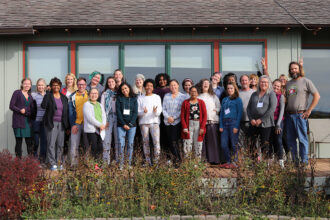
Ag Opportunities Volume 14, Number 5 March - April 2004 ******** Solar Heated Greenhouse By Forrest Rose MU Ag News and Information Solar-heated greenhouse at Southwest Center keeps crops coming throughout the winter. Picture Caption: An open house at the MU Southwest Center's solar greenhouse drew a capacity crowd on January 18th. On a cold and blustery January day, nearly 200 people visited a wood and plastic structure at MU Southwest Center near Mt. Vernon, Mo. The temperature outside was 22 degrees F., but inside the solar-heated greenhouse the thermometer registered a balmy 62. The chilled participants at the open house weren't the only happy creatures. Also thriving in the greenhouse were rows of "just about any cool-season crop that you can think of," said Anastasia Becker, extension research associate. "It's a cool-season greenhouse. Tomatoes wouldn't be happy in here, but peas, broccoli, cauliflower, kale and cabbage are ecstatic." Becker and Southwest researcher Andrew Thomas kept the fresh green stuff coming throughout the winter, thanks to the sun's rays and an ingenious design. Twenty 55-gallon black plastic barrels filled with water are stacked along the inside of the north wall, where they receive the full blast of the sun. They heat up during the day and release the heat through the 12-by-24-foot greenhouse at night. The east, west and south walls are insulated with double layers of durable plastic. Although it got as cold as minus 5 this winter, "it was a relatively toasty 33 degrees in the greenhouse," Becker said. 'You could supply a family of four' "It’s the water that drives the system," she added. "It holds the thermal energy. Some folks who use this system even grow water plants in the top row of barrels and offer them for sale." Thomas and Becker believe their research will prove the economic viability of a well-designed solar greenhouse for home gardeners as well as commercial growers. "There's 123 square feet of growing space in there, and it's very productive," said Thomas, "We didn't even use any lights. You could probably double the yields just by using lights. You could supply a family of four with vegetables for most of the winter." For now, he said, "we're doing it very, very low tech. But if for example I had a contract with a restaurant to provide lettuce three times a week, I'd do it very differently than I would for my own little family garden. You can ramp it up if that's your goal." Picture Caption: The greenhouse was originally built in 1988 using recycled materials. It was renovated in 1999 with the addition of aluminum siding and a redesigned ventilation system. ‘We can really break the pest cycle’ The two grow their crops directly in the soil, not in pots as is done in most conventional greenhouses. "It lets you grow deeper-crops like carrots," Becker said. Drip irrigation lines keep the plants well watered. Becker said the greenhouse "is really well suited for organic production, and since we don’t grow anything in here during the summer because it's too hot, we can really break the pest cycle. We don't get the buildup of pest problems. "Another advantage is, you can grow things where the deer and rabbits can’t get at them." The greenhouse was originally built in 1988 by retired horticulturist Dan Wooley. "He used a lot of recycled materials," Thomas said. "He used telephone poles for the foundation, old barrels he got for free, tin off an old barn. It was put together the way that anybody could do it." For the 1999 renovation, "we felt we needed higher quality lumber," he said. "We put aluminum siding on it and redesigned the ventilation system. But it still wasn't very expensive." Twenty 55-gallon black plastic barrels filled with water are stacked along the inside of the north wall. They heat up during the day and release the heat through the 12-by-24-foot greenhouse at night. Becker admits she takes a personal interest in her professional project. "We gardeners have got to have our fix," she said. "There's a sense of empowerment that comes with being able to go out and pick vegetables in the middle of winter." Thomas agreed: "In the greenhouse, it's very tropical on a cold winter day: humid and moist and warm -- very pleasant." ******** Small Farm Network The North Central Region Small Farm Task Force, along with an NCR SARE grant, developed the Sustainable Small Farm Information Network (SSFIN). The SSFIN was created to meet the needs of present and future small-scale agriculture in the North Central Region by providing quick and easy access on a wide range of sustainable agriculture information related to small farms. Small farm families clearly need this information so they can explore alternatives to traditional enterprises and ways to fit new alternatives into sustainable whole-farm systems. With the wealth of information and the multitude of its various forms, the task force categorized the information by a search through categories and then subcategories. Categories include: animal production Community development (home-based business) Crop production Economics and marketing Education and training (research methods) Natural resources and the environment Pest management Quality of life (including food systems) Soil management Information can also be searched by information origin (university, USDA, or other source) and by the different media types (articles, audio tapes, bibliographies, books, CDs, education programs, guide sheets and fact sheets, websites, magazines and journals, newsletters, people contacts, conference proceedings, slides and videos). This is an ongoing resource as new information will be updated on a regular basis. For more information, visit http://ssfin.missouri.edu. ******** State of the States: Organic Farming Systems Research at Land Grant Institutions, 2nd Edition The State of the States II inventories information through 2003 and shows dramatic changes in the organic research scene since 2001; the total number of organic research acres in the US land grant system has more than doubled between 2001 and 2003, while the number of certified organic research acres has trebled. Still, organic research acreage still lags far behind the proportion of US farmland that is certified organic. The study found that, overall, organic research occupies only 1,160 acres (0.13%) of the 885,862 available research acres in the land grant system. A recent USDA report documents that overall, 0.3% of all US farmland is certified organic. In high-value crops such as vegetables, a full 2% of US acreage is certified organic. The survey found that certified organic research acreage is only 496 acres (0.06%) of the total available research acreage. This represents a trebling of the 154 certified organic research acres that were report in 2001, a growth trend that expects will continue. The five states having the strongest organic research programs in 2001 -- Iowa, Ohio, Minnesota, North Carolina and West Virginia -- are joined by new programs in Washington and New York. South Carolina, Maryland, Florida and New Hampshire have emerging organic research programs and are bringing research land through the transition to certified status. Michigan and California both have relatively high numbers of organic research projects being conducted, but lack a centrally coordinated organic research program. Land grants in Wisconsin, Oregon and Pennsylvania have notable few resources for the large numbers of organic farmers in these states. For the full survey report go to www.ofrf.org. ******** Solar Power Grants Available The MO Dept of Natural Resources Environmental Assistance Office (EAO) has received a federal grant to help farmers and ranchers develop rotational grazing systems using solar-powered water pumps. The project’s goal is to improve water quality and protect the environment by fencing cattle out of water sources like ponds and streams. DNR received 30 grant applications in 2003, but can accept 15 more. EAO will help fund solar panels, pumps, tanks, platforms, some piping and valves for a limited number of farmers. The grant recipients will provide water sources and animal grazing paddocks. Data from each individual farm project will be collected for the length of the project. For more information and an application, contact Glenn Lloyd, EAO or Roger Korenberg, Energy Center, 800-361-4827. ******** Missouri Sustainable Ag. Grants Awarded for 2004 Whether it's using mushrooms to turn forest waste into compost for vegetable production or finding markets for goat milk and cheese, innovation is the driving force behind the state's Sustainable Agriculture Demonstration Award Program. The program, which this month issued its 2004 grants to 16 MO producers, enables producers to try farming practices that are profitable, environmentally friendly and benefit farm families and rural communities, said Peter Hofherr, director of the MO Dept of Ag. The department's Market Information and Outreach Division administers the grant program, with support from the Community Food Systems and Sustainable Ag Program of the Univ of MO and Lincoln Univ. Under the program, farmers throughout the state can receive up to $3,000 to try innovative projects that protect and conserve the state's natural resources and reduce dependence on non-renewable resources, such as minerals and petroleum. Projects typically help farmers cut back or eliminate their use of pesticides, chemical fertilizers, and fuel. Since the MO legislature established the program in 1995, more than $700,000 has been awarded to 230 producers. "These grants help drive the creative engine that enables MO farmers to be more productive and use fewer non-renewable inputs, such as electricity and fuel," Hofherr said. Even though state budget cuts have caused the department to limit the aid it provides to producers, new partnerships with the Thomas Jefferson Agricultural Institute and the Univ of MO Center for Agroforestry are helping maintain the program, Hofherr said. This year, the department sponsored 11 general sustainable agriculture grants. The agroforestry center funded three grants for projects that integrate trees and shrubs into agriculture systems. The Jefferson Institute awarded two grants that focus on alternative crops such as amaranth, buckwheat, pearl millet and sunflowers. The following producers received general demonstration award grants: Cindy Becker, Montreal, to incorporate a rainwater collection and gravity-fed watering system into a wildflower and herb production system; Bryan Boeckmann, Westphalia, to use solar power for temperature control and watering systems in high tunnels; Jim and Linda Comley, Buffalo, to improve self-sufficiency and sustainability, as well as the soil, by reducing chemical fertilizer and pesticide use; Tom Craft, Butler, to evaluate poultry litter as a fertility source and a tool to increase diversity in both cool and warm season grasses in a managed grazing system. Grant F. C. Gillard, Jackson, to produce naturalized queen honeybees from mite-resistant stock; Renae and Steve Farnsworth, Downing, to test market locally produced goat milk and milk products, primarily cheese; Tim Hite, Ozark, to turn forest and yard waste into compost for vegetable production using edible mushrooms; Gary Ogg, Richmond, to use strip cropping, poultry litter and over seeding of ryegrass to increase farm productivity and sustainability; Jason Pobst, Sikeston, to evaluate commercial crawfish production in re-established wetlands; Lyn Simuns, Collins, to evaluate market opportunities for domestic fiber products, including wool, mohair and alpaca; and Paul Smith, Lebanon, to establish a shrimp hatchery and raise shrimp for direct sale to consumers. Those producers receiving agroforestry grants are: R. Scott Brundage, Columbia, to develop a deer-proof fence for agroforestry; Tom Fuhrman, Moberly, to improve farm productivity by raising heritage-breed turkeys and poultry in the alleyways between pecan trees; and Robert Karr, Monett, to develop a low-maintenance wind break to protect livestock. Two producers received grants from the Jefferson Institute. They are: Mary Ann Kohl, Louisiana, to create natural fences as buffer zones for an organic farming system; and Bryan Van Holten, Cole Camp, to use cover crops and diverse crop rotation to control erosion. The projects must be completed in three years. The program also requires participants to share their findings with other producers through on-farm demonstrations, published reports, field days, poster sessions and other means. More information on the sustainable agriculture program can be found on the Internet at http://agebb.missouri.edu/sustain/ or by contacting the MO Dept of Ag, Market Information and Outreach Division, Sustainable Ag Program, PO Box 630, Jefferson City, MO 65102-0630, 573-522-8616, Joan.Benjamin@mda.mo.gov. ******** *** In Print *** *A Different Field: Innovative Entrepreneurs in Illinois Farming* www.aces.uiuc.edu/~asap/ or Agroecology/Sustainable Ag Program, University of Illinois, 217-968-5512, asap@aces.uiuc.edu. *Fresh Grown Promotions* Available from Eckert AgriMarketing, 8054 Teasdale Ave, St Louis, MO 63130, 314-862-6288, www.eckertagrimarketing.com, $19.95. *The Native Warm Season Grass Newsletter* Free for MO residents. Contact Steve Clubine, MO Dept of Conservation, PO Box 368, Clinton, MO 64735 or steve.clubine@mdc.mo.gov *MO Timber Price Trends* Available from the MO Dept of Conservation, Forestry Division, PO Box 180, Jefferson City, MO 65109, holly.foster@mdc.mo.gov or 573-522-4115 x 3308 Agroforestry projects funded by USDA-SARE are featured in Summer/Fall 2003 issue of Inside Agroforestry, www.unl.edu/nac, for print copy, contact USDA's National Center for Agroforestry, 402-437-5178. *Assessing Chestnut Market Opportunities* available from the Univ of Nebraska’s Food Processing Center and can be accessed on line at the FoodMAP website, www.foodmap.unl.edu/index.asp. This report summarizes US and world chestnut production and assesses current markets and distribution channels for chestnuts. It also reports on the test marketing of three value-added chestnut products to the food service industry. *Growing Plants for Hawaiian Leis* Covers 85 plants including some (especially annuals) that are commonly grown in temperate areas. Color photographs show each of the plants as used in a lei. (Potential idea for cut flower growers to create leis for local market?) College of Tropical Agriculture and Human Resources, Univ of Hawaii at Manoa, 3050 Maile Way, Gilmore Hall 119, Honolulu, HI 96822, 808-956-7036, $20 + s/h. *Greenhouse Raspberry Production Guide* Dept of Horticulture, Max Welcome, 134a Plant Science Bldg, Cornell University, Ithaca NY 14853-5904, $9.00 or www.fruit.cornell.edu/Berries/ghrasp.html *Pumpkin Production Guide* ($43)Topics include variety selection, cultural practices, maximizing yields, weed, insect and disease control, maintaining post-harvest quality an marketing. And *Growing and Selling Fresh-Cut Herbs* ($38.95). GFM, PO Box 3747, Lawrence KS 66046, 800-307-8949, www.growingformarket.com, $43. *High Tunnel Production Manual* Penn State University, Dept of Horticulture, 206 Tyson Bldg, University Park, PA 16802, www.plasticulture.org, $25. Crop Planning and Record Keeping Spreadsheets for Diversified Vegetable Farms. An excellent, easy to use template for record keeping and crop planning on a diversified farm. Especially useful for CSA farms. Available from Brookfield Farm. Call 413-253-7991, info@brookfieldfarm.org. Or order through www.brookfieldfarm.org -- click on Crop Planning Spreadsheets. *Organic Agriculture Symposium CD* Information presented at the Organic Agriculture Symposium held November 4-5 at the ASA-CSSA-SSSA annual meetings in Denver, CO. available in CD format. The CD is free of charge, call the MISA office at 612-625-8235 or kseager@umn.edu. *CSA Across the Nation, Findings of the 1999 CSA Survey* www.wisc.edu/cias/pubs/csaacross.pdf a PDF file called, a collaborative effort that provides the first comprehensive portrait of the CSA movement. *14 Tips to Increase Restaurant Sales* and *20 Tips to Improve Sales at Farmer’s Markets and Roadside Stands* are available at no charge. Contact Future Harvest, 410-604-2681 or email fhcasa@verizon.net *Enhanced Nutrient Content of Grass-Fed Beef: Justification for Health Label Claim* 11-pg review paper from CA State Univ-Chico and Univ of CA Cooperative Extension researchers, available from Grassfed beef educational website, http://www.csuchico.edu/agr/grsfdbef or call 530-822-7515, ganader@ucdavis.edu. *Organic Agricultural Products: Marketing and Trade Resources* bibliography and resource guide, http://www.nal.usda.gov/afsic/AFSIC_pubs/OAP/srb0301.htm also free on compact disc from M. Gold, Alternative Farming Systems Information Center, National Agricultural Library, 301-504-6559. *Comprehensive listing of funding opportunities* from National Sustainable Agriculture Information Service, is online at http://attra.ncat.org/management/financl.html *Greenhouse Cost Accounting Program* A software program that is useful in analyzing various strategies to improve the overall profitability of greenhouse businesses. It is useful for greenhouse managers and business owner who already have a grasp on financial management and maintain good records. To order call brumfield@aesop.rutgers.edu or 732-932-9171 x 253, *Crop Planning and Record Keeping Spreadsheets for Diversified Vegetable Farms* An excellent, easy to use template for record keeping and crop planning on a diversified farm. Especially useful for CSA farms. For either Mac or PC platforms. From Brookfield Farm, 413-253-7991 or bfcsa@aol.com. *Market Farm Forms: Spreadsheet Templates for Planning and Organizing Information on Diversified Farms* For either Mac or PC platforms. $45 plus $5 shipping. Full Circle Farm, 3377 Early Times Lane, Auburn, CA 95603, 530-885-9201. Missouri Farm Accounting Resources--http://agebb.missouri.edu/mgt/mofar/index.htm *Poultry Health Handbook 4th Edition* by Dr L. Dwight Schwartz, DVM. 246-page book includes several diseases not covered in earlier editions. Available from Penn State Univ, 814-865-6713 or pubs.cas.pus.edu/Catalog.html, $20 + $5 for S&H. *Remedies for Health Problems of the Organic Laying Flock: A Compendium and Workbook of Management, Nutrition, Herbal and Homeopathic Remedies* NE SARE grant that surveyed organic poultry producers and consultation of a vet on preventative measures, management treatments, physical treatments, nutritional treatments, herbal treatments, and homeopathic treatments have been used for 42 illnesses and conditions found in poultry. $5. Call 607-657-2860, karma@kingbirdfarm.com, on online at www.kingbirdfarm.com *Pasture Perfect* by Jo Robinson gives a clear understanding of the many benefits of raising animals on pasture. Available from www.eatwild.org or Eatwild, 29428 129th Ave SW, Vashon, WA 98070. *Cover crops on the Intensive market Farm* and *Fresh Market Vegetable Resource CD* from Center for Integrated Agricultural Systems at the Univ of WI-Madison. Call 608-262-5200, phaza@wisc.edu, http://www.wisc.edu/cias/ ******** *** IN THE NEWS *** The Growing New Farmers (GNF) project was developed for northeastern states, but it provides answers and support for new farmers anywhere, www.northeastnewfarmer.org. Agriculture of the Middle project on strategies for regenerating mid-scale US farms and food-related enterprises, including draft 'white paper' for public comment, http://www.agofthemiddle.org or contact Steve Stevenson, Center for Integrated Agricultural Systems, Univ of WI, gwsteven@wisc.edu; 608-262-5202. Need help sorting through federal labor laws? The Labor Dept has a simple guide for employers, including a separate index for agricultural employers. The Employment Law Guide is online at www.dol.gov/asp/programs/guide.htm. It covers legal requirements for things such as overtime, wages, protections for seasonal workers, H-2A visas for migrant workers and occupational safety and health rules. Organic food sales are gathering steam, headed for $30 billion in annual sales by 2007. In part, that's propelled by new regs USDA put in place 15 months ago that set standards for organic foods. So far, the department has accredited 54 state and private entities plus 35 foreign agents to certify that organic products meet standards. Organic meat demand will grow especially fast, nearing $4 billion by 2007. That's up from about $650 million in 2003, the first full year USDA allowed an "organic" label on meats. Before then, some producers with organic or near-organic practices simply labeled products "natural." Organic farmers will soon be exempted from some check off charges. As ordered by Congress, USDA is rewriting check off rules on 28 fruits, nuts and vegetables to ensure that producers with 100% organic output no longer pay for advertising and promotion of conventional crops. But USDA plans to keep in place a portion of the check off assessments (a third or so) to fund research that also benefits organic crops. Comments on proposed regs were due by Feb. 2. They'll become final in a few months, and USDA will push similar rules for other check offs. The National Agricultural Library has recently upgraded its AGRICOLA catalog, which is a searchable on line database of the materials in the library's collection. The database, which is the world's largest compilation of agricultural information, includes materials in all formats, and covers all aspects of agriculture and related disciplines, including animal and veterinary sciences, entomology, plant sciences, forestry, aquaculture and fisheries, farming and farming systems, agricultural economics, extension and education, food and human nutrition, and earth and environmental sciences. While the materials themselves are not contained in the database, thousands of records are linked to full-text documents available on line. AGRICOLA catalog at http://agricola.nal.usda.gov/ Enterprises like pastured poultry can add to farm income with careful financial planning. The Center for Integrated Agricultural Systems (CIAS) has developed a spreadsheet to help farmers make financial and management decisions about new or existing poultry enterprises. While the budget was developed for a CIAS pastured poultry project, it is applicable to most kinds and sizes of poultry enterprises. This budget was developed using Microsoft Excel 2000, and is accompanied by a “Suggestions for Use” file, both of which are aimed at farmers with a basic background in farm management. Access the budget on line at http://www.wisc.edu/cias/pubs/poultbud.html www.smallfarmsuccess.com.info is a website created by the Small Farm Success Project. The site contains profiles of successful farmers, marketing tip sheets and more. You can list your farm on this site. http://organicaginfo.org is an on-line database of research reports, farmer-to-farmer information, outreach publications and more. The database can be searched by keywords, region, crop or livestock type. All information on this website is available free of charge. Organizations interested in federal grants can now visit one web site to find application materials and other related information. The Health and Human Services Dept announced the completion of Grants.gov, a site providing "one-stop" grants shopping. The site includes information about more than 800 grant opportunities at 26 agencies, according to HHS. The site includes a feature for subscribing to receive grant announcements. http://www.grants.gov ******* *** ON THE CALENDAR *** March 2--AgriTourism/Niche Market Conference, St. Joseph, MO. March 3--Sunflower Informational Meeting, Jackson, MO. Call 573-449-3518 or info@jeffersoninstitute.org March 3--Sunflower Informational Meeting, Dexter, MO. info@jeffersoninstitute.org or Call 573-449-3518 March 3--Sunflower Informational Meeting, Charleston, MO. info@jeffersoninstitute.org or Call 573-449-3518 March 4--Mid Missouri Grazing Council Conference, Jefferson City, MO. Call 573-893-5188. March 5--Customer Service Training Workshop for Agritourism Businesses, Concordia, MO. Call 573-751-4339. March 5--MO Assn of Meat Processors Convention, Tan-Tar-A. Call 660-827-0005. March 6--Soil Building for Vegetable & Fruit Crops Workshop, Leavenworth, KS. Call 913-488-1270. March 9--Landowner Burn Workshop, Moberly, MO. Call 660-385-2616 x 3. March 12--Customer Service Training Workshop for Agritourism Businesses, Hermann, MO. Call 573-751-4339. March 13--Landowner Burn Workshop, Moberly, MO. Call 660-385-2616 x 3 March 13 --MU College of Veterinary Medicine Equine Health Day, Columbia, MO. Call 573-882-7848. March 14-20--National Agriculture Week March 19--Small Game Workshop, Union, MO. Call 636-583-2303 x 3. March 22--Goat Production Workshop, Doniphan, MO. Call 573-996-2921. March 23--Options for Small Acreage, Crane, MO. Call 417-357-6812. March 25--Kansas City Food Circle Farmers Exhibition, Kansas City, MO. Call 913-334-0556. March 27--Small Game Workshop, Macon, MO. Call 660-385-2626 x 3. March 27--Options for Small Acreage, Lebanon, MO. Call 417-532-7126. March 27--Tri-State Forest Stewardship Conference, Keokuk IA. Call 573-882-3234. March 27--Realities & Opportunities: Beginning Farmer and Rancher Conference, Kearney, NE. Call Heidi Busse 507-523-3366 or Joy Johnson 402-846-5428. (focusing on minimizing risk in starting new farm or ranch, sponsored by Center for Rural Affairs, Land Stewardship Project, Univ of NE, and USDA's Risk Management Agency) April 3--Spring Horticulture Seminars, Mountain Grove, MO. Call 417-926-4105. April 3--From Food to Recipe Seminar, Lincoln, NE. Call 402-472-8930, http://fpc.unl.edu April 3--Goat Day -Carver Farm, Jefferson City, MO. Call 660-852-3222. April 12--Plant Production for the Vegetable Grower Workshop, Osceola, MO. Call 913-488-1270. May 14--Missouri-Illinois Peach Tour, Edwardsville, IL. Call 618-692-9434. June 1--From Food to Recipe Seminar, Lincoln, NE. Call 402-472-8930, http://fpc.unl.edu June--3rd Annual Rabbit University, St Louis, MO. Call 800-227-8941. June 9-10--Dairy Specialization, Decorah, IA. Call 563-382-2949. July 17--MO Christmas Tree Assn Summer Meeting, Jackson, MO. July 30--Ozark Empire Fair, Springfield, MO. Aug 18--From Food to Recipe Seminar, Lincoln, NE. Call 402-472-8930, http://fpc.unl.edu Aug 12-22--Missouri State Fair Oct 18--From Food to Recipe Seminar, Lincoln, NE. Call 402-472-8930, http://fpc.unl.edu Nov 4-5--National Small Farm Trade Show & Conference, Columbia, MO. Call 800-633-2535. Green Hills Farm Project 2004 Farm Walk Schedule March 18th--4pm at John & Jackie Woods, Smithville, MO 816-532-3795--Should be doing a lot of kidding around then. We have rotational grazing, stockers, and meat goats and can discuss brush control project on KC property. April 15th--5pm at Eric & Hope Bright, Bucklin, MO 660-695-3567--Dairy, Orchard, Greenhouse, Farmers Market sellers of flowers, vegetables & fruits. Pastured pigs, lambs & layer chickens. May 20th--5pm at Joe & Sarah DeVorss, Spickard, MO 660-485-6430--We have everything and the kitchen sink.....Cows, pastured chickens, ducks, sheep, rabbits, blueberries, small allotment of tobacco. Lawn chair. June19th--1pm at Jordan & Anne Bentley, Bucklin, MO 660-695-3482--Pastured meat chickens, turkeys, lambs, and pigs. Will demonstrate our pasture poultry operation from brooders to pasture to processing. Construction of a poultry hoop house will be demonstrated. See our truck bed liner brooders! The processing trailer will show the upgrades given by MDA’s Sustainable Ag Demonstration Award Grant. Bring a camera to take home an idea! July 15th--5pm at Martin & Bev Turner, Elmer, MO 660-486-3388--We will tell our red cow (South Poll) story and look at yearling bulls for sale. Our breeding and selection program is focused squarely on the maternal virtues--fertility, calving ease, mothering ability, disposition and longevity. These traits are absolutely essential to consistently achieve a high weaning percentage, and weaning percentage is the only measure of herd performance that is consistently related to profitability. The physical attributes that are consistent with these maternal traits are moderate frame size, moderate milking ability, large rumen capacity, easy fleshing ability, high heat tolerance, sound udders and sound feet. These are also the attributes that are necessary to thrive on forage alone without expensive supplemental feed. Our goal is to raise cows that meet these standards and bulls that sire daughters that meet them. Aug 19th--5pm at Tom & Paula Parker, Richmond, MO, 816-470-3276. Sept 16th--5pm at Allen & Tauna Powell, Laclede, MO 660-963-2685--Speaker: Jessica Powell closing her MDA SADA Grant project. Sheep & Cattle. Lawn chairs. Oct 21st--4pm at Matt & Tina Reichert, Brunswick, MO 660-548-3283--"We are in the process of converting our traditional cow/calf operation over to a MIG system here on our Centennial Farm. Matt is the fourth generation of Reicherts to farm this land. The children are working on brush and weed management with their Boer African Meat Goat herd. We have recently launched a web site for our Bed & Breakfast to expand our operation into agri-tourism. Lawn Chairs. Nov 18th--4pm at Forage System Research Center (tentatively) Growing Growers Workshops Kansas State University and the University of MO have launched a project to expand local produce production in the Kansas City region. Most of the fruits and vegetables bought by consumers in this area are imported. Extension training session have been scheduled. If you grow or market within 100 miles of KC and are interested in attending any of the workshops call Katherine or Ted at 913-488-1270, growers@ksu.edu March 6--Soil Building for Vegetables and Fruit Crops, Leavenworth, KS. April 12--Plant Production for the Vegetable Grower, Osceola, MO. May--Integrating Meat & Dairy into your Vegetable Operation June--Small Farm Health & Safety Practices July--Slow Down and Taste Your Food Aug--Pests and Diseases and Weeds Sept--Post-Harvest Handling Practices Oct--Business Planning for Small Farms Nov--Mechanization for Vegetable Production Dec--Selling your Locally-Produced Food Products in Kansas City