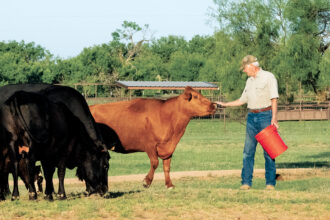
Missouri Alternatives Center's Bimonthly Electronic Newsletter 800-433-3704 "AG OPPORTUNITIES" May-June 2000 (Vol 10 No 6) * Small Farms * New Family Farms * Agricultural Alternatives How to Conduct Research on Your Farm or Ranch (reprinted with permission from USDA's Sustainable Agriculture Network) (This is the third in a four set series. The last one in the series will be: July/Aug - Other Types of Research and Resources) On-Farm Research With Livestock On-farm research with livestock poses separate challenges from conducting research with cropping systems. While sometimes difficult, livestock research can yield substantial rewards if properly carried out. "I can lay out plots for crop trials: zip, zip, zip, but livestock work is certainly challenging." says Dick Thompson, a diversified farmer from Boone, Iowa, who has conducted on-farm research for 30 years. "I have learned a lot about my livestock (beef cattle and swine) and my farm, by doing the research." Tom Frantzen, a diversified, transitional organic farmer near New Hampton, Iowa, uses on-farm research to evaluate new methods to produce pork and beef organically. "If you believe in it, if you have the commitment and if you have the facilities, on-farm livestock research will work for you," he says, "With electric fence and temporary water lines, it is much easier to set up pasture trials." On-farm livestock research comprises several types Animal-to-animal comparisons These studies work well when the treatment can be administered individually. For example, an injection or an implant is given to some animals, but not to others. Scientists say that the animal is the "experimental unit." Animal-to-animal comparisons are the simplest and easiest studies to conduct. All of the animals can be managed in the same pen or group. The trial has more replications because every animal is a replication. For example, if you want to evaluate implants in beef steers, you would give one-third of the steers Implant A, one-third Implant B and no implant to the remaining third. The last group would be your "control" group. Just as in crop research, be sure to apply the treatments randomly. In this scenario, you manage all steers together in one pen. Each steer would be weighed at implanting, a few times on a regular schedule, and then at the end of the trial 60 days later. This trial would enable you to compare, 1) implant A to implant B, and 2) implants to no implants. The cost of the implant could be compared to the improvement in gain. Pen-to-pen comparisons Many times, animals cannot be treated individually, such as a trial when all the animals are fed from one feeder. In this case, you would designate the pen of animals the "experimental unit." You need to use several pens of animals at once or in succession to conduct a trial and to achieve more replication. Your facilities or the number of animals available may be a limiting factor for pen-to-pen studies. However, when animals are penned individually -- such as in a farrowing house or a dairy tie stall barn -- trials are simple to set up because you can work with many pens. Livestock are important on Thompson's farm because they complete the nutrient cycle by consuming the grain and forage and returning manure to the land to improve soil tilth and crops. To learn what level of oats worked best in his nursery pig diets, Thompson conducted several feeding trials. Using a pen-to-pen comparison, he divided a group of pigs randomly between the pens. He fed one pen a diet with oats and the other pen a diet without oats. He compared pig weight gain, feed efficiency, sickness incidence and death loss. He repeated the trial several times until he decided that using a 10-percent oat diet was about right for his operation. The experiment compared complete pens, with all pigs in each pen receiving the same diet. "Weaning is a stressful time," Thompson says. "The oats really help combat that stress." Seasonal comparisons Seasons affect animal performance. Some trials are set up to examine the seasonal effect of a certain treatment. These trials are often repeated over several years. Each year of such long-term studies becomes a replicate. Tips for on-farm livestock researchers * Have good reliable scales for livestock, feed, forage, etc. * Check them often with something of known weight. * Use several pens or paddocks of the same size for side-by-side, pen-to-pen comparisons. * Use two or more feed storage bins for feeding trials, if you are using different diets. * Allot or assign animals to the treatments carefully. The pens need to be as much alike as possible, with equal numbers of heifers and steers grouped together in one pen or both larger and smaller animals included in each pen. * Weigh animals. Cattle, especially, can have varying amounts of feed and water, or fill, in their digestive tracts. * The rumen in a mature cow's stomach can hold 42 gallons, or 350 pounds. Weigh the cattle in the morning before they are fed, under the same conditions. If the cattle are on pasture, they should be penned in a dry lot the night before weighing. * Animals unexpectedly die during experiments. Record the date, cause of death and weight of the dead animal as soon as it is discovered. These records are helpful in accounting for the feed and gain of the dead animal. * Use a team approach. Feed suppliers, veterinarians, extension or university staff and electric fence suppliers make great team members. Link with other livestock producers with similar interests. * Think about what you are measuring. Animal growth or weight gain, feed intake, days on feed and milk production are common measurable livestock outputs. * Write it down! "I carry a little notebook with me at all times," Thompson says. "I keep my notes and go back to them year after year." Observations may be as important as actual data. * Start small and keep it simple. Don't design elaborate comparisons, particularly at first. * Use available technology. ATVs, cell phones, ear tags, electric fence, freeze branding and plastic water pipe make many studies possible. Data Analysis and Interpretation Analyzing research data involves the use of statistics. Statistics allow you to determine whether the apparent difference between treatments is real because of the test or because of chance variability. Many computer spreadsheet programs conduct statistical tests. If an on-farm research experiment involves more than two treatments, analysis of the data becomes somewhat more complex. But don't let that scare you. With help, any farmer can use the more complex designs to conduct scientifically valid and practical research. Seek assistance when designing your project, and again for data analysis. "If not done properly, on-farm research can generate inaccurate and misleading information," says Rick Exner, coordinator of Practical Farmers of Iowa, a group supporting Iowa farmers who want to carry out their own research. "Done properly, research will lead to the most promising ways to reduce costs and improve farm stewardship." Black Medic Diversifies, Adds Profit to Montana Wheat Farm For years, Montana farmer Jess Alger wanted to introduce cattle into his wheat/fallow rotation. After learning about the nutritive and soil-building capabilities of a legume called black medic, Alger decided to combine livestock with a SARE-funded experiment comparing his conventional wheat rotation to the wheat/medic cycle. Alger wanted to determine whether rotating his wheat/barley crop with black medic rather than his former crop/fallow rotation would increase profits. At the same time, he rotated a small herd across the medic fields in between cash crops. "I like cattle and wanted to bring them into the operation to have more diversity," Alger says. "Introducing black medic seemed like a good way to bring cattle in." Despite hail damage, Alger realized a more than $3-per-acre net profit on the field where spring wheat followed black medic compared to a control plot of wheat/fallow. Measuring gross income, the wheat/fallow field earned more. But once Alger factored in expenses, primarily plowing and spraying the control strip, the reduced operation costs of the medic system made it the clear winner. Alger's 30 head of cattle also performed well on black medic, gaining an average of 2.56 pounds per day, which is comparable to, or even higher, than cattle raised on conventional rangeland. That may be because the medic Alger seeded--developed by a Montana State University agronomist from native seed--grows taller, establishes well and stays green longer than other range species. "Medic comes later in the year and lasts longer," Alger says. "It prolongs the season by a week or two, and can stay green into the fall if we don't have 100-degree weather with no rain." Medic reseeds itself, reducing planting and plowing costs while maintaining a ground cover. Alger's stand has helped reduce weed pressure, especially broadleaves. But perhaps the most eye-opening aspect of his medic trials was discovering how introducing the legume to his wheat/barley rotation improved soil quality. Over seven years of research, Alger noted an increase in organic matter from 2.8 percent in 1990 to 4.6 percent by 1997. "I didn't anticipate the soil would improve so much," Alger says. "That's almost off the chart." Alger will continue his research with a SARE-funded project testing no-till wheat against conventionally grown wheat. He intends to measure production costs, net income per acre, weeds and soil tilth. A researcher at heart, Alger continually seeks ways to improve his operation. Receiving a grant merely forces him to take careful measurements, a crucial step. "The grant helps me document my findings better than I would otherwise," he says. "I maybe would have taken a test once in a while for organic matter, but, by putting it on paper, I can look back and see where we were and how far we have come." (The full bulletin can be found at: http://www.sare.org/san/onfarm99/index.htm or available by calling 301-504- 6422.) Sustainable Small Farm Tour See how sustainable small farms are profitable first-hand! The tour is Friday, June 2nd starting at 10 am. The starting point will be the Central Missouri Wholesale Auction. See quality vegetables sold at auction and learn how the auction operates. Location is Hwy 5 north of Versailles to Hwy HH, turn left on Hwy E for 1.5 miles. The auction is on Hwy E at the Morgan/Moniteau County line. Lunch on your own, may be purchased at the auction if indicated upon your registration. Stop #2 at 12:30 pm on James Shirk's vegetable farm. Visit with a top quality producer about his production practices including trickle irrigation. Stop #3 at 1:15 pm at Melvin Zimmerman's swine farm. A sow/farrow to finish operation featuring quality confinement housing and dead hog composter. Stop #4 at 2:00 pm at the Lawrence Martin dairy farm. See a twenty-five dairy cow seasonal milking system with intensive rotational grazing system. Also, the Martins raise pasture poultry. Stop #5 at 3:00 pm at Stanley Garber's farm. See this greenhouse operation and a discussion of developing markets for produce. The longest drive will be two miles between tour stops. This free tour is limited to fifty people. To register, contact Bill Buehler, Farm Management Specialist at the Morgan County Extension Center, 100 E Newton, 4th Floor, Versailles, MO 65084, 573-378-5358, Buehlerw@missouri.edu Again, please indicate the number of people who would like to eat lunch at the auction, so pre-arrangements can be made. *** In the News *** The next go-around for the National Organic Standards are out. The entire revised proposal, 508 pages in all, can be downloaded as a pdf file from the web at: http://www.ams.usda.gov/nop/ How to comment to the proposed revised rule can also be found at the same web site. Comment period is from March 13-June 12, 2000. The Univ of MO is now recommending a new soil nitrogen test. The three reasons to use the new testing is 1) to quantify how much unused N remains in the soil after a drought year; 2) to quantify fertilizer N losses when weather conditions have been favorable for N loss; and 3) a field that has received manure. N moves easily in the soil, so a test of the top 6" gives very incomplete information. To use the new test, soil must be sampled to a 2-foot depth. A minimum of 15 soil cores must go into the sample to give reliable results. A new MU extension guide sheet is available from your local county extension office--G9177, Preplant Nitrogen Test for Adjusting Corn N Recommendations. (Integrated Pest and Crop Management newsletter, Vol 10, No 1) Missouri is leading the north central state region in aquaculture-related sales according to the 1998 Census of Aquaculture recently released by USDA's National Agricultural Statistics Service. The survey found that 49 aquaculture farms in MO sold nearly $5.4 million of fish in 1998. Aquaculture is considered one of the fastest growing segments of the US agriculture industry, increasing twenty-fold in the last 25 years. For more information contact Joe Myers, Aquaculture Marketing Specialist with the MO Dept of Ag at 573-526-6666. The Energy Ideas Clearinghouse authors a weekly, electronic current awareness service called the Energy Ag News Briefs. This listserve profiles energy and agriculture-related information, as well as emerging trends highlighted in professional journals and web sites. Contact Energy Ideas Clearinghouse, 800-872-3568, energyline@energy.wsu.edu. You can also search the EIC Energy Solutions Database for technical information at http://www.energy.wsu.edu/eic The Organic Farming Research Foundation, and the Center for Rural Affairs with the Consortium for Sustainable Agriculture Research and Education are seeking applications for organic farming grants. OFRF is accepting applications for grants to fund research into organic farming methods, dissemination of research results to organic farmers and growers interested in making the transition to organic production systems, and education of the general public about organic farming methods. Proposals are due by July 15. Details about the application process are available on the Internet at www.ofrf.org/grants, or from Jane Sooby, jane@ofrf.org. 1999 was a tough year for vegetable grower-shippers, says American Vegetable Grower magazine. According to USDA, shipping point prices for fresh vegetables were the lowest since 1994, down at least 8% from the previous year. But prices for most inputs rose dramatically. The magazine quoted one grower who noted that his snap bean seed cost 50% more than 10 years earlier-but he was still selling his beans for the same price. The Rural Enterprise Grant Program provides grants to organizations such as co-ops and small and emerging private businesses serving rural areas with populations of 25,000 or less. The Rural Cooperative Development Grant provides grants to public, nonprofit organizations and institutions of higher learning serving rural areas with a population of 50,000. Grants can be used to establish and operate centers for co-op development. For grant info, contact the Missouri USDA/Rural Development Office at 573-876-0987. A pilot study to improve and expand marketing of angora goat fleeces, roving, batts, and all products from animal and plant fibers can be viewed on the internet at: http://agebb.missouri.edu/fibers. The project's goals are to expand market access and link the 'community' of people involved with fiber throughout the state. This web site is just the starting point of a value-added fiber program. For more information call Helen Swartz, 573-681- 5551 or Laura Bergman, 573-884-3794. The Equity Livestock Internet Marketing of Baraboo, WI is the first to market goats on the internet. The Equity Marketing Program, headed by Emmanuel Ajuzie from Lincoln University uses special software for buyers to bid on the goats to purchase over the internet. Bids were taken in Dec 1999 for 1,182 goats in MO from 31 consignors. The winning bid was $83/cwt for prime 50-70 pounds kids. For more info, contact Emmanuel Ajuzie at 573-681- 5997. Several flower growers have discovered by accident that floral preservative does a good job of trapping cucumber beetles and Japanese beetles. Several farmers reported on the listserve of the Assn of Specialty Cut Flower Growers that they had inadvertently left buckets of diluted floral preservative in the field overnight. The next morning, the buckets were full of beetles. One grower reported that she now routinely leaves buckets of Floralife out as traps in crops that are attractive to cucumber beetles. Floral preservatives contain sugar, which could be the attractant, and a biocide, which kills the insects. (Growing for Market, March 2000) The Perennial Vegetable Seed Company catalog is on-line at http://www- unix.oit.umass.edu/~trf/pvsc99.html. It introduces a diversity of perennial vegetables. These plants have mostly been neglected as food plants because they do not fit well into annual cropping systems. However, many are low maintenance, virtually trouble-free crops that provide food year after year. Examples of perennial vegetables include: sea beet, the perennial ancestor of beets and chard; turkish rocket, a perennial mustard relative; along with broccolis and kales. (A Voice for Community Supported Agriculture, Winter 2000) Genetically fingerprinting the plant material used to prepare St John's-wort can guarantee consumers that they are getting their money's worth of this herbal product. St John's-wort is a widely used dietary supplement that is popularly taken as an antidepressant. Various species of the genus Hypericum contain many of the chemical constituents of St John's-wort, but only the flowering tops of H. perforatum are supposed to be used in its preparation. Today, adulteration of commercial preparations often occurs, due mainly to the use of species other than H. perforatum. ARS scientists developed a molecular technology that uses genetic markers to reveal the identity of the plant material. Using these markers, they were able to detect contamination in seed packages sold as H. perforatum. This was possible because differences among the DNA sequences of the various Hypericum species can be detected in the form of genetic fingerprints. The continued public acceptance of herbal dietary supplements largely depends on the ability of manufacturers and regulatory agencies to ensure that botanical preparations are safe and appropriately labeled. In the current regulatory environment, the safety of herbal products is tightly linked to the positive identification of their ingredients. Contact Natural Products Utilization Research Unit, Oxford, MS, Camilo Canel, 662-915-7965, canel@oldmiss.edu (ARS Quarterly Update, Oct-Dec 1999) Jade peas, or edible vegetable soybeans, can be eaten just like green peas. A new type of jade peas, BARC-18, can give farmers a crop they can tailor to their individual taste, needs, and growing conditions. ARS geneticists bred a vegetable soybean to a vigorous, tall-growing forage soybean to develop BARC-18. It provides soybean growers with source material for developing their own vegetable-type soybean of superior vigor for a variety of local conditions. Vegetable and soybean growers can use BARC-18 to develop their own, unique lines. BARC-18 produces a wide variety of plant types-tall and short, large and normal-size seed, early- and late-maturing, green seeds, and yellow or pale-cream seeds. Growers can select plants with suitable characteristics and preferred eating qualities after they grow selections of the plants for three generations. To cook jade peas, just boil them for about 3 minutes, pop them from their pods and season to taste. BARC-18 has genes for exceptional plant height and vigor, large seed size, green seed coat, green embryo, resistance to lodging. Contact Weed Science Laboratory, Beltsville, MD, Thomas Devine, 301-504-6375, tdevine@asrr.arsusda.gov (ARS Quarterly Update, Oct-Dec 1999) *** In Print *** *Fate and Transport of Organic Chemicals in the Environment: A Practical Guide* Ronald Ney Jr. Introduces tools and simple predictive techniques for determination of fate and transport of chemicals (including pesticides) in air, water, soil, flora and fauna. Includes discussion of how to assess route of exposure, data on 303 chemicals, effects of the environment on chemicals and more. $59.00 Contact Government Institutes, 4 Research Place, Rockville, MD 20850-3226, 301- 921-2300, email giinfo@govinst.com; web site http://www.govinst.com. *The Small Dairy Resource Book* Annotated bibliography of books, periodicals, videos and other materials on farmstead dairy processing is intended for farmers and others interested in adding value to dairy products. Resource topics: on-farm cheese making, ice cream, butter, dairy processing, raising dairy animals, business & marketing, food safety, and feeds & grazing. Visit www.sare.org/san/htdocs/pubs/ $11.95. Sustainable Ag Publications, Hills Building, Room 12, Univ of VT, Burlington, VT 05405- 0082. *Hormonal Chaos* Sheldon Krimsky. Explores scientific, historical, social and political aspects of endocrine disruptors. Links certain types of synthetic chemicals to over a dozen human and animal abnormalities and addresses implications for public policy makers. Discusses pesticide legislation and synergistic effects. $35.95. Contact Johns Hopkins Univ Press, 2715 N Charles St, Baltimore, MD 21218-4363, 800-537-5487, web site http://www.press.jhu.edu. *Handbook of Pediatric Environmental Health* Committee on Environmental Health-American Academy of Pediatrics. Concise summaries of published evidence about environmental hazards to children. Provides information and guidance for pediatricians about how to diagnose, treat, and prevent childhood diseases linked to environmental exposures. $53.45. American Academy of Pediatrics Publications, PO Box 747, 141 NW Point Blvd, Elk Grove Village, IL 60009, 888-227-1770, web site http://www.aap.org *Exploring Organic Alternatives: Meeting the Challenges of Agriculture, Health and Community* $37.50. U-LEARN/Extension, Univ of Saskatchewan, Rm 125 Kirk Hall, 117 Science Pl, Saskatoon, Saskatchewan S7N 5C8, 306-966- 5565. *Organic Farming and Marketing Research-New Partnerships and Priorities Proceedings* Organic Farming Research Foundation, PO Box 440, Santa Cruz, CA 95061, 831-426-6606; research@ofrf.org; on the Internet, www.ofrf.org. *Alternatives to Insecticides for Managing Vegetable Insects* proceedings from a conference with the same name. Available from NRAES, 607-255-7654, www/nraes.org. $8.00 *Digging Deeper: Integrating Youth Gardens into Schools and Communities* Illustrated resource for teachers, kids and community people. A culmination of 10 years of Food Works' experiences in schools and communities demonstrating how gardens can be used to grow food, grow children and grow curriculum. American Community Gardening Assn, 100 N 20th St, 5th Floor, Philadelphia, PA 19103, 215-988-8785. $19.95 *** On the Calendar *** May 20-Fiber Fair, Marshfield, MO. Call Gladys Gaeke, 417-589-2914. May 23-25-Three Day Beginning Grazing School, Forage Research Center, Linneus, MO. Call 573-499-0886. June 2-4-Heart of America Fiber Festival, Butler, MO. Call 816-697-2104. June 3-5-Spring Symposium on Herbal Medicine, Black Mountain, NC. Call 800- 252-0688. June 8-10-MO Forest Products Assn Spring Technical Session, St Louis, MO. Call 573-634-3252. June 11-15-MO Agribusiness Academy, St Louis, MO. Call 573-751-5618. June 13-15-Advanced Grazing School, Forage Research Center, Linneus, MO. Call 573-499-0886. June 13-15-Grant Writing Workshop I, Springfield, MO. Call Southwest RC&D, 417-732-6485. June 14-15-Grant Writing Basics, Columbia, MO. Call Grants Link, Inc, 800- 396-8829. June 15-18-Midwest Renewable Energy Fair, Madison, WI. Call 715-592-6595. June 19-30-Training Program in New Crops: Aromatic and Medicinal Plants, West Lafayette, IN. Call 765-494-1328. July 8-Organic Farm Tour - Sandhill Farms, Rutledge, MO. Call 660-883-5812. July 11-12-Special Grazing Workshop for Veterinarians. Call 573-882-7848. July 11-13-Grant Writing Workshop II, Springfield, MO. Call Southwest RC&D, 417-732-6485. July 29-Aug 6-Ozark Empire Fair, Springfield, MO. Call 417-833-2660. July 30-Aug 1-MO Landscape & Nursery Assn Summer Meeting & Trade Show, Kansas City, MO. Call 816-233-1481. Aug 8-10-Grant Writing Workshop III, Springfield, MO. Call Southwest RC&D, 417-732-6485. Aug 10-20-MO State Fair, Sedalia, MO. Aug 28-29-Alternative Agriculture Expo, Sioux City, IA. Call 712-546-8858. Aug 31-Sept 1-Fiber Expo, Bethel, MO. Call 573-681-5551. Sept-MO Women in Agriculture Conference, Hannibal, MO. Call 660-327-4117 ext 3. Sept 19-21-Advanced Grazing School, Forage Research Center, Linneus, MO. Call 573-499-0886. Oct 6-8-Ozark Fall Farmfest, Springfield, MO. Call 417-833-2660. Oct 13-14-MO State Beekeepers Assn Conference, Lake Ozark, MO. Call 314-398-5014. Oct 10-12-Three Day Beginning Grazing School, Forage Research Center, Linneus, MO. Call 573-499-0886. Dec 10-12-MO Governor's Conference on Agriculture, Tan-Tar-A, MO. Call 573- 751-5622. Feb 4-6-Midwest Regional Grape & Wine Conference. Call 800-392-WINE. Farm Tours at MU Research Centers Aug 3-Greenley Research Center, Novelty Aug 22-Graves Memorial Experiment Center, Corning Aug 31-Delta Center, Portageville Sept 6-Thompson Farm, Spickard Sept 7-Hundley-Whaley Farm, Albany Sept 8-Southwest Research Center, Mount Vernon Sept 15-Wurdack Farm, Cook Station Sept 28-Forage Systems Research Center, (FSRC), Pasture Day, Linneus University Outreach and Extension does not discriminate on the basis of race, color, national origin, sex, religion, age, disability or status as a Vietnam-era veteran in employment or programs.