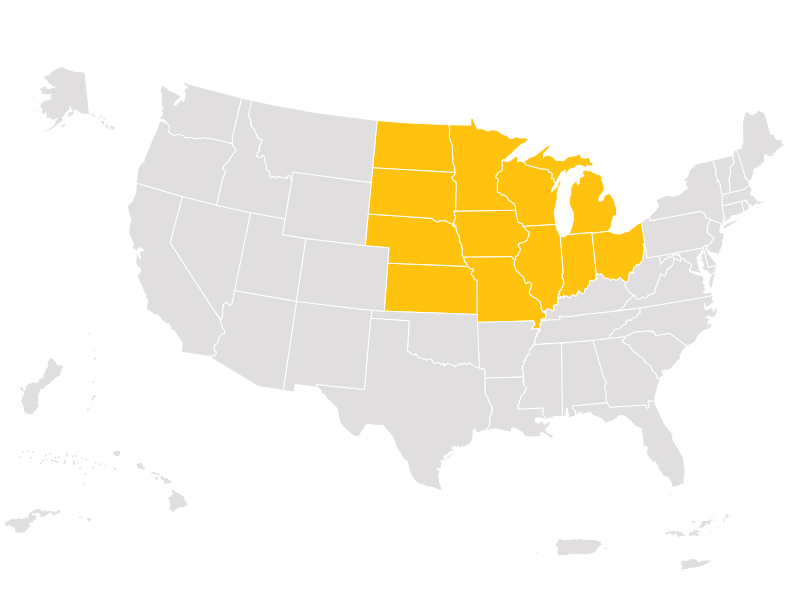
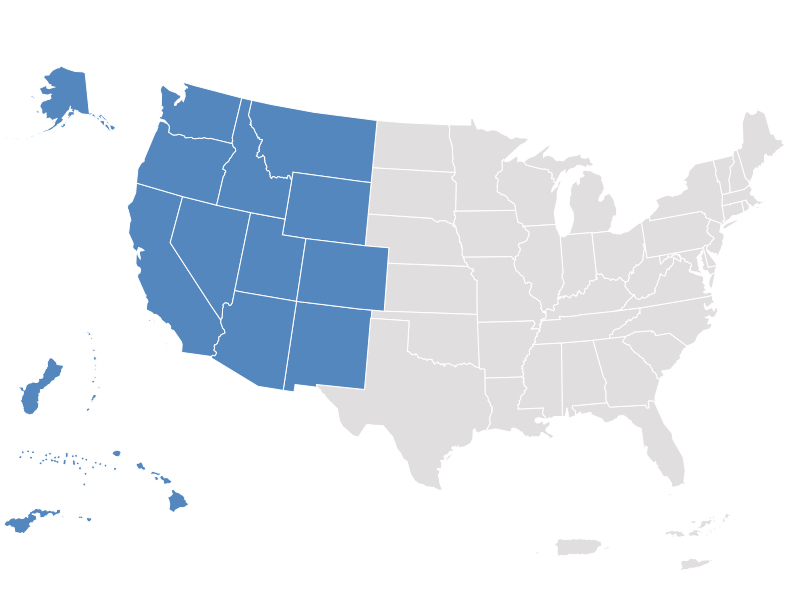
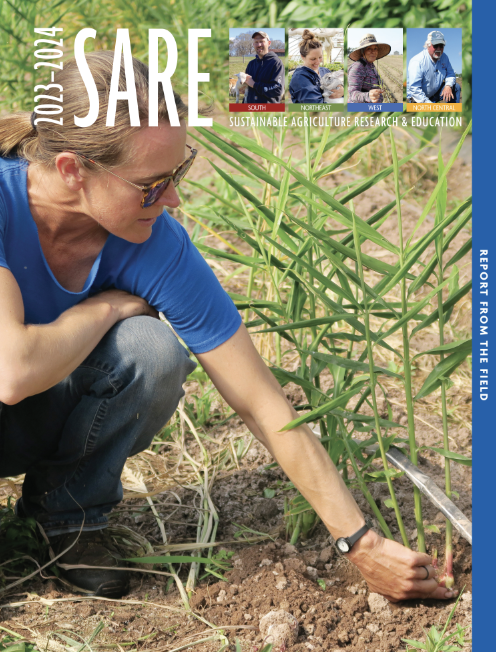
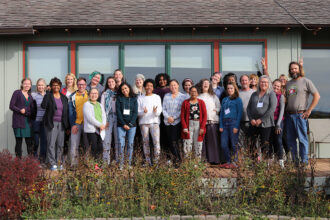
March 27, 1998 Missouri Alternatives Center's Bimonthly Electronic Newsletter 800-433-3704 "AG OPPORTUNITIES" March-April 1998 (Vol 8 No 5) * Small Farms * New Family Farms * Agricultural Alternatives Sustainable Agriculture Conference Is A Huge Success! Sustainable agriculture is a farming system whose time has come! If you need proof, just ask the farmers who attended the Sustaining People Through Agriculture conference at the University of Missouri at Columbia on March 5th through the 7th. Farmers and guest speakers from Missouri, Indiana, Kansas, and Iowa presented sessions on innovative and successful marketing techniques, pasture-based farming systems, producer grant programs, on-farm research, farmer-to-farmer networking, food circles and sustainable food systems. A group of 80 farmers and agriculture supporters experienced the variety and delicious flavor local food systems offer by attending a local-foods banquet sponsored by the Columbia Area Food Circle and the Bonnie Clark Fund for Sustainable Agriculture. Farmers who have received Missouri Sustainable Agriculture Demonstration Awards gave conference-goers the opportunity to explore sustainable agriculture options close to home. At poster sessions and panel discussions, these farmers revealed how they've used grant funds to discover sustainable agriculture methods that work. With sessions on pastured poultry, growing vegetables for market, reduced input cropping systems, alternative enterprises and more, everyone attending came away with plenty of new ideas and farming methods to explore. A group of over 100 farmers gathered to hear former congressman Harold Volkmer's explanation of the USDA Small Farms Commission report titled A Time to Act. These farmers decided it was indeed a time to act to help promote sustainable agriculture in Missouri. They formed an organization to support Missouri farmers who are interested in sustainable agriculture. The organization will support on-farm research and demonstrations and publicize sustainable agriculture field days and farm tours throughout the state. The organization doesn't have a name yet, but a steering committee of 25 people is already making plans for another sustainable agriculture conference next year. If you'd like more information about this organization, write Jim Lummus, RR 3, Box 191, Concordia, MO 64020 or e-mail him at: jrlummus@almanet.net. If you would like to receive a summary of the Sustaining People Through Agriculture Conference, or have farm tour information that you would like to publicize, contact Debi Kelly at the Missouri Alternatives Center, 1-800 433-3704. To see the latest on-farm tour information available, check the Agriculture Electronic Bulletin Board (AgEBB) at the following web site address: http://agebb.missouri.edu/sustain/. Sustainable Agriculture Demonstration Awards - 1998 Projects The Missouri Department of Agriculture and the University of Missouri Extension offers sustainable agriculture demonstration awards annually. A maximum of 23 projects are funded in the amount of up to $3,000. On farm experiments or demonstrations, that reduce dependency on nonrenewable inputs, are considered for awards. Farmers must document production and financial information, which may be presented through farm tours or meetings. Below is a listing of those who received the awards for the 1998 growing season. Applications are available now by contacting Joan Benjamin or through your Local County Extension Centers beginning in August. For more information concerning the Sustainable Agriculture Grant Program contact: Joan Benjamin, MO Dept of Ag, Sustainable Agriculture Program Coordinator, 4411 N Boothe Ln, Rocheport, MO 65279, 573-445-2194. 1998 Award Recipients 1. Growing Shiitake and Reishi Mushrooms - Marie Bennett, 101 Lincoln Ln, Waynesville, MO 65583 2. Comparison of Solar Powered Pump and RAM Pump to Deliver Water to Livestock - Terry Bohmont, 939 Bohmont Rd, Sparta, MO 65753 3. Increased Gain and Decreased Cost for Sheep and Goats Through Intensive Management Grazing - Betty Boudreau, 1557 SW Hwy H, Montrose, MO 64770 4. Organic Dairy with On-Farm Bottling Facility - Barb and Kerry Buchmayer, 14649 Hwy M, Purdin, MO 64674 5. Testing Water Insulators on Raised Beds Covered with Synthetic Mulch for Early Tomato Production - Arden Compton, Rt 1, Box 330, Tunas, MO 65764 6. Returning CRP Acres to Productive Use by Converting Cool-Season Grasses to Perennial and Annual Warm-Season Grasses and Utilizing Them in a System of Finishing Cattle on Pasture - Thomas Craft, Rt 4, Box 397, Butler, MO 64730 7. Develop an Agroforestry System of Growing Ginseng in Black Walnut Plantations - Larry Harper, 1007 N College Ave, Columbia, MO 65201 8. Comparing the Effectiveness of Pollen Traps to Apistan Strips for Control of Varroa Mites - Troy Hart, 3738 Hwy 47, Lonedell, MO 63060 9. Assessment of Mineral Oil to Control Varroa Mites on Honey Bees in Mid-Missouri - Matt Higdon, 10701 N Hecht Rd, Hallsville, MO 65255 10. Designing and Evaluating an Herb-Drying System - Robert Hunolt, Rt 1, Box 195, Rutledge, MO 63563 11. Supporting a Family with Sustainable Diversified Agriculture on Ten Acres - Jerry Lee Inman, RR 2, Box 2597, Seymour, MO 65746 12. Yield and Taste Effects of Vertical Growing Techniques with Red Plastic Mulch - Harold Klein, 521 Audubon St, Ste Genevieve, MO 63670 13. Biological Weed Management and Pasture Improvement Through Managed Intensive Grazing of Meat Goats - Debra Leunen, PO Box 189 Lancaster, MO 63548 14. Integrated Management Intensive Grazing System Agroforestry Demonstration - Don Light, 13878 State Hwy B, Perryville, MO 63775 15. Feasibility of Producing Marketable Tilapia in a Hydroponic Greenhouse - Jan McCrackin, RR 2, Box 2598-2, Seymour, MO 65746 16. Hot Water Weeder Project - Steve McKaskle, Box 280, Braggadocio, MO 63826 17. Improving the Market for Goat Milk and Adding Value to Dairy Goat Products in Missouri - Bob, Kim and Marilyn Mauzy, 36561 Hwy 65, Ionia, MO 65335 18. Transition from Hay to Herb Production - Ron Morris, Box 25, Gorin, MO 63543 19. Pastured Poultry with a Purpose - Dan and Jenny Packard, Rt 3, Box 3250, Seymour, MO 65746 20. Aromatic Barnyard Composting for Durable Equine Forage - Ann Quinn & Charlotte Hammon, HCR 83, Box 17, Niangua, MO 65713 21. Intensive Grazing for a More Efficient Small Flock Operation - Beth Ranes , 3216 US Hwy 63, Willow Springs, MO 65793 22. Heart of Missouri Home Grown, Kevin Webb 19010 S Mackie Ln, Hartsburg, MO 65039 23. Performance Enhancement for Gastrointestinal Parasite Control in Small Ruminants by the Use of Alternative Technology - Dan and Paulette Wohnoutka, 3326 South First Rd, Humansville, MO 65674 In The News NC SARE call for producer grant proposals: Celebrating a decade of the USDA's Sustainable Agriculture Research and Education (SARE) program, SARE's North Central Region (NCR) launches 1998 by offering competitive grants to farmers and ranchers. Producers interested in researching, demonstrating or educating others about profitable, environmentally sound, socially responsible agricultural systems are encouraged to apply to the NCR Producer Grant Program. "We think this is an excellent program," says Kim Cates, a Wisconsin farmer and Producer Grant recipient. "It gives producers an opportunity to take a chance without having to fund the whole idea on their own. There's always enough financial risk involved with a farming enterprise." $225,000 is available for awards of up to $5,000 for individual producers investigating any sustainable practice or concept and up to $10,000 for groups of three or more producers proposing creative marketing projects. "The Producer Grant Program emphasizes the importance of farmer- driven research and indigenous knowledge," says Ken Schneider, former farmer/rancher and NCR SARE's producer grant liaison. "We support innovative farmers and ranchers looking for ways to overcome obstacles to a sustainable operation." Nearly 200 producer projects in 12 NCR states have been awarded at a total of more than $800,000 since 1992. Projects cover a variety of topics, such as reducing off-farm inputs, testing technologies, improving water quality, educating young people or consumers about agriculture, managing weeds and pests, recycling wastes and creating viable markets for sustainable products, among a host of other issues. Applications are available from the North Central Region office beginning February 2, 1998. Producers must reside in the 12-state North Central Region: IL, IN, IA, KS, MI, MN, MO, NE, ND, OH, SD and WI. Applications are due May 1, 1998. Funding decisions will be made in late-June 1998. Funds will be available in mid-fall for the 1999 crop production season. Call 402-472-7081 or email: sare001@unlvm.unl.edu for an application. You can also find the application at http://www.sare.org/ncrsare/. The deadline for public comment on the USDA's proposed national organic standards has been extended until May 1. Written comments may be sent to Eileen S. Stommes, Deputy Administrator, Agricultural Marketing Service, USDA, Room 4007-S, Ag Stop 0275, PO Box 96456, Washington, DC 20090-6456. They can also be sent via the Internet through the National Organic Program Web page at http://www.ams.usda.gov/nop, where the rules are posted, and other public comments are available for review. There are "two good reasons to seek out organic food, one personal and one societal," according to an article entitled "Greener Greens? The Truth About Organic Food" in Consumer Reports (January, 1998). "Organic food guarantees you a diet as low in pesticide residues as possible," the article concludes. "On a public scale, organic agricultural practices are much less harmful to the environment than conventional chemical agriculture." The article tested a thousand pounds of produce from across the country for pesticide residues and taste, but did not test it for nutritional value. It concluded that "organic foods had consistently minimal or nonexistent pesticide residue;" that "organic fruits and vegetables [are] as attractive and tasty as their conventional counterparts;" and that "buying organic food promotes farming practices that really are more sustainable and better for the environment -- less likely to degrade soil, impair ecosystems, foul drinking water, or poison farmworkers." The chief beneficiary of the boom in organic food during the past decade is Whole Foods Market, "whose 900% growth in the 1990s has produced a billion-dollar juggernaut with 78 stores in 17 states," according to Time (February 23, 1998). "Consumers aren't willing to pay a hefty premium for organic, nor do they want to give up any of the conveniences of shopping in large stores that stock everything from soup to lug nuts." Whole Foods meets those goals by offering chemical and preservative-free foods, organic produce, hormone-free meats, cruelty-free cosmetics, and ecologically friendly household products. But the stores also stock conventional items and non-organic produce. Having bought out several of its competitors in the last three years, Whole Foods is expected to grow 25% annually for the next five years. Rutgers University has a nice web page on budget sheets for organic production. It also has farm enterprise budgets which included comparisons of organic vs. conventional production costs. It can be found at http://aesop.rutgers.edu/ ~farmmgmt/ne-budgets/NEbudgets.html Agroforestry offers livestock farmers new money making options-- especially for those with limited acreage. ARS scientists studying two types of agroforestry, silvopasture and alley cropping, say farmers who plant the right tree species in their pastures can boost their income by as much as 300 percent. In silvopasture, farmers raise trees, cows and grass on the same land. In alley cropping, farmers grow crops between tree rows while waiting for their trees to mature. Livestock farmers can use their land to make supplemental or alternative income when livestock prices are low without sacrificing their main source of income. Extra income from grazing in silvopasture is estimated at about $3,400 a year for a 50 cow, 200 acre pasture. By planting 60 acres of a 200 acre pasture with trees over a 30 year period, extra income could increase to about $5,000 a year. ARS researchers are looking at a wide range of alternative crops, including corn, muscadine grapes and plants with natural chemical properties used in industry, medicine and as dietary supplements, to learn which crops would work best in an agroforestry system. For more information, contact Catalino Blanche, Dale Bumpers Small Farms Research Center, Booneville, AR, 501-675-3834. (Quarterly Report, Oct to Dec 1997) New for Controlling Birds: The Vigilante Helikite provides a "high- tech" approach to farmers' and gardeners' bird problems, this new contraption "flies" 200 feet high to hover and move like a hawk in the sky. The instinctive fear that this creates gives awesome long- term bird control, far better than anything previously available. Huge areas controlled (up to 25 acres!). It is essentially reliable, which is why it is used by the US Dept of Agriculture, top research organizations, and thousands of farmers worldwide." It looks like a small blimp, trailing a tail and tethered to the ground. For more information, Allsopp Helikites, South End Farm, Damerham, Fordingbridge, Hampshire SP6 3HW, ENGLAND, phone 01144 1725 518750. (HortIdeas, Jan, 1998) Formic acid mixed with a food-grade gel protects honey bees from tracheal and varroa mites, the two worst bee pests in this country. In field tests, the experimental ARS product killed up to 84 percent of varroa mites and 100 percent of tracheal mites. The gel could help gain US EPA registration of formic acid to combat both mites. Currently, in the US, the only registered control of varroa mites in fluvalinate; and for tracheal mites, menthol. Formic acid has proved effective against the pests. But in liquid form it evaporates quickly and must be applied several times per season. Sealing acid and gel in a plastic bag would provide a longer lasting product requiring less handling. The bag could be sliced open inside the hive. Formic acid would evaporate and leave behind a harmless residue. ARS scientists are seeking a patent. For more information, contact Mark Feldlaufer, USDA-ARS Bee Research Lab, Beltsville, MD, 301-504-8205, mfeldlau@asrr.arsusda.gov (Agricultural Research, Feb 1998) Midwest floodplain sites can support a wide variety of tree species. Selection should be based on which species are capable of growing on the site, the availability of planting stock, resource protection needs and landowner objectives. A minimum of three different species should be planted in the waterbreaks to reduce insect and disease risks and improve wildlife benefits. Some suggested tree species for flood plain sites in the Midwest include: Eastern cottonwood, American sycamore, green ash, silver maple, swamp white oak, red maple, pecan bur oak, bald cypress, black willow, pin oak and hackberry. (Inside Agroforestry, Fall 1997) Americans spend 11.4 percent of their personal income on food compared to 21 percent in Japan, 26 percent in Italy and 53 percent in China. (Conservation Technology Information Center Newsletter, Dec/Jan 1998) Honeybees pollinate some 90 different crops in the US, including melons, squash, broccoli, almonds, strawberries, blackberries and raspberries. An estimated one third of the world food supply depends on insect pollination either directly or indirectly. (AgVentures, Feb/Mar 1998) Honeybees are proving an effective pesticide alternative in battling lethal mites, says an entomologist with the Univ of Minnesota's Extension service. According to Marla Spivak, "hygienic bees" are their own best ally in controlling the spread of lethal varroa mites in the US. "We have found a way to breed honeybees which can detect the presence of the mite on immature bees (brood) and remove the parasitized brood from the colony." Varroa mites were originally parasites of an Asian honeybee species which is able to coexist with the mites. However, the US species has so far been indefensible since the mites came to the US in 1987. The varroa mite is quickly taking its toll on the honeybee population. Spivak said that in Minnesota alone, mites have killed off 90 percent of the wild honeybees and 50 percent of the managed ones over the last decade. This poses a serious threat to both agricultural crops and hive products, such as honey. Honeybees are critical for pollinating the plants that supply one-third of our diet. Because of the mite destruction, there is now a shortage of bee colonies. Spivaks' work has given hope for a solution. She found that certain bees possess an unexplainable ability to naturally detect and remove the parasitized brood from within their nest cells. In fact, these hygienic bee colonies can remove up to 70 percent of infested brood, which interrupts the mites' reproductive cycle. However, if left alone, the parasitized, immature bee will develop with deformities and will have a shorter lifespan. "The mites will always be there with the bees, we're just hoping to find bees that tolerate mites better. Ten percent of all existing US honeybees are estimated to be hygienic." Spivak hopes to transfer her breeding technology to beekeepers so that they can raise this figure. She said that the efforts are relatively small given the economic rewards available to bee producers. Bee breeders need only two or three seasons to develop an effective force to mite combatants. (The Great Lakes Vegetable Growers News, Feb 1998) In Print *A Patch of Eden: America's Inner-City Gardens* Discusses successful urban gardens in more than 200 US cities, describing the variety of benefits and services they provide. Participants speak for themselves about how these gardens serve them and their communities. $22.95. Chelsea Green Publishing Co, PO Box 428, White River Junction, VT 05001. *Techniques for Reducing Pesticide Use: Economic and Environmental Benefits* Examines technologies and processes available for reducing pesticide use in field, fruit, greenhouse and vegetable crops. Describes cultural pest control methods, IPM, breeding for resistance, biological control and other practices that minimize pesticide use, and discusses environmental and social costs of pesticides. Examines Swedish pesticide reduction program, which has cut use by 75%. $99.00 John Wiley & Sons, Inc, 9th Floor, 605 Third Ave, New York, NY 10158-0012, 800-879-4539. *Midwest Small Fruit and Grape Pest Management Handbook* Contact Rick Weinzierl, Crop Sciences, Univ of IL, AW-101 Turner Hall, 1102 S. Goodwin Ave, Urbana, IL 61801. $5.50. *Earthworm Ecology* $64.95. Comprehensive book edited by earthworm guru Dr. Clive Edwards from The Ohio State Univ covers the gamit from earthworm biology and physiology to earthworms in agroecosystems. *1997 Midwest Vegetable Variety Trial Report* $10.00. Available from Jeff Kindhart, 618-695-2444 or Chuck Voigt, 217-333-1969. *Soil Fertility for Organic Farmers* Describes tools and techniques for building and maintaining organic soil fertility. Presents information about water management, crop rotations, green manures and managing sod pastures. $5.00 Eric Kindberg, PO Box 2407, Fairfield, IA 52556. *Produce Handling for Direct Marketing* $10.50 and *Farming Alternatives: Evaluating the Feasibility of New Farm-Based Enterprises* $11.50. Available from Northeast Regional Agricultural Engineering Service, 152 Riley-Robb Hall, Ithaca, NY 14853, 607-255-7654. *1998 Directory of Flower & Herb Buyers* $10.00. Prairie Oak Seeds, PO Box 382, Maryville, MO 64468, 816-582-4084. *1997 Illinois Fruit and Vegetable Crop Research Report* Free. Includes research conducted at several locations in Illinois. Report contains fungicide and herbicide evaluations, cultivar trials in peppers, pumpkins, tomatoes, and sweet corn, cover crop studies, and companion crops. Contact Illinois Fruit and Vegetable Crop Research Report, contact John Masiunas, 260 ERML, 1201 W Gregory Dr, Urbana, IL 61801, 217-244-4469. *Paddock Shift: Changing Views on Grassland Farming* $25.95. Stockman Grass Farmer, PO Box 9607, Jackson, MS 39286, 800-748-9808. *The Control of Internal Parasites in Cattle and Sheep* EAP Publication #70, $9.95; *Cover Cropping in Potato Production* EAP Publication #71, $6.95; *Mechanical Weed Control In Cereals,* EAP Publication #72, $6.95 and *Treating Mastitis Without Antibiotics* EAP Publication #69, $9.95. Available from Ecological Agriculture Projects, Macdonald Campus, McGill Univ, 21,111 Lakeshore Rd, Ste Anne de Bellevue, Quebec, Canada H9X3V9, 514-398-7771. *60 Ways Farmers Can Protect Surface Water* is a new book from Univ of IL Extension that offers practical information on no-till and 59 other ways innovative farmers can protect water without sacrificing production. $10.00 plus shipping. Call 800-345-6087. *Agricultural Cooperatives as Effective Marketers of Value-Added Products* covers topics such as capital requirements and funding, strategic planning and managerial requirements. $6.00. Contact Center for Cooperatives, Univ of CA, Davis, CA 95616, 916-752-2408. *Selling Value to the Market* describes how producers can increase profits with value added products. Complied by the editor's of Farmer's Digest, the report explains how producers can benefit from knowing what users want and meeting their supply needs. $7.95. Lessiter Publications, 800-645-8455. *Weed Management in Horticultural Crops* Practical guide to weed management techniques that fruit and vegetable growers can use. No other books exist which solely emphasize weed management in horticultural crops. Chapters discuss integrated weed management techniques, herbicide mode of action, and specific information on weed management in fruit and vegetables. American Society of Horticultural Sciences and the Weed Science Society of America. ASHS Press, 600 Cameron St, Alexandria, VA 22314, 703-836-2418. *Nutritional Effects on Goat Health* New guidesheet covers diseases such as milk fever, enterotoxemia, pregnancy disease, rickets, bloat, acidosis, founder and other metabolic disorders. Contact Lincoln University, Media Center, PO Box 29, Jefferson City, MO 65102, 573-681-5554. *Tapestry Weaving Part I, Part II, and Part III* Videos produced on a three part series on a variety of fibers that have been used in producing tapestries, including mohair. Videos are available free for rent only for a week. Contact Lincoln University, PO Box 29, Jefferson City, MO 65102, 573-681-5554. Calendar of Events April 25-26 Draft Horse Basics, Kalamazoo, MI. For more information, call 616-344-3233. April 25-26 Solar Applications for Small Farms, Kalamazoo, MI. For more information, call 616-344-3233. April 27-28 Amish Community Study Tour, Morrilton, AR. Call Ed Martsolf, 501-727-5659. May 16 Fiber Fair, Marshfield, MO. Contact Gladys Gaeke, 417-859-2914. May 20-22 MU Grazing School, Brookfield, MO. Call Joetta Roberts, 573-499-0886. June 4-7 MO Forest Products Technical Session, Branson, MO. June 6 Sheep & Farm Day, Buffalo, MO. Contact Marilyn Powell, 417-345-7358. June 24 MU Refresher Grazing School, Brookfield, MO. Call Joetta Roberts, 573-499-0886. July 8-10 MU Grazing School, Brookfield, MO. Call Joetta Roberts, 573-499-0886. July 11 Polyface Farm Field Day, Swoope, VA. Contact ACRES USA, 800-355-5313. Aug 13-23 MO State Fair, Sedalia, MO. Aug 16-18 MO/KS Landscape & Nursery Assn Summer Meeting & Trade Show, Kansas City, MO. Call Sara Woody Bibens, 816-369-3115. Sept Artificial Insemination Workshop for Sheep and Goats, Jefferson City, MO. Call Helen Swartz, 573-681-5551. Sept 3-4 Fiber Art Expo, Bethel, MO. Contact Helen Swartz, 573-681-5551. Sept 5-7 World Sheep, Fiber Art and Flower Festival, Bethel, MO. Contact Helen Swartz, 573- 681-5551. Oct 4-7 Farming the Agroforest for Specialty Products, Minneapolis, MN. Call Scott Josiah, 612-624-7418. Oct 4-8 BioEnergy '98, Madison, WI. Call Fred Kuzel, 312-407-0177. Oct 7-9 MU Grazing School, Brookfield, MO. Call Joetta Roberts, 573-499-0886. Nov 8-11 New Crops & New Uses: Biodiversity & Agricultural Sustainability, Phoenix, AZ. Contact Dave Dierig, 602-379-4356. "University Outreach and Extension does not discriminate on the basis of race, color, national origin, sex, religion, age, disability or status as a Vietnam-era veteran in employment or programs." Missouri Alternatives Center ------------------------------ The Missouri Alternatives Center is supported by University Extension; Lincoln University; MU Extension Division; MU College of Agriculture, Food and Natural Resources; and the MO Dept of Conservation. MAC provides information to Missourians on alternative crops, livestock, small farm options and alternative rural enterprises. MAC is open weekdays from 8 am to 5 pm. For more information contact: The Missouri Alternatives Center, 628 Clark Hall, Columbia, MO 65211, 573-882-1905 or 800-433-3704. Missouri Alternatives Center University of Missouri 628 Clark Hall Columbia, MO 65211