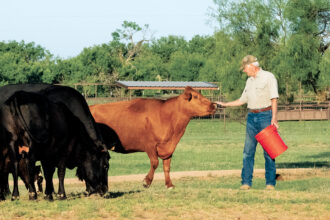
July 17, 1997 Ag Opportunities * Small Farms * New Family Farms * Agricultural Alternatives Vol. 7, No. 7 July - August 1997 Harmony Beef (by Lindsey Head, Agriculture Journalism Student) ====================================================================== Rolph Christen gently taps the deep brown soil off his weathered work boots. He raises his tanned face, flush from the cool morning air, to scan the field where he prepares the soil for planting. He smiles and says with a heavy German accent, "My uncle said to me on my wedding day that in farming you'll never get rich, but you'll always be happy. I believe that to be true." Christen was raised in Kronberg, Germany. Coming to the United States as an exchange student, Christen fell in love with the rolling hills of North Missouri and the quiet of country living near the town of Green City. Christen has lived in Sullivan County for 14 years. He takes pride in the high-quality products produced such as beef cattle in a more environmentally conscious manner, with the help of Harmony Beef. Harmony Beef is a nonprofit organization composed of Christen and 12 other family farmers in Putnam and adjacent counties. These farmers are dedicated to producing a quality product that is hormone-free. Also, beef cattle must not have been fed, injected or administered antibiotics 120 days before slaughter. All Harmony Beef animals to be slaughtered are raised in a humane and environmentally conscious atmosphere. Harmony Beef cattle are raised in a traditional setting, not in close confinement. Gary Godfrey, a certified member, selected the ten best animals from the 80 head of cattle in his herd to be sold for Harmony Beef. However, Godfrey's entire herd meets Harmony Beef guidelines. Walking into Godfrey's back yard, beef cattle graze lazily on a thick carpet of green grass. Walking around the animals, Godfrey looked pleased at their growth. "I kept the best ones for Harmony Beef and send the other ones to the packing plant, " Godfrey said with a smile. The majority of beef purchased in supermarkets has been injected, fed or implanted with hormones to stimulate growth and antibiotics to keep animals healthy under the stressful conditions in which they are raised. Christen opens his palm to point behind him: a vast space of freshly broken earth and green hills spotted with trees. "What are your chances of catching the flu out here?" said Christen. "Now think about being in a mall, like in Kansas City, what are your chances of getting sick there? It's the same with cattle." In modern mechanized beef production, animals are fed out in close living quarters with thousands of other animals. Raising cattle in a confinement environment is the same as people in a mall; many animals in a mall space increases the chances of infection and the need for antibiotics. Harmony Beef also sets the standards that animals must have been owned birth to finish by the same farm family. Cattle must be fed corn based rations and be no older than 24 months of age at the time of processing. Harmony Beef has implemented a quality improvement program to ensure that producers are raising a premium product. From each animal sold to the consumer, Harmony Beef board members will take one 12 ounce rib steak. Tests will be done on this meat to measure quality and taste. This way producers will know what meat had a high success rate and be able to look at the techniques used to make improvements for next year. After testing is finished, board members have special plans for the meat. "The last thing we'll do is cut it up and eat it, we'll have a big barbecue," said Godfrey. Members of Harmony Beef are working as a team to get this organization up and running. The first two Harmony Beef animals were cut up the last of May, divided into 25 pound bundles and sold locally in Putnam and Sullivan counties. More animals should be ready in late June. Harmony Beef members are excited about selling their products to community members along with people around the state. Marvin McDonald, a certified producer, stands in the middle of his Angus herd with his wife Loreen. They share all the responsibilities of the farm work. They feel that Harmony Beef will help their farm prosper along with helping the economic stability of the community. "I feel like Harmony Beef will hold money in the community," said Loreen. "We're all small farmers, we want to keep our money here." Loreen also said that this organization will bring closer ties between rural communities and the people in town. By selling to people in towns like Columbia, a link can be made between where the food is produced and the consumer. Harmony Beef producers feel that their method of production is better for consumers and animals. The families involved in this project are dedicated to pressing issues key to making harmony between consumers, themselves, the environment and meet the goals of all family farmers, to sustain their way of life. As Christen turns to walk towards his tractor, he stops to give his parting thought on Harmony Beef. "Everything we do needs to come back to the land. My kids might someday want to inherit this land, I want to do all I can to help it." Customer Satisfaction for Your Farm Market ====================================================================== A seasonal reminder ... If you want to compete with other markets, you must have customer satisfaction high on the list of priorities for your farm market. You may not be able to compete on price, but everyone can compete for a satisfied customer. The master retailer of America, Sam Walton, founder of Wal-Mart, listed seven rules for customer satisfaction in his book, "Made in America." 1. Give customers what they want Quality produce direct from the farm. 2. Provide a wide assortment of quality merchandise Having more than one commodity will give them more reason to stop by. 3. Set the lowest possible price Make sure you are making an acceptable profit. Know your cost. 4. Provide a pleasant shopping experience They want to do business with someone who wants their business and treats them as a valued customer. 5. Provide friendly, knowledgeable service If someone in the shed is having a bad day, don't let them wait on customers. It will pay off. 6. Maintain convenient hours and free parking Driving out from town to find your stand closed can cost customers. Give your hours and stay with them. Free parking for farm markets usually isn't a question, but having plenty of room to park can be. Keep the traffic problems under control. 7. Guarantee satisfaction on all purchases Tell them politely you are sorry they have a problem and fix it. I heard a grower once say, "It cost me $25.00 in advertising to get one customer, you think I'm worried about $3.00 worth of corn". Customer satisfaction is a big piece of the puzzle for success. Look at your market and see how you can improve ... and it doesn't hurt to ask your customers. (IL Fruit and Veg News Vol 3 No 4) In the News ====================================================================== Missouri Sustainable Agriculture Conference dates have been set for March 5-7, 1998. The conference will be held on the University of Missouri-Columbia campus. For more information, contact John Ikerd, 573-882-4635. Section 319 of the federal Clean Water Act provides funds through states for the prevention and abatement of nonpoint source water pollution and restoration of watershed resources. This program is a potential source for 60% funding of agroforestry projects which improve or protect surface or ground water quality. Such practices might include: bioengineering using plantings for stream bank and shoreline stabilization; alley-cropping and bio-terracing on highly erodible soils; riparian buffers used for restoring aquatic habitat or for filtering out sediment, nutrients and/or pesticides from runoff, including urban storm-water runoff. Public institutions of higher education, units or subunits of government and non-for-profits with 501(C)3 status are eligible recipients of grants. For more information contact Betty Keehart, MO Dept of Natural Resources at 573-751-7428. (Source: Inside Agroforestry, Spring 1997) Tilapia sales increased in 1996 to a projected 55 to 60 million pounds from imports (based on live weight) and 18 to 20 million pounds from domestic production. Although domestic production is increasing, the value of tilapia imports rose 32 percent above the previous year. (Aquaculture in Missouri newsletter, Vol 4 No 1) Sustainable Farming Connection web site. Two former editors of The New Farm magazine have launched a web site that offers innovative production and marketing stories to help you cut costs, improve soil, protect the environment and add value to healthy food. It includes commentary by rural writers, timely news and action alerts, archived material, and links to other key sites, as well as farmer forums. Contact Chris Shirley, Committee for Sustainable Farm Publishing, 609 S Front St, Allentown, PA 18103, 610-791-9683, http://sunsite.unc.edu/farming-connection Alternative Agricultural Research and Commercialization Web site. AARC, a wholly-owned corporation of the USDA, is a venture capital firm that makes equity investments in companies to help commercialize biobased industrial products (nonfood, non-feed) from agricultural and forestry materials and animal by-products. Most clients are small, rural-based firms. http://www.usda.gov/aarc/ Purdue Univ researchers say marketing-savvy farmers can make their buffer strips pay. They planted shrubs such as pussy willow, red twigged dogwood and corkscrew willow as part of buffers around farm fields since 1990. By harvesting the twigs and selling them to a local florist for floral arrangements, the researchers calculate a farmer could earn $5,000/acre from a strip planted with 660 shrubs/acre. Shrubs also provide a haven for wildlife to feed, nest/hide from predators and bad weather, trap soil and take up nutrients from field runoff. Researchers doubt harvested shrubs would qualify for farm bill buffer strip payments but they suggest farmers consider planting the shrubs alongside buffer strips. Contact Brian Miller, 765-494-3586. (Conservation Technology Information Center newsletter, April/May 1997) A new gooseberry variety named Jahn's Prairie could give most Americans a chance to enjoy this plump, tart, native fruit. Many wild gooseberry plants in the US were destroyed decades ago because they can harbor a disease that threatened the pine industry. Jahn's Prairie, which resists the white pine blister rust, was selected from the wild by ARS and Canadian experts. Gooseberries are high in vitamin C and are popular in pies and preserves in England. They ripen the first week in July and could spark new life into a developing commercial gooseberry industry. The industry was largely abandoned here in the 1940's when a federal law called for eliminating gooseberries and their cousins, currants, because of the rust. The law was repealed in 1966 but some states still prohibit growing the fruits. The new variety also resists powdery mildew, a fungal disease of the leaves, stems and berries. Contact Kim Hummer, 541-750-8712. (Quarterly Report, Jan-Mar, 1997) If farmers want their livestock to eat more and gain more weight, they'd better make hay while the afternoon sun shines. A new study shows that sheep, goats and cattle all prefer grass hay harvested in the afternoon over those cut in the morning. A possible explanation: plant carbohydrate production peaks at midday. Researchers suspect animals "remember" the afternoon-cut hay give them more energy than morning cut hay. It's long been known livestock grazing peaks in the afternoon. This led researchers to explore whether cutting hay later in the day could boost consumption. Contact Dwight Fisher, 919-515-7597. (Quarterly Report, Jan-Mar, 1997) Careful timing of corn ridge-till cultivation could allow farmers to cut back on insecticide treatments against corn rootworm. In ridge tilling, the cultivator throws dirt up around the base of the corn plant. Corn plants that had at least seven leaves before ridge tilling produced more brace roots, scientist found. Corn with a stronger brace root system is less likely to fall to the ground after rootworm damage. Because rootworm damage is usually restricted to older roots that are lower on the stem, new brace roots higher up on the plant may help corn plants tolerate some rootworm damage. In the 3-year experiment, researchers found grain yields generally unaffected by ridge tilling. But when the tilling was postponed to the seven-leaf stage, ridging the soil increased the number of brace roots by 5 to 8 roots. Contact Thomas Kaspar, 515-294-8873. (Quarterly Report, Jan-Mar, 1997) Ornamental horticulture represents 13% of our nation's agricultural net worth but receives only 1% of agricultural research dollars. (Grower's Talk) During the summer of 1996, the Kemper Center for Home Gardening at the MO Botanical Garden started a trial designed to observe the effects of organic soil amendments on the growth of annuals. The objective was to amend a typical clayish, rocky St Louis subsoil. The growth of annuals planted without any added fertilizers in the amended soil was observed. Six small plots were amended: control, sawdust, human hair, pine needles, peat moss and straw. Periwinkle seedlings were planted on all six plots. Within two weeks of planting, there was a noticeable difference in the growth of the annuals in the plots amended with hair versus the other plots. Plants were taller, more branched and had more flowers than the plants in the other plots. Also the foliage was darker green and the flowers were more brightly colored. Human hair, which is predominately protein, contains approximately 18% nitrogen. Hair is believed to act as a slow release fertilizer. Plots will be repeated this spring with one additional amendment, a grain waste product marketed under the trade name Biocarb. Hair can either be composted or incorporated directly into the garden. (Branching Out, May 1997) In Print ====================================================================== *1997 International Pesticide Directory, 1997* Research Information. Provides contact information for pesticide manufacturers worldwide, and lists each company's pesticide products. Provides one-sentence descriptions of 3,200 pesticide products including names of active ingredients, and cross lists this with 633 active ingredients. 126 pp. $68. Research Information, Ltd, 222 Maylands Ave, Hemel Hempstead, Herts. HP2 7TD, UK, email: resinf@globalnet.co.uk. *Handbook of Successful Ecological Lawn Care, 1996* Paul Sachs. Describes least toxic practices for growing and maintaining turf grasses, including methods for building soil and controlling pests. Focuses on helping lawn-care professionals develop skills and build business, and features chapters on marketing, business plans and accounting. 284 pp. $20.45. The Edaphic Press, PO Box 107, Newbury, VT 05051, 802-222-4277. *Partners in Production: How to Work With Pollinators to Improve Your Harvest, 1997* Discusses ways to create pollinator-friendly environment for improving crop yields and describes threats to pollinators from pesticides. Provides guidelines for minimizing negative effects of pesticides on pollinators. Contact Forgotten-Pollinators Campaign, Arizona-Sonora Desert Museum, 2021 N Kinney Rd, Tucson, AZ 85743, 520-883-3006, email: fpollen@azstarnet.com. *Successful Whole Farm Planning: Essential Elements Recommended by the Great Lakes Basin Farm Planning Network, 1996* Loni Kemp, The Minnesota Project. Describes whole farm planning -- a system for meeting multiple economic, environmental and personal objectives on individual farms. Discusses components of whole farm planning and outlines a range of related systems being implemented by farmers, including Holistic Resource Management, the Ontario Environmental Farm Plan, the Pennsylvania One Plan and organic farm plans. 18 pp. $5. The Minnesota Project, 1885 University Ave West, Ste 315, St Paul, MN 55104, 612-645-6159, email: water007@gold.tc.umn.edu. *Northwest Coalition for Alternatives to Pesticides (NCAP) Web Page.* NCAP. Updated web site provides information about pesticides and alternatives. Currently provides fact sheets about pesticides imazapyr and glyphosate and control of ants and cockroaches. Lists fact sheets and articles available from NCAP. NCAP, PO Box 1393, Eugene, OR 97440, 541-344-5044, email ncap@pesticide.org; http://www.efn.org/~ncap. *The IPM Practitioner* Various subscription rates. Monthly journal from BioIntegral Resource Center about integrated pest management. Includes research updates, book reviews and listings of IPM resources. BIRC, PO Box 7414, Berkeley, CA 94704, 510-524-2567, birc@igc.org. *Building a Sustainable Future* the proceedings from the 4th North American Agroforestry Conference. $40 from John Ehrenrich, College of Forestry, Wildlife, and Range Sciences, Univ of Idaho, Moscow, ID 83844-1135, 208-885-7600. *1997 Directory of Flower & Herb Buyers* $7.50 from Prairie Oak Seeds, PO Box 382, Maryville, MO 64468, 816-562-3743. *1997 National Organic Directory* $50.95 from Community Alliance with Family Farmers, PO Box 363, Davis, CA 95617, 800-852-3832. *The Myths and Realities of Pesticide Reduction: A Reader's Guide to Understanding the Full Economic Impacts* $6.00. Available from the Henry A Wallace Institute for Alternative Agriculture, 301-441-8777. *Dig It! Biointensive Sustainable Mini-Farming* video, $24.95 from John Jeavons, 5798 Ridgewood Rd, Willits, CA 95490. *Planting the Future* current information on future choices, backed by research showing what sustainable agriculture can do for farmers/communities. $14.95. ISU, Univ Press, 2121 S State Ave, Ames IA 50014, 800-862-6657. *Ratite Management, Medicine and Surgery* $65.00. Krieger Publishing Co, PO Box 9542, Melbourne FL 32902, 407-724-9542. *A Farmer's Guide to Total Resource Management* easy guide to help analyze potential environmental risks around your home and farm and look for ways to farm smarter and more economically. $56.88. Call 800-441-1410. *Asparagus Production, Management and Marketing* by Carl Cantaluppi and Robert Precheur and *Proceedings of the Specialty Crops School* each $10.00. Available from Granville County Extension, PO Box 926, Oxford NC 27565. *The Straw Bale House* 1994. For information call 800-639-4099. *Barns, Sheds and Outbuildings* reprint of an 1881 book, which includes designs for nearly 100 buildings. The practical, moderate-cost design of many of these buildings will work on small farms still today. $15.45. Available from Alan C Hood & Co, Inc, PO Box 775, Chambersburg, PA 17201. Tidbits ====================================================================== Did You Know... The US loses nearly 50 acres of prime farmland an hour to urban development, according to the American Farmland Trust. Save Those Honey Bees Apply pesticides after 2:00 pm to help preserve our honey bee populations. Bee activity is less at this time. Sevin is one of the most toxic insecticides to honey bees. Try an Answering Machine... Ask farmers what distracts them the most, and they will say "customer calls." ... all of those customer calls asking questions through the growing season about when this or that is going to happen. Let an answering machine be your friend. (Make sure your message is inviting and not irritating). Prepare a short, timely message by writing it down ahead of time and read it off with enthusiasm. Listen to it and think ... if you were the customer, would you like it? Remember to grab their attention, give your hours clearly, state how long the season will last, and it never hurts to mention a special offer. Your answering machine can be your friend (and your partner). Use it wisely. (Ed Billingsley, Illinois Cooperative Extension, Illinois Fruit and Vegetable News) On the Calendar ====================================================================== July 19 Natural Dyeing Workshop, Macon, MO. Contact Helen Swartz, 573-681-5551. July 17-20 MO Emu Assn Convention, St Louis, MO. Contact Fritzie Hawkins, 816-542-2022. July 21 Turf Field Day, MU South Farm, Columbia, MO. Contact Jewell Coffman, 573-882-9555. July 26 MO Nut Growers Assn Summer Tour, Windsor, MO. Contact Philip Moore, 816-540-3169. July 26 Central Region Elk Velvet Competition and Seminars, Sedalia, MO. Contact Tom Sommer, 314-978-1139. July 30-31 Leopold Center for Sustainable Agriculture's 10th Anniversary Conference, Ames, IA Contact Rich Pirog, 515-294-3711. Aug 2-4 Summer Farm Market Tour, St Louis-Kansas City. Contact Paul Peters, 816-493-2902. Aug 3 National Mini Donkey & Open Mule & Donkey Show, Humeston, IA. Contact John Nissen, 515-824-3606. Aug 3-7 5th North American Agroforestry Conference, Ithaca, NY. Call 607-255-2004. Aug 3-8 23rd Christianson Native Craft Workshop, Salem, MO. Contact Phil Jones, 618-493-6371. Aug 6-8 Grazing School, Linneus, MO. Contact Joetta Roberts, 573-499-0886. Aug 7-9 MO Christmas Tree Producers' Assn Meeting, Warrensburg, MO. Contact Stephen Meier, 573-243-5501. Aug 10-12 MO Landscape & Nursery Association Summer Meeting & Trade Show, Springfield, MO. Call 816-369-3115. Aug 14-23 Missouri State Fair, Sedalia, MO. Aug 16 Organic Field Crops Farm Tour, Mexico, MO. Contact Curtis Bennett, 573-581-5049. Aug 22-23 Midwest Forest Industry Show, Cape Girardeau, MO. Call 573-624-4625. Aug 23-24 Beekeeping Short Course, Urbana, IL. Contact Jack Kuehn, 217-333-0977. Aug 24 Heirloom Garden Show, Geneva, IL. Call 630-584-8485. Aug 27-30 Specialty Cut Flower Growers National Conference, Portland, OR. Contact Kate Van Ummersen, 503-390-7276. Aug 28-29 Fiber Art Expo, Bethel, MO. Contact Helen Swartz, 573-681-5551. Aug 30-Sept 1 World Sheep Fiber Art Festival & Flower Festival, Bethel, MO. Call 573-633-2652. Sept 12-13 2nd Annual Mid-Missouri Farm & Garden Show, Jefferson City, MO. Contact Mike Forck, 573-636-9074. Sept 13 MO Sheep Producers/Merchandising Council Meeting, Jefferson City, MO. Contact Gary Thomson, 816-766-2300. Sept 17 Nursery and Landscape Field Day, Horticulture and Agroforestry Research Center, New Franklin, MO. Contact Sara Woody Bibens, 816-369-3115. Sept 19-21 Mutton Hollow Heritage Days, Branson, MO. Contact John Hedrick, 417-357-6812. Sept 23-25 Sustainable Beef Management Workshop, Linneus, MO. Contact Ron Morrow, 800-346-9140. Oct 4 MO Nut Growers Assn Fall Meeting, Butler, MO. Contact Philip Moore, 816-540-3169. Oct 6-8 - National Shiitake Mushroom Symposium, Huntsville, AL. Contact Cathy Sabota, 205-851-5710. Oct 10-12 Living History Festival, Lathrop, MO. Contact Jim Plowman, 816-528-3511. Nov 7-8 Small Farm Trade Show & Seminars, Columbia, MO. Contact Chuck DeCourley, 800-633-2535. Dec 5-6 Value Added Agriculture Conference, Osage Beach, MO. Contact Matt Nichols, 816-665-9866. Dec 7-10 Midwest Fish and Wildlife Conference, Milwaukee, WI. Contact Gerald Bartelt, 608-221-6344. Dec 14-16 MO Governor's Conference on Agriculture, Tan-Tar-A. Jan 9-10 Great Plains Vegetable Conference, St Joseph, MO. Contact Keith Hawxby, 816-279-1691. Jan 15-18 7th Annual Southern Sustainable Agriculture Working Group Conference and Trade Show, Memphis, TN. Contact Jean Mills, 205-333-8504 or email jeanmills@aol.com Jan 18-20 Midwest Grape and Wine Conference, Tan-Tar-A. Contact Jim Anderson, 573-751-6807. Jan 30-31 17th Annual Organic Conference, Guelph, Ontario, Canada. Contact Tomas Nimmo, 705-444-0923. Feb 26-28 North American Farmers Direct Marketing Assn Conference, Victoria, British Columbia. Contact Vance Corum, 360-693-5500. Feb 26-28 North American Strawberry Growers Assn Conference, Victoria, British Columbia. Mar 5-6 National SARE Conference - Building on a Decade of Sustainable Agriculture Research & Education: Sharing Experiences to Improve Our Agriculture, Austin, TX. MISSOURI ALTERNATIVES CENTER =============================== The Missouri Alternatives Center is supported by University Extension; Lincoln University; MU Extension Division; MU College of Agriculture, Food and Natural Resources; and the MO Dept of Conservation. MAC provides information to Missourians on alternative crops, livestock, small farm options and alternative rural enterprises. MAC is open weekdays from 8 am to 5 pm. For more information contact: Missouri Alternatives Center University of Missouri 628 Clark Hall Columbia, MO 65211 (800) 433-3704 (573) 882-1905 Debi Kelly, Editor Ag Opportunities is published six times yearly. Questions or address corrections should be sent to the Missouri Alternatives Center. Ag Opportunities can be found on the WWW at http://agebb.missouri.edu/mac/agopp/ University Extension does not discriminate on the basis of race, color, national origin, sex, religion, age, disability or status as a Vietnam-era veteran in employment or programs.