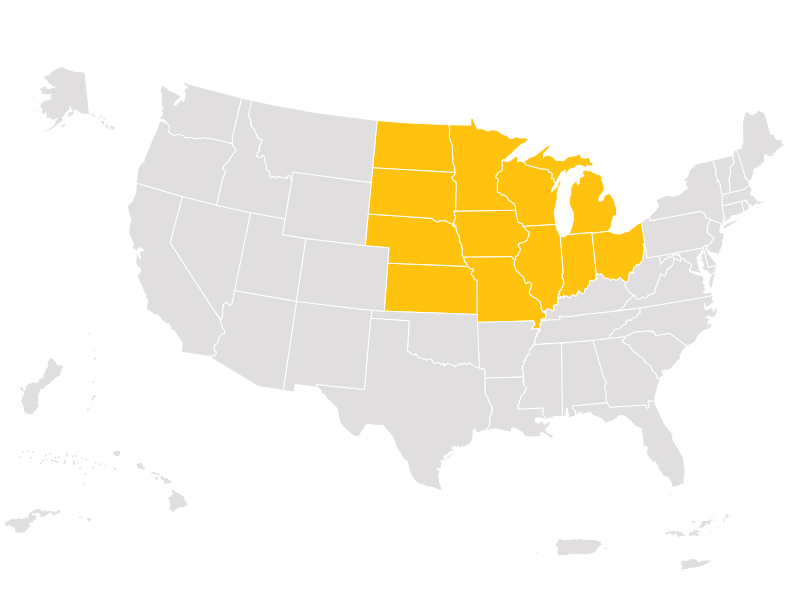
March 4, 1997 Ag Opportunities * Small Farms * New Family Farms * Agricultural Alternatives Vol. 7, No. 5 Mar - Apr 1997 What is Holistic Management? (by Bill Casey, Farm Management Specialist, Clark County and John Leeser, Rancher, Marion County) ============================================================ Holistic Management is a value centered decision making process. This process provides an economical and practical approach to the management of our ecosystem. This includes the human, financial, and biological resources on our farms, ranches, public and tribal lands, as well as national parks, vital water catchments and other areas. To manage these resources, we have to understand how they interrelate and how our management will affect their interrelations. This is the process we call Holistic Management, and it is essential to achieving lasting success. Unlike the standard methods of tackling resource problems, Holistic Management does not advocate any specific technique. A solution is acceptable if it meets three simple criteria: It must be economically sound, ecologically sound and it must help achieve your goal. Holistic Management has a specific process, a checklist of sorts, to ensure that we are consciously aware of each of these criteria before we make a management decision. The process helps you think through the many ramifications a single action can produce in your environment to ensure that if taken it will produce the goal you're ultimately aiming for. This checklist forces us to look for the true causes of problems instead of continually treating symptoms. Evaluating and planning our expenditures of time and money toward the right things is critical. Tools that take us closer to our goal and that create new wealth from the land. Farmers have a unique position. New wealth for our families and communities can be generated from harvesting a brand new ray of sunshine each minute. No other business can do this. Once a decision is made, you then monitor your progress by looking for early warning signs, using the Holistic Management process to guide you. If you stray off course, you'll know fairly quickly and can readily make adjustments before serious mistakes are made. Many people who are practicing Holistic Management have said that this step-by-step process really helped them take their own thoughts, that were already rolling around in their head, put them on paper and organize them! Holistic Management is being practiced by ranchers, farmers, conservationists, public organizations and others throughout Missouri, the US and Africa and Australia. Here in Northeast Missouri the Greenley Research Farm and about 30 families are just beginning the process of learning this new way of making management decisions. This network of people, just like you, are helping each other through joint business efforts that are win-win for both parties, brainstorming innovative management strategies and putting their time and money where it counts the most. The results of using this process are economically sound while at the same time improving the land, wildlife and water resources that are the keys to our survival in the long run. For more information on this dynamic management process contact, Bill Casey, Extension Farm Management Specialist Certified Holistic Management Educator, Clark County Extension Office, 115 West Court, Kahoka, MO 63445, 816-727-3339, caseyw@ext.missouri.edu. See "In Print" section for books on HRM. Holistic Management on the Leeser Farm A few of the things that John Leeser feels have been critical in their operation include: 1)evaluating the situation and looking for the true causes of "problems" and not trying to always "buy" a solution. True solutions don't create other problems and they only happen once, not over and over again; 2) determining where the expenditure of time and money will give the "biggest bang for the buck". Prevention is stressed. The following is John's comparison of traditional versus holistic management on two common "problems" on his farm: TRADITIONAL Goal : Fly eradication. To bring fly populations to an economic threshold. Tools: Usually chemical or mechanical control that costs about $1 per head every year. Goal : Weed eradication. To bring weed populations to an economic threshold. Tools: Usually chemical or mechanical control that costs about $3-$4 per acre every year. HOLISTIC Goal includes: 1) Your quality of life, what you have to produce to support it (including profit), the landscape you desire in the future to support the production indefinitely. Tools: All tools are considered. In John's case: Planned grazing which also helps him to harvest more grass. -The cattle have often moved several pastures away by the time flies hatch. Many, but not all, flies remain behind lowering the pressure on livestock. -Improvements in insect and microbial biodiversity help manure piles to break down more quickly and leave reduced breeding areas for flies. Goal includes: 1) Your quality of life, what you have to produce to support it (including profit), the landscape you desire in the future to support the production indefinitely. Tools: All tools are considered. In John's case: Planned grazing which also helps him to harvest more grass. -Many "weeds" are palatable and quite nutritious at a young tender stage. -Planned grazing helps improve pasture density. By reducing overgrazing and over resting, the ability of many "weeds" to germinate in large numbers is reduced dramatically. Grasses and legumes gain a competitive advantage. Grant program offers producers funds for innovative on-farm research, education and demonstration projects. =========================================================== Farmers and ranchers interested in exploring new possibilities for higher profits, environmental stewardship, or community development have the opportunity to do so with funds for research and education projects from the USDA's North Central Region (NCR) Sustainable Agriculture Research and Education (SARE) Producer Grant Program. "This is a very good program for farmers who want to make a change for the better," says Joe Golimbieski, a Michigan farmer and Producer Grant recipient. "Farmers receiving the grant get help and in return they can help many other farmers from experience gained by the SARE grant work." This year, $200,000 is available through this competitive grant program. The North Central Region will award up to $5,000 to individual producers investigating any sustainable practice or concept and up to $10,000 to groups of producers proposing creative marketing projects. "Marketing in this age of competitive global food systems is more and more a necessary survival skill for farmers," says Molly Bartlett, Ohio farmer and NCR SARE Administrative Council member. "With marketing knowledge, farmers are better able to seek out satisfying, profitable and regional markets." The Producer Grant Program combines practical knowledge, farmer networking and collaboration among farmers, agricultural educators and researchers in inventive projects. Ken Schneider, the NCR's producer liaison, strengthens this program by visiting NCR SARE project farms. "The farmers I meet know what they would like to change or explore, they just need an incentive," says Schneider. "The SARE program offers them the opportunity to take risks and make changes they may not otherwise make." Applications are available from the North Central Region Office beginning Feb 3, 1997. Producers must reside in the 12 state North Central Region: IL, IN, IA, KS, MI, MN, MO, NE, ND, OH, SD and WI. Applications are due May 1, 1997. Funding decisions will be made in late June 1997. Funds will be available in mid-fall for the 1998 crop production season. Call 402-274-7081 or e-mail sare001@unlvm.unl.edu for an application. Circle of Life (by Lindsey Head, Agricultural Journalism Undergraduate, University of Missouri) ======================================================= A circle is never ending. It is a line that unites to produce a uniform bond. Circles of life and love surround Dennis and Cynthia Middletons farm. The Middletons farm is located in the heart of Amish country, near Jamesport, Missouri. Their farm, like the Amish community, is linked together by family, hard work, traditions, goals and a deep respect for the environment. These links form an unbreakable chain of sustainability. The Middletons have been using traditional farming practices for the past 21 years. They farm 570 acres of land. They raise cattle, hogs, prairie chickens and a variety of crops. Two years ago the Middletons decided to change their way of thinking. "If you take something off the land, you should put it back," says Dennis. The Middletons turned to sustainable agriculture to help them become less dependent on chemicals and outside products and more dependent upon on-farm resources. Although the Middletons have faced hardships, they are slowly taking new steps to sustainability. "We keep telling ourselves that it doesn't happen overnight," says Dennis. "We are trying to relearn things our fathers learned from their fathers. We have to start all over." The Middletons are learning together. Their circle of love revolves around devotion and shared responsibilities in the management of the farm. Cynthia spends two days a week working in town. She devotes the rest of her time to the farm. She runs the combine, manages the finances and is in charge of advertising, selling and caring for their prairie chickens. She enjoys helping Dennis, a full time farmer, and attributing to the profit of the farm. "We need to both be here," says Cynthia. "Its not good for Dennis to be by himself." The Middletons share the dream of becoming completely sustainable. The Middletons use crop diversity and rotation, intensively managed grazing systems and a livestock and crop relationship to begin their new circle of life. The circle begins with crop production. They raise a variety of crops, which include milo, soybeans, wheat and occasionally corn. They utilize crop diversity and rotation to keep the nutrition level of the soil balanced. They practice a variety of tillage which includes no-till, minimum till and mulch till. The Middletons livestock operation revolves around crop production. "We cut the wheat, bail it, and put it in the hog houses," says Dennis. The Middletons have a deep bedding system for their hogs. In a deep bedding system, a producer places straw on the floor of the livestock building. New straw is placed on top of old straw forming a layered floor. This method is a relatively inexpensive alternative to a confinement system. The Middletons have built two 30 x 84 feet hog houses on an old concrete feeding floor. There are 210 hogs in each building. These buildings are roofed by a hoop structure covered in a special cloth. It has a half-moon appearance. Every two to three days Dennis places a bail of straw, from his land, in the buildings. A clean layer of straw is placed on top of the old layer forming a deep bedding for the hogs. The hogs love to play in the new straw and have adapted well in both summer and winter. Each side of the building can be opened in summer for ventilation. The buildings are closely spaced in order to create a wind tunnel effect to keep the hogs cool. A sprinkler system has also been installed in case of extreme heat. In winter, the decomposition of the manure and straw provides enough heat that no electricity is required to keep the hogs warm. The Middletons have a contract with Cargill to buy and sell hogs twice a year. When the hogs are sold, Dennis removes the accumulated layers of straw with his Bobcat and spreads it on the fields where their 15 head of cattle graze. The ground depends on the manure and straw to add nutrients which in turn helps the livestock. The Middletons divide 35 acres of land into nine paddocks. They practice intensively grazing systems on this land. They let the cattle graze for three to four days and then move then to a new paddock. This process keeps the soil nutrition high and the weed problems low. The cows continue the circle by leaving manure. The Middletons also raise prairie chickens. The chickens follow the cattle in the grazing cycle. They eat the larvae in the manure and other bothersome insects. They advertise their chickens by word of mouth and only raise what they can sell locally. Then it is time for the Middletons to begin the circle all over again, planting crops in the land where the cattle and chickens have eaten the weeds and insects, bailing the wheat from the land, using the straw for the deep bedding system, and placing the manure and straw back on the land. The Middletons appreciate the circles that sustain their lives. They have united each aspect of their farm to produce a uniform circle of production. That circle helps them to obtain economic goals for their future, and fill their lives with love and laughter. "Were not trying to get rich", says Dennis. "Were just trying to sustain our way of life with a balance." In The News =========== The new strategy to obtain fair bargaining rights for commodity producers will be an amendment to the 1967 Agricultural Fair Practices Act, introduced in Jan 1997 by Marcy Kaptur (D-OH), will accomplish the same objective as the proposed Ag Bargaining Act supported by the Campaign for Sustainable Agriculture in 1995-96. The amendment will create a bargaining obligation between processors/handlers and cooperative associations of agricultural producers. It would apply to all types of producers who form member-controlled cooperatives, for commodities such as livestock, timber, fish and produce. For more information contact John Morrison, National Contract Poultry Growers, 318-251-9227. (National Campaign for Sustainable Agriculture, Nov 1996) There are 211,600 beekeepers in the US. They are tending 3.2 million bee hives. It is estimated we need more than 4 million hives for adequate pollination. (Missouri State Beekeepers Assn Newsletter, Dec, 1996) The Law School at the Univ of AR offers a legal clinic for farmers. The clinic works with farmers throughout the country who face legal problems with USDA, EPA and other federal agencies. General information and legal assistance is provided by law students, under the supervision of licensed attorneys. Contact The Univ of AR, School of Law, Legal Clinic, Fayetteville, AR 72701-1201, 501-575-3056. (Farmers Assistance Program Newsletter, Dec 1996) Bird depredation continues to reduce the harvest from blueberries, grapes, apples and cherries. In preliminary studies at Cornell Univ, researchers have found that common table sugar applied to blueberries resulted in more fruit at harvest. Sugar was added to a tank of water until it would no longer dissolve (a saturated solution). A spreader-sticker was added before the solution was applied to the fruit. The first application was made when the berries first turned blue, and reapplied after rainfall. In 1996, four applications were made before harvest to ensure that berries were sugar-coated. Each application cost about $100/acre. The reason for the decreased depredation is unclear. It may be that certain birds, such as robins, starlings and cedar waxwings, are unable to digest sucrose or that the birds are repelled by the sticky surface of the fruit. (Top Crops, Winter, 1996) For the past several years, the Univ of MO has participated in the NC-140 rootstock project, which evaluates the performance of new rootstock. A table summarizing characteristics of rootstocks have been included in these research trials at the University's Horticulture and Agroforestry Research Center in New Franklin is available by contacting MAC, 800-433-3704 or Michele Warmund, 573-882-9632. Farm Aid distributed $582,000 in grants in 1996 to help family farmers stay on their land. These grants funded a variety of programs, including projects to provide legal and financial counseling to help farmers avoid foreclosure, provide support for farmer-led sustainable agriculture initiatives, support efforts to restrict the growth of factory farming, and build links between farmers and consumers. Since 1985, Farm Aid has granted over $13 million to farm organizations, hotlines, and service agencies in 44 states. For more information about Farm Aid grants, call Harry Smith at 617-354-2922. "Guardian", a new peach rootstock, could offer an alternative to using the pesticide methyl bromide to rid the soil of nematodes that cause peach tree short life(PTSL). PTSL is a major problem for peach growers throughout the US. Scientists with USDA's Agricultural Research Service developed the new rootstock-in conjunction with Clemson University-to resist the ring nematode that leads to PTSL related tree death. ARS scientists have recently found that this rootstock also resists the root-knot nematode which causes reduced tree growth. Guardian is now available at commercial nurseries at bulk seed for next year's growing season. (Small Farm Today, Feb, 1997) Four watermelon lines that have resistance to a key virus are now available to breeders. The lines are the result of a 5 year research project to find melons resistant to watermelon mosaic virus, an aphid-transmitted pathogen that can drastically reduce yields. Limited quantities of seed for the new lines are available only to public and private breeders, who must cross the lines with commercial types to develop new hybrids for public sale. It could take 5 years or more for breeders to incorporate the resistant lines into the sweet tasting melons that are popular summer picnic fare. Contact A Graves Gillespie, Jr, USDA-ARS Plant Genetic Conservation Resources Unit, Regional Plant Introduction Station, 1109 Experiment St, Griffin, GA 30223, 770-412-4777. (Agricultural Research, Jan 1997) ARS and Perdue Farms in Salisbury, MD, will try to turn chicken feathers into a cheaper, biodegradable substitute for wood or synthetic fibers. Work is being done under a cooperative research and development agreement. An ARS scientist discovered that feather fibers are strong and more absorbent than wood or plastic fibers. Commercially available microorganisms can compost feather fiber in 3 weeks. ARS is patenting a feather fiber separation process. It uses less water, energy, and chemicals than methods for other fibers. Feather fibers may be used in disposable diapers, hospital wipes, and sanitary napkins. Future products may include air and oil filters, specialty papers and structural composites. Contact Walter Schmidt, USDA-ARS Environmental Chemistry Lab, Beltsville, MD, 301-504-5030. (Agricultural Research, Jan 1997) An interesting development with Trichodex has been the use of honeybees to deliver the biocontrol fungus to strawberry flowers when the bees visit the flowers for pollination and nectar. The product is put directly into the beehive in a specially designed tray that the bee has to crawl through as it leaves the hive. When the bee visits the flower the beneficial fungus rubs off onto the flower. Research has shown this delivery method to be more effective than conventional spray rigs because the bee fully coats the flower with the material, whereas sprayers do not. The substance is completely harmless to the bee, the strawberry plants, and the environment. (Farmer to Farmer, Jan-Feb 1997) The National Organic Standards Board (NOSB) ruled last Sept that genetically engineered food can not be labeled organic. The NOSB defines genetically engineered as "made with techniques that alter the molecular or cell biology or an organisms by means that are not possible under normal conditions or processes. Genetic engineering includes recumbent DNA, cell fusion, micro- and macro-encapsulation, gene deletion and doubling, introducing a foreign gene and changing the positions of genes." NOSB does not prohibit breeding, conjugation, fermentation, hybridization, in-vitro fertilization or tissue culture in organic production systems. (Farmer to Farmer, Jan-Feb 1997) The Univ of AR has released another new blackberry cultivar, Kiowa. Kiowa produces thorned canes, with thorn size and density similar to that of Shawnee. Canes are self-supporting and require no trellis. Noted characteristics of Kiowa are its large fruit size, which is maintained throughout the harvest season, and its long ripening period. Also from the Univ of AR, the first blueberry developed by their breeding program should be available at nurseries in 1997. It is a southern highbush blueberry that is resistant to frost damage. This variety has a longer chilling requirement than other southern highbush varieties. Ozarkblue will produce high yields of large berries with good fruit quality. (Illinois Fruit and Vegetable News, Vol 3, No 1, Jan 1997) In Print ======== The following books on Holistic Resource Management are available from The Center for Holistic Management, 1010 Tijeras NW, Albuquerque, NM 87102, 505-842-5252: *Holistic Management Quarterly Special Edition* - Overview and introduction to Holistic Decision Making. *Creating A Sustainable Civilization* - Video of Allan Savory giving an introduction to Holistic Decision Making, how the process was developed and why it is so critical to our future. *Holistic Management Quarterly* - Contains the latest on Holistic Management and stories about folks who are using the process in everyday life. *Holistic Management Textbook* - Available now with revisions for a new edition to be ready in a year or so. *Holistic Management Workbook* - Valuable for those with grazing operations and that are going to make long run land planning decisions. *Comprehensive Guide to Holistic Financial Planning* - Guide to planning a profit and generating true wealth. It has a whole different psychology than conventional financial planning. *Aide Memoire for Grazing Planning* - this is not "rotational grazing" but grazing with a purpose, using animals with a tool and considering the "whole" situation. *For those with crops* contact Bill Casey, Extension Farm Management Specialist Certified Holistic Management Educator, Clark Co Extension Office, 115 W Court, Kahoka, MO 63445, 816-727-3339, for a short packet on holistic management and crop farming. *Direct Marketing Resource Notebook* produced by the Midwest Sustainable Agriculture Working Group, $20.00. Available from Nebraska Sustainable Agriculture Society, PO Box 736, Hartington, NE 68739, 402-254-2289. *Knee Deep in Grass* a study of 29 grazing operations published by the Minnesota Institute for Sustainable Agriculture, $7.00. Call 800-876-8636. *Small Acreage Farming* $16.00, an 8 page newsletter and *Starting Your Small Farm* $7.00, a decision series guide are both available by contacting Jeff Rast, Center for Small Acreage Farming, PO Box 219, Fairfield, ID 83327. *Planting the Future* current information for future choices, backed by research that shows what sustainable agriculture can do for farmers and their communities, $14.95. ISU Press, 2121 S State Ave, Ames, IA 50014, 800-862-6657. *Turning Garbage Into Gold* $15.00, is an introduction to vermiculture. Contact Stephen White, Worm Digest, Box 544, Eugene, OR 97440-0544, 541-896-9058. *Educational and Training Opportunities in Sustainable Agriculture* available from Alternative Farming Systems Information Center, National Agricultural Library, Room 304, 10301 Baltimore Ave, Beltsville, MD 20705-2351, 301-504-6559, afsic@nal.usda.gov *Exploring the Role of Diversity in Sustainable Agriculture* by Richard Olson, Charles Francis and Stephen Kaffka. Examines relationship of diversity to agriculture, including diversity of soil microbial life, crops, farmscapes and sources of income. $26.00. American Society of Agronomy, CSSA, SSSA Headquarters Office, Attn: Book Orders, 677 S Segoe Rd, Madison, WI 53711, 608-273-8080. *Biological Control Web Page* (Web site). Center for Integrated Pest Management and Consortium for International Crop Protection. Provides links to biological control organizations, databases and other web sites with information about biological control. http://ipmwww.ncsu.edu/biocontrol/biocontrol.html. *Growing Together: Community Gardening and Food Security* FREE. Handbook covers details of establishing a community garden. Call 800-882-5592. *1997 Midwest Vegetable Production Guide* $6.00 + $2.50 S&H. Available from Agricultural Publications, 69 Mumford Hall, Univ of IL, Urbana, IL 61801, 217-333-2007. On The Calendar =============== Mar 15 MO Beekeepers Assn Meeting, Columbia, MO. Contact Neal Bergman, 573-888-1301. Mar 16-22 National Agriculture Week Mar 16 Midwestern Beekeepers Beginning Beekeeper Workshop, Kansas City, MO. Contact Joli Winer, 800-547-1392. Mar 18 Compost Procurement and Use Workshop, Central Iowa. Contact Garth Frable, 515-281-8895. Mar 19-21 International Conference on Agricultural Production and Nutrition, Boston, MA Mar 19-20 Sheep & Goat Shearing School, Jefferson City, MO. Contact Helen Swartz, 573-681-5551. Mar 21-23 BioIntensive Sustainable Mini-Farming Workshop, at The Center for Sustainable Living, Chambersburg, PA. Contact Cynthia Jeavons, 707-459-0150. April 4-6 MO Association of Meat Processors State Convention and Trade Show, Jefferson City, MO. Contact Ronnie Alewel, 816-827-0005. May 17 Fiber Fair, Marshfield, MO. Contact Gladys Gaeke, 417-859-2914. May30-June 1 MoFA Annual Conference, Springfield, MO. Contact DK Talliaferro, 3354 Independence, Springfield, MO 65804. June 3-5 Wind Erosion: An International Symposium/Workshop, Manhattan, KS. Call 913-532-6495. June 14-15 Watkins Mill Lost Arts Festival, Lawson, MO. Contact Ann Sligar, 816-296-3357. June 25-28 3rd International Interdisciplinary Conference on the Environment, Boston, MA. July Fiber Workshop, Poplar Bluff, MO. Contact Jack Crofford, 573-686-8064. July 30-31 Leopold Center for Sustainable Agriculture's 10th Anniversary Conference, Ames, IA Contact Rich Pirog, 515-294-3711. Aug 10-12 MO Landscape & Nursery Association Summer Meeting & Trade Show, Springfield, MO. Contact Sara Woody Bibens, 816-369-3115. Aug 14-23 Missouri State Fair, Sedalia, MO. Aug 28-29 Bethel Fiber Expo, Bethel, MO. Contact Helen Swartz, 573-681-5551. Aug 30-Sept 1 World Sheep & Fiber Arts Festival & Flower Festival, Bethel, MO. Contact Karen Arment, 573-633-2652. Dec 14-16 MO Governor's Conference on Agriculture, Tan-Tar-A. MAC Needs Pictures ==================== The MAC is creating a new display for exhibits. If you have pictures of your farm where you are growing or raising agricultural alternatives, we would be happy to use your picture in our display. What a great way to utilize free advertising. Your expense, the cost of a picture. Below the picture we will list the name of your farm and its location. If you're interested send your picture with a short description of your operation, contact name, address and phone number to: Missouri Alternatives Center, 628 Clark Hall, Columbia, MO 65211. Missouri Alternatives Center =============================== The Missouri Alternatives Center is supported by University Extension; Lincoln University; MU Extension Division; MU College of Agriculture, Food and Natural Resources; and the MO Dept of Conservation. MAC provides information to Missourians on alternative crops, livestock, small farm options and alternative rural enterprises. MAC is open weekdays from 8 am to 5 pm. For more information contact: The Missouri Alternatives Center, 628 Clark Hall, Columbia, MO 65211, 573-882-1905 or 800-433-3704. Missouri Alternatives Center University of Missouri 628 Clark Hall Columbia, MO 65211 (800) 433-3704 (573) 882-1905 Debi Kelly, Editor Ag Opportunities is published six times yearly. Questions or address corrections should be sent to the Missouri Alternatives Center. Ag Opportunities can be found on the WWW at http://agebb.missouri.edu/mac/agopp/ University Extension does not discriminate on the basis of race, color, national origin, sex, religion, age, disability or status as a Vietnam-era veteran in employment or programs.