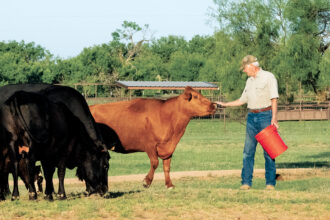
August 21, 1996 Ag Opportunities * Small Farms * New Family Farms * Agricultural Alternatives Vol. 7, No. 2 Sept-Oct 1996 "American Livestock Breeds Conservancy" (Reprinted with permission from "Southern Sustainable Farming.") ---------------------------------------------------------------- Eighty-three percent of the registered dairy cattle in the United States are a single breed--Holsteins. Together with Jerseys, Ayrshires, Guernseys, and Brown Swiss, these five breeds comprise almost our entire milking herds. Sixty percent of the beef cattle in our country are Angus, Hereford, or Simmentals. Only three breeds make up more than 75 percent of the swine population in the United States. And four breeds make up two-thirds of the sheep population in our country, with the Suffolk accounting for 40 percent. To a proponent of industrialized agriculture, these figures may conjure images of uniformity and high production, but to Don Bixby, director of the American Livestock Breeds Conservancy (ALBC), they point out a glaring loss of genetic diversity. He says, "Modern production agriculture favors the use of a few highly- specialized breeds that have been selected for maximum production in a controlled environment." Many traditional livestock breeds are threatened with extinction because they are no longer favored. When we lose breeds, we lose genetic diversity. "In order to meet our agricultural needs for the future, we need to have as many genetic resources as possible," according to Bixby, who practiced veterinary medicine for 20 years before coming to ALBC. Who knows what the future will bring? If we only have four or five breeds to choose from, we'll have lost innumerable valuable traits from the gene pool. And to those who think gene banks are the answer, Bixby replies that frozen semen isn't the same as having hundreds of breeds of living animals constantly making micro-adaptations to climate and conditions. Besides losing genetic diversity, our development of a few highly specialized breeds has led to what Bixby calls "high-tech husbandry." Most of the predominant breeds of farm animals need an agricultural support system of high inputs and more intensive management. For example, Holsteins--having been bred for maximum milk production at the expense of other traits--may be fine for a high-tech milking and feeding facility. But what about the farmer who is trying to cut his costs and become more sustainable with a pasture dairy operation? A Holstein cow isn't as efficient as many other breeds at converting forage to milk. They develop more problems in their joints when moving around all day. And they require almost three services per conception on the average, as opposed to one for many other breeds. By trying to adapt a handful of breeds to every farm and every condition in our country, we are losing the heritage breeds--animals that, according to Bixby, "retain the survival traits no longer found in industrial stocks, such as climate adaptation, resistance to disease and parasites, forage efficiency, longevity, high fertility, and maternal abilities." In the US, nearly one-third of our cattle breeds are facing extinction. World-wide, 1,500 farm animal breeds are threatened, according to the Food and Agriculture Organization in Rome. Protecting Livestock Breeds From Extinction The mission of the American Livestock Breeds Conservancy is to protect breeds of cattle, goats, horses, asses, sheep, swine and poultry from extinction. By conducting a census of livestock approximately every five years, the organization has been able to develop a conservation priority list and monitor the progress of endangered breeds. ALBC encourages the use of these endangered, heritage animals. "Our work is mostly helping to educate people to consider more than one option when they make their breed selection," says Bixby. "We help people to figure out their goals and to pick a breed based on their needs and market." Over half of the 4,000 members of this non-profit organization are raising heritage breeds themselves. The ALBC staff also provides technical assistance to breed associations, helping them to establish bylaws, breed standards, and in setting up or maintaining registries. Where no breed association exists for an endangered animal, ALBC will help establish an association. And ALBC assists producers to network with buyers and sellers of the breeds they're interested in, especially for those breeds which don't have a national association. This is done mostly through publishing a yearly directory of breeders and a bi-monthly newsletter. The conservancy works with several universities to conduct research on breed characteristics and use. By documenting the grazing efficiency or parasite resistance of various breeds, for example, producers are able to make more informed choices about the appropriate animals for their farms. Producers seeking assistance in developing specialty markets for rare breed products can also contact ALBC for help. Bixby says. "We can help people develop a marketing plan for specialty products [such as unusual wool colors and textures from heritage sheep]. Instead of selling the product at a low market price because of low demand, they can sell high in a niche market." More than anything, ALBC acts as an information source for producers and consumers interested in endangered breeds of livestock. They publish literature on heritage breeds and host an annual conference with a different focus and location each year. Resources Available From ALBC *Noah's Ark Today: Saving Rare Breed Farm Animals for the Future* Bixby feels that the message to many youth focuses on the importance of saving plants and wild animals (ie: the rainforest), but neglects the importance of farm animals. "Animals have always been an integral part of agriculture," he says. "They provide nutritious foods, such as milk, cheese, eggs and meat, as well as wool, cashmere, mohair and other natural fibers. Properly managed animal services, including browsing and grazing, pest control, and draft power can replace environmentally damaging practices." *A Conservation Breeding Handbook* Carolyn Christman and D. Phillip Sponenberg. Explains the importance of livestock and poultry breeds, and demonstrates how individual breeders can be stewards of these genetic resources. *Taking Stock: The North American Livestock Census* ALBC Staff. The best source on livestock genetic diversity, breed status, and conservation strategy. A complete list of breed associations is included. *American Minor Breeds Notebook* Laurie Heise and Carolyn Christman. An illustrated guide to 77 breeds of livestock. *1987 Poultry Census and Sourcebook* Laurie Heise and Carolyn Christman. Description and drawings of 15 breeds of poultry and a list of sources. ALBC also has a catalog of several animal health and care books, notecards and posters. For more information, contact ALBC, PO Box 477, Pittsboro, NC 27312; 919-542-5704 (phone); 919-545-0022 (fax). "Something to Think About" by Bill Casey, Farm Management Specialist, Clark County ------------------------------------------------------- I recently participated in a conference on soil fertility. There were some things discussed that I think have great importance to our future profitability in agriculture. The soil scientists there were from two Missouri Universities and the University of Vermont. The following are some of the highlights. Fertile soil is the foundation for healthy plants, animals and humans. While several things affect soil fertility, the biggest key is organic matter. Improving organic matter levels in the soil improves nutrient availability, soil structure, water infiltration and storage capacity, lowers insect and disease problems and decreases soil loss due to erosion. The bottom line is, increasing organic matter levels in the soil makes its easier to grow plants! What could it do to your pocket book? There are 3 types of organic matter. 1) Living creatures such as bacteria, fungi, insects, nematodes, earthworms, plant roots, etc. Some of these can be seen and observed and some can't. 2) Dead plant material such as this years crop residues that can be seen. 3) "Very Dead". This is what is sometimes called "true humus" and can't be seen with your eye. This is what is measured in a soil test. Why is all of this stuff important? A diversity of living soil life is important to the health of our crops. Every "bad" bug, such as soybean cyst nematodes and fungal diseases have other critters that survive by eating them. This is just nature's way. By promoting an environment good for all of these critters it makes it less likely that any one critter will get out of control. Bacteria and fungi break down crop residues so the nutrients in them can be released for plant use again. Fungi such as mychorhizea are crucial for plant phosphorous intake and can actually extend the root systems of plants many fold so that water can be more efficiently utilized. Many of the insects in the soil in addition to the earthworm help stir and churn the soil and improve its ability to get the proper balance of air and water in the soil. Plant residues or mulches help the soil stay porous by keeping raindrops that pack it down and seal it off away. They also keep the soil moisture and moderate its temperature so that the living organisms can be at work for longer periods of time. The unseen humus is the smallest possible particle of organic matter and is a source of plant nutrients. For example a 5% organic matter soil can release nearly 100 pounds of nitrogen slowly over the growing season. It also increases the exchange capacity of the soil which allow the soil to hold more nutrients than before. This is particularly important for nutrients such as nitrogen, sulphur and boron which are easily leached out of the soil with heavy rainfall. It also naturally chelates micro nutrients and keeps them in a state that is more available for our plants. The microbes in the soil must have organic matter to survive. Generally, the higher your humus levels the more of these little unseen workers you will have in the soil. There are several ways to increase the organic matter content of our soils. The use of manures, green manures, composts and carefully selected crop rotations can all contribute. The use of sod forming plants such as grass and legumes such as clovers and alfalfa are particularly effective. Tillage of any kind literally burns up the organic matter reserves in the soil. The less that is done the better if you want to improve this situation. Any time the soil erodes it takes the most valuable part down the creek, topsoil containing humus and the bulk of plant available nutrients. None of this stuff is new but it is still very crucial. None of this is rocket science either. Anyone can do it if they really want to. The following are some tips from Gary Hoette, regional Extension Agronomist. You need to know where you are right now, how you got there and where you want to go. Building organic matter levels is not easy. Start with where you are at and try to improve it by 1%. Just get started! Observation is critical! You have to study what's going on out there on the ground and pay attention. Gary said to "Consider that your kids are under your feet!". The soil is a dynamic growing organism. Working ground wet will very quickly destroy what you have built because it pushes air out of the soil. The soil microbes need this air to survive and break down crop residues. Soil compaction is also created. Soil compaction is a human problem. You can have it in any tillage system. If you are serious about improving the productivity of your soils and increasing organic matter levels, you must try to prevent and eliminate it! In The News ----------- The following upcoming programs will be used to promote professional development opportunities for extension workers, as well as others, who provide sustainable agricultural information to farmers. Oct 2-Oct 4-Holistic Resource Management, Marshall, MO-Learn how to actually apply this practical decision making process: Defining the whole under management, utilizing all of our resources, setting a holistic goal, testing our decisions against our goal and to ensure they are good for people, finances and land, financial planning and wealth generation. For more information on the program content contact Bill Casey, Farm Management Specialist, Clark County, Extension Center, 115 W Court, Kahoka, MO, 63445, 816-727-3339. To register contact Cynthia Crawford, Consumer & Family Economics Specialist, Saline County Extension Center, Courthouse Basement, Room 100, Marshall, MO, 65340, 816-886-6908. Oct 31-Nov 2-Sustaining People on Small Farms, Columbia, MO-Thursday afternoon will see presentations by Andy Lee and Joel Salatin. Friday and Saturday will include two one and half hour workshops in either mushrooms, seed saving, herb/ginseng, livestock, and market gardens. In addition, seminar presentations will be attended in ethnic vegetables, community supported agriculture (CSA), deer, sheep, marketing, goats, small fruit, ostrich, hydro-organics, pet markets, aquaculture, emu, rabbit and flowers. For additional information, contact JC Owsley, Hickory County Extension Center, PO Box 187, Hermitage, MO 65668, 417-745-6767 or Jack Crofford, SFFP, Butler County Extension Center, Courthouse, Poplar Bluff, MO, 573-686-8064. The number of Missouri farms on June 1, 1996 is estimated at 104,000, down 1,000 from a year earlier. The average farm size in Missouri is estimated at 288 acres, up 2 acres from a year ago. A farm is defined as "any establishment from which $1,000 or more of agricultural products were sold or would normally be sold during the year." Total land in Missouri farms is 30 million acres, unchanged from 1995. Missouri farms in the economic sales class of $1,000 to $9,999 in 1996 are estimated at 54,600 compared with 55,000 a year earlier. Farms in the sales group of $10,000 to $99,000 totaled 39,500, down 600 from last year. The $100,000 and over group is estimated at 9,900 unchanged from 1995. Texas remained the state with the most farms at 205,000, 3,000 more than a year earlier. Missouri was second with 104,000 farms, down 1,000 from last year, followed by Iowa with 98,000 farms, down 2,000 from 1995. (Missouri Crop and Livestock Reporter, Aug 14, 1996) For information about a Grade A dairy facility on your farm, contact Terry Long, Missouri State Milk Board, 915C Lesley Blvd, Jefferson City, MO 6510, 573-751-3830. Sawmills in Missouri generate about 750,000 tons of sawdust yearly. Most has been stockpiled over the years, resulting in many large, old piles that could be used horticulturally. MU research has shown that oak sawdust can be composted efficiently with poultry manure, the end product having properties similar to peat. The main objective of the experiment was to determine whether amending a clay loam soil with composted sawdust can enhance the establishment of bluegrass. For more information, contact Chris Starbuck, 573-882-9630. (Branching Out,Aug 96) The Missouri Department of Conservation and the Forest ReLeaf of Missouri have proudly begun the Missouri Forestkeepers Network-the state's first comprehensive citizen forest health monitoring program. Forestkeepers is designed to teach participants about tree and forest health, assist them in assessing general conditions, and provide the opportunity to share findings through a statewide network. Forestkeepers provides not only the first statewide citizen network for forestry, but also an early warning system against threat to the health of forest communities. For a program brochure or additional information call 888-9-FOREST. A study at Lincoln University focused on identifying the vegetation responses that result from goat grazing of selected browse components during different phenological stages in the midwest. Goats were utilized at a grazing intensity to simulate a high intensity (170 goats per acre) short duration (3 days) grazing period. The effects of grazing on two species of woody pasture weeds (Eastern red cedar and blackberry) were evaluated. Consumption during the first summer grazing period was determined to be 30% for cedar and 38% for blackberry. The nutritional quality of 27 species of plants consumed by goats was determined. Ten of these 27 plants exceeded the relative feed value of alfalfa in full bloom. For more information, contact Dr. Fred Hassien, 573-681-5370. (Cooperative Research, Lincoln University, Vol 1, No 1) Sales of US organic products in 1995 increased 22% over 1994 figures, according to a recent survey conducted by Natural Foods Merchandiser, a natural products industry journal. Sales increased from $2.31 billion in 1994 to $2.8 billion in 1995. This is the 6th year the market for organic products has had a greater than 20% growth. Several factors contributed to the continuing growth: a widening consumer base, expansion by natural products retailers, greater mainstream acceptance and increasing organic acreage. (Pesticide Action Network, Aug 16, 1996) The US Food and Drug Administration will now allow apples to be labeled "fat free and high in fiber." The label change is expected to give health-conscious consumers more reasons to eat apples. The new label may state "0 grams of fat and 5 grams of fiber" and contain the words "fat free and high in fiber." (Illinois Fruit & Vegetable News, Vol 2, No 17) Diatomaceous earth (DE) is being considered as a stored grain protectant, as pests are developing increased resistance to organophosphates, pyrethroids and other residual treatments. Composed of billions of fossilized diatoms, or aquatic one-celled plants, DE is an inert dust that kills pests by desiccation. In large scale field tests, USDA proved DE to be effective control against the rice weevil, confused flour beetle, red flour beetle, flat grain beetle, rusty grain beetle, sawtooth grain beetle, granary weevil, khapra beetle, and lesser grain beetle, among others. High moisture and high relative humidity impede the efficacy of DE, as insects have a constant source of moisture. High temperatures increase the efficacy of DE, as water loss is enhanced. The primary disadvantages: reduction in bulk density where grain is sold by unit and generate significant dust production. When applied only to the top layer and combined with aeration, there is a substantial decrease in dust accumulation. (The IPM Practitioner: Monitoring the Field of Pest Management, Vol XVIII, No 5/6) In Print -------- *Ten Essential Reasons to Protect The Birds and the Bees: How an Impending Pollination Crisis Threatens Plants and the Food on Your Table, 1996.* The Forgotten Pollinators Campaign presents 10 reasons to protect pollinators, stating agricultural production depends on pollination and that fewer pollinators lead to fewer plants. Forgotten Pollinators Campaign, Arizona-Sonora Desert Museum, 2021 N Kinney, Tucson, AZ, 85743; email: fpollen@azstarnet.com; WWW: http://www.oldwestnet.com/asdm/fp/ *Cotton Connection: Towards Sustainable Cotton Production, 1996.* Proceedings of 1994 conference on sustainable cotton, integrated pest management in cotton and organic cotton production. 98 pp. $33.00. Pestizid Aktions-Netzwerk, EV Nernstweg 32, D-22765, Hamburg, Germany; phone (49-40) 39 39 78, email: pan-germany@umwelt.ecolink.org. *Making It On The Farm: Increasing Sustainability Through Value-Added Processing and Marketing* 1996, by Keith Richards & Deborah Wechsler. Written for farmers who want to take a bite out of the middlemen by bringing the dollars for processing, packaging, labeling, and marketing home to their farms, and to encourage farm-based value-added businesses in their communities, a discussion of 10 keys to success for farm-based value-added operations, and a list of resources. 40 pp. $12.00. SSAWG Publications, PO Box 324, Elkins, AR 72727; 501-292-3714; e-mail: HN3551@handsnet.org. *Weeds: Control Without Poisons* Charles Walters. Describes weed and soil ecology and provides information for identifying many North American weed species. Stresses that careful weed identification can provide important information about soil, plant health and water availability, and discusses how this information can enable farmers to improve crops and control weeds without relying on herbicides. 352 pp. $20.00 Acres, USA, PO Box 8800, Metairie, LA, 70011, 800-355-5313. *Monitoring Sustainable Agriculture with Conventional Financial Data, 1996* Dick Levins. Proposes guidelines for determining the environmental and social sustainability of farms by examining financial records. Assesses sustainability in terms of four criteria: reliance on government programs, job creation, balance between feed use compared to feed production and use of equipment, chemicals and non-renewable energy. States that sustainable farms should not require continual government assistance or excessive chemical and non-renewable energy use, and that they should create jobs and make use of animals on-farm. Provides worksheets and instructions enabling farmers to carry out self-evaluations. $7.00 Land Stewardship Project, 2200 Fourth Street, White Bear Lake, MN 55110; 612-653-0618 On The Calendar --------------- Sept 18-21-The EcoAgroForestry Century-A New Paradigm of Sustainable Development, Dermott, AR. Contact Carol Cross, 501-367-6127. Sept 21-MO Goat Breeders Assn Meeting & Registered Breeding Stock Sale, Lebanon, MO. Contact Paulette Wohnoutka, 417-754-8135. Sept 21-22-Shephard of the Hills Small Livestock & Fiber Festival, Branson, MO. Contact Helen Swartz, 573-681-5537. Sept 25-Nursery and Landscape Field Day, New Franklin, MO. Contact Sara Woody Bibens, 816-369-3115. Sept 27-28-Midwest Forest Industry Show, Cape Girardeau, MO. Sept 27-Oct 1-National Extension Technology Conference, Atlanta, GA. Call 706-542-5387. Oct 2-3-Holistic Resource Management, Marshall, MO. Contact Bill Casey, 816-727-3339 Oct 2-3-Community Food Systems: Sustaining Farms and People in the Emerging Economy, University of California-Davis. Contact Dave Campbell, 916-752-7541. Oct 4-5-MO State Beekeepers Assn Fall Meeting, Jefferson City, MO. Contact Neal Bergman, 573-888-1301. Oct 5-MO Nut Growers Assn/MO Chapter of the Walnut Council Research Field Day, Elsberry, MO. Contact James Jones, 417-276-5181. Oct 7-Special Forest Products Workshop, Hannibal, MO. Contact Marty Calvert, 573-767-5276. Oct 9-10-MO Poultry Federation Fall Meeting, Springfield, MO. Contact Jo Ann Manhart, 573-761-5610. Oct 10-13-MO Grocers' Assn Convention & Food Trade Show, Tan-Tar-A, Lake Ozark, MO. Oct 12-Organic Crop Improvement Assn Meeting & Sorghum Syrup Demonstration, Rutledge, MO. Contact Stan Hildebrand, 816-883-5543. Oct 19-Blueberry Council Assn Meeting, Mountain Grove, MO. Contact Mary Hinze, 573-341-2783. Oct 23-24-Tapestry Weaving Workshop, Marshfield, MO. Contact Helen Swartz, 573-681-5533. Oct 25-Kerr Ranch Field Day, Poteau, OK. Contact Lara Ervin, 918-647-9123. Oct 28-MO Goat Breeders Assn Fall Gathering, Univ of MO-Columbia. Contact Paulette Wohnoutka, 417-754-8135. Oct 31-Nov 2-Sustaining People on Small Farms Professional Development Opportunity, Columbia, MO. Contact JC Owsley, 417-745-6767 or Jack Crofford, 573-686-8064. Oct 31-Nov 2-Four-State Heartland Community Development Conference, Fayetteville, AR. Contact Donald Voth, 501-575-2409. Nov 1-2-Small Farm Trade Show & Seminars: Profit From Diversity, Columbia, MO. Contact Chuck DeCourley, 800-633-2535. Nov 6-8-21st Century Solutions: New Uses for Agricultural Products and Biomass Workshop, Tulare, CA. Contact Ken Foster, 520-621-7900. Nov 6-24-American Royal, Kansas City, MO. Nov 8-9-13th Annual Hydroponic Grower Conference, Orlando, FL. Contact 800-321-5656. Nov 11-16-14th International Symposium on Sustainable Farming Systems, Colombo, Sri Lanka. Dec 6-8-Organic Farmers Marketing Association Conference, Kansas City, MO. Contact Bill Welsh, 319-535-7318. Dec 8-11-National Pepper Conference, Naples, FL. Contact Don Maynard, bra@gnv.ifas.ufl.edu Dec 15-17-1996 Governor's Conference on Agriculture, Tan-Tar-A. Jan 10-11-Great Plains Vegetable Conference, St. Joseph, MO. Contact Keith Hawxsby, 816-279-1691. Jan 10-11-16th Annual Oklahoma Horticulture Industries Show, Tulsa, OK. Contact Lara Ervin, 918-647-9123. Jan 22-25-Ecological Farming Conference, Pacific Grove, CA. Contact 408-778-7366. Jan 24-25-16th Annual Organic Conference and Eco-Products Trade Show, University Centre, University of Guelph, Ontario, Canada. Contact Tomas Nimmo, 705-444-0923. Jan 13-16-Tartan Weaving Workshop, Owensville, MO. Contact Helen Swartz, 573-681-5533. Jan 28-Feb 2-National Direct Marketing Conference, Albuquerque, NM. Contact Vance Corum, 360-693-5500. Feb 5-8-Mid-Atlantic Direct Marketing Conference, Dover, DE. Contact Carl German, 302-831-1317. Feb 20-23-World Aquaculture '97, Seattle, Washington. Call 206-485-6682. Feb 23-25-14th Annual California Farm Conference, Riverside, CA. Contact David Visher, 916-752-7779. Mar 21-23-BioIntensive Sustainable Mini-Farming Workshop, at The Center for Sustainable Living, Chambersburg, PA. Contact Cynthia Jeavons, 707-459-0150. Missouri Alternatives Center ------------------------------ The Missouri Alternatives Center is supported by University Extension; Lincoln University; MU Extension Division; MU College of Agriculture, Food and Natural Resources; and the MO Dept of Conservation. MAC provides information to Missourians on alternative crops, livestock, small farm options and alternative rural enterprises. MAC is open weekdays from 8 am to 5 pm. For more information contact: The Missouri Alternatives Center, 628 Clark Hall, Columbia, MO 65211, 573-882-1905 or 800-433-3704. Missouri Alternatives Center University of Missouri 628 Clark Hall Columbia, MO 65211 (800) 433-3704 (573) 882-1905 Debi Kelly, Editor Ag Opportunities is published six times yearly. Questions or address corrections should be sent to the Missouri Alternatives Center. Ag Opportunities can be found on the WWW at http://agebb.missouri.edu/mac/agopp/ University Extension does not discriminate on the basis of race, color, national origin, sex, religion, age, disability or status as a Vietnam-era veteran in employment or programs.