
To send a message to an author, click on the author's name at the end of the article.
This Month in Ag Connection | Ag Connection - Other Issues Online
A successful fall food plot begins long before seed is ever planted. Hunters often are marketed costly and complex seeding blends to attract deer, but without proper consideration a fall food plot can fail. The most important things to consider are soil fertility, planting practices, species selection, and weed control.
The foundation of every successful food plot is a soil test. Many of Missouri's soils are naturally acidic, and common food plot species such as wheat, oats, clovers, and brassicas perform best when soil pH is maintained between approximately 6.0 and 6.5. Though some species can tolerate a lower pH, many forage species are not as productive. Liming, if needed, should be conducted 6 months ahead of planting for best results. Many times, pelletized lime is the best option for small plots with limited accessibility. Pelletized lime typically has a higher concentration of acid neutralizing material.
Soil testing provides recommendations on liming and fertilizer based on crop needs and existing soil nutrient levels, preventing both under-fertilization that limits plant growth and excessive fertilizer applications that increase costs and the risk of environmental pollution.
Many food plot failures result from poor seeding practices that either bury seed too deep, leave seed placed too shallow in the soil, or do not allow for the seed to make adequate contact with the soil to germinate. In many cases, problems with soil moisture can be alleviated by proper seeding depths during planting. Refer to MU Guide G4652 Seeding, Rates, Dates and Depths for Common Missouri Forages for more information.
Species selection should match both site conditions and hunting objectives. Forage selection should be based upon soil fertility, sunlight availability, soil drainage, equipment availability, deer herd density, and surrounding land use practices.
Winter wheat, cereal rye, and triticale are dependable food plot species which are relatively easy to establish, provide excellent forage quality, and tolerate repeated browsing. Oats produce highly palatable early-season forage but are prone to winter kill.
Brassicas (forage turnips, radishes, rapeseed, canola, and kale) are frequented by deer in colder climates more often after several hard frosts. Brassicas produce large amounts of above ground forage and edible tubers and can have protein levels as high as 40%.
Clover species (red, white, crimson) provide very high-quality forage and supply biologically fixed nitrogen to companion crops or forages planted after the clovers for up to one growing season following termination. It is crucial to inoculate clovers and other legumes before planting and to buy legume species specific inoculant. Without inoculation, legumes will not produce nitrogen and will not persist.
It is often beneficial to plant a diverse species mixture which can potentially improve resilience to weather extremes and reduce the risk of complete stand failure if one species performs poorly.
If weed pressure is an issue, planting monocultures may simplify control allowing for the greatest options for chemical weed control. There are several pre-emergent and post emergent options available for monoculture production, and once weeds have been routed out, stand species diversity can be increased if desired. The length of time this must be done will depend on weed species present. Certain food plot species, like rye, perform very well at suppressing small-seeded weeds like water hemp and marestail, two of Missouri's most encountered glyphosate resistant weeds.
Not every plant that comes up in a food plot that was not planted is necessarily a weed that requires herbicide application. Some non-planted forb and grass species can be of benefit to wildlife when allowed to grow in plots. Identification is key. There are several guides available from MU and Missouri Department of Conservation to help with this process.
Another tool in weed management is to plant warm season annuals in spring in the same plots, providing forage and ground cover throughout the year. This strategy adds weed control options, helps reduce erosion, runoff, and nutrient loss. It is very important when adding this step to a food plot program to pay close attention to planting restriction intervals found in herbicide labels. Labels must be followed exactly on herbicides or any other pesticide and are legally binding. Pesticides are crop, use site, and pest species specific.
For more information on food plots, wildlife management, and soil testing, see MU resources:
Source: Nick Wesslak, Field Specialist in Agronomy
This Month in Ag Connection | Ag Connection - Other Issues Online
Garlic is an excellent crop for both beginning and experienced gardeners. It is relatively easy to grow, requires minimal maintenance, and takes up very little garden space. Once established, garlic needs little care beyond occasional watering and weed control, making it one of the most rewarding crops in the home garden. In addition to being simple to grow, fresh garlic adds exceptional flavor and aroma to countless dishes, making it a kitchen staple that is well worth the effort of growing.
Native to Central Asia, garlic has been cultivated for thousands of years and is valued for its culinary uses and also for ipotential health benefits. It is a close relative of onions, shallots, and leeks. One way to distinguish garlic from onions is by the leaves. Garlic leaves are flat, while onion leaves are round and hollow. A garlic bulb, commonly called a head, is made up of individual cloves enclosed in a papery outer covering. Each clove is actually a small bulb composed of tightly packed, unexpanded leaves.
Three types of garlic are commonly grown: hardneck, softneck, and elephant garlic.
Hardneck garlic produces fewer but larger cloves. The cloves are easy to peel, making them a favorite among home cooks. However, hardneck varieties generally do not store as long as softneck types. Hardneck garlic also produces a flower stalk, or scape, which develops a cluster of small bulbils. Removing the scape allows the plant to direct more energy into bulb development. The tender scapes are edible and are excellent in stir-fries, pesto, or grilled dishes. If left on the plant, the bulbils can spread and become weedy in the garden.
Softneck garlic includes the artichoke and silverskin types. These varieties typically produce 14 to 20 cloves per bulb, depending on the cultivar. Softneck garlic stores exceptionally well, with silverskin varieties offering the longest storage life. Because the stems remain flexible after harvest, softneck garlic is the type most commonly braided for storage and decoration.
Elephant garlic is not a true garlic but is more closely related to leeks. It produces very large, cream- to yellow-colored cloves with a mild, garlic-like flavor that is less pungent than true garlic.
Garlic should be planted in the fall to allow it enough time to develop roots before winter dormancy. In Missouri, October is the ideal planting time. Choose a location with well-drained soil, as overly wet conditions can encourage disease. Garlic tolerates a wide range of soil pH, but a pH between 6.0 and 6.5 is ideal. Prepare the planting bed by incorporating organic matter or other soil amendments as needed. Good weed control is essential because garlic competes poorly with weeds.
Avoid planting garlic purchased from grocery stores. Many commercial bulbs are treated to prevent sprouting or may not be adapted to Missouri growing conditions. Purchase seed garlic from a local grower, farmers market, or reputable garden supplier, or use garlic grown in the garden.
Separate the cloves just before planting and plant each clove individually with the flat basal plate facing downward and the pointed end facing up. Space cloves 4 to 5 inches apart in rows, planting them about 2 inches deep. During the fall, the cloves will develop roots and limited shoot growth before becoming dormant for the winter. Growth resumes in early spring, and bulbs mature in early to mid-summer. In northeast Missouri, harvest garlic in late June.
Depending on soil type, garlic may benefit from a light application of fertilizer in early spring. Soils rich in organic matter generally require fewer supplemental nutrients. Adequate moisture is important during bulb development, and irrigation may be necessary during dry periods.
As the leaves begin to yellow, discontinue irrigation to allow the bulbs to dry down before harvest. Continuing to water at this stage can increase the risk of bulb rot. Garlic is generally free of serious insect problems, and any insects that appear are usually well tolerated by the plants. As a result, insect control is rarely necessary. When it is time to harvest, gently dig the bulbs rather than pulling them from the ground to avoid damage. Fresh garlic can be used immediately, but bulbs intended for storage should be cured in a dry, well-ventilated area. Once cured, store garlic in mesh bags, baskets, or other containers that allow good air circulation. Avoid storing garlic in plastic bags, as trapped moisture can encourage decay.
Source: Jennifer Schutter, Field Specialist in Horticulture
This Month in Ag Connection | Ag Connection - Other Issues Online
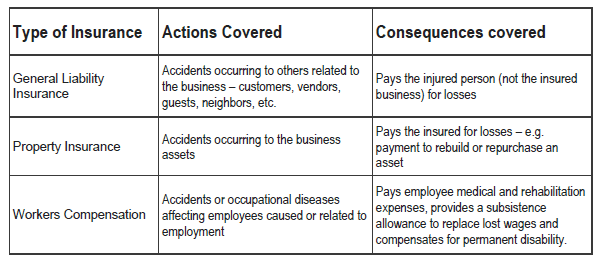
Farms and ranches have various types of risk. Insurance is a tool to help manage certain types of risk by transferring the risk from one party (farm business) to another (an insurance company). In this instance, risk refers to and is understood as the probability of an action resulting in a negative consequence. The insurance needs to cover the action that could potentially occur as well as the resulting negative consequence. These types of insurance are not mutually exclusive, and it is prudent to carry insurance for any area of risk. The table below gives a brief overview of common types of farm insurance.
General liability insurance covers the insured person or business when legally responsible for damages to others caused by the insured person's negligence. The insurance company providing the liability coverage pays the legal obligations for harm unintentionally caused to other people or property by the insured person or business.
General liability insurance often provides for legal defense costs when another person brings a lawsuit alleging harm against the insured person. The cost of defense can include attorneys, discovery, trial preparation, and other costs. The policy also pays the injured for any judgment obtained, up to the maximum coverage purchased by the business. General liability policies state specific coverages, exclusions, and the maximum amount of liability that will be covered while the policy is in force.
When a claim is made on liability insurance, the insurance company will ask:
Certain activities may void a liability insurance claim including illegal activities, fraud, and intentional damage. Such action can be grounds to deny a claim.
Details are important. Every liability insurance policy is a contract between the insurance company and the insured person(s). Insurance contracts contain these details:
It is a good idea to review coverage options thoughtfully. A good way to review is focus on the questions of who, what, when, where and how much. The review should include who is covered, what type of damages are covered, when does the coverage apply, where does the coverage apply and how much coverage is needed.
Communication with the insurance agent is very important. The agent needs to understand each individual's farming operation and the risks to be insured. Changes in farming operations should be shared with the insurance agent, such as changes in farms rented. Each insurance agent and company are slightly different so clear communication is significant.
More details on farm liability insurance can be found in the MU guide G455.
Source: Mary Sobba, Field Specialist in Ag Business
This Month in Ag Connection | Ag Connection - Other Issues Online
As celebrations for the United Nations' International Year of the Woman Farmer continue around the world, the MU Extension September virtual learning session will feature representatives from Neogen, a global leader in science-based genomic testing and DNA analysis solutions for livestock producers.
The session will focus on how genomic technologies are helping producers make more informed breeding and management decisions that improve animal health, performance, and profitability. Through advanced DNA testing and genetic evaluation tools, livestock operations can identify desirable traits, enhance herd productivity, and make data-driven decisions that support long-term sustainability.
As agriculture continues to embrace technology-driven solutions, genomic tools are playing an increasingly important role in helping producers meet evolving industry demands while maintaining profitable and sustainable operations. The September session promises valuable insights for livestock producers, agricultural professionals, students, and anyone interested in the future of animal agriculture.
Event Details
Date: September 23, 2026
Time: 12:00 p.m. CST
Location: Zoom
Registration: pears.io/events/mu/9150/
For more information visit https://extension.missouri.edu/programs/pearls-of-production. Contact Heather Conrow, hconrow@missouri.edu with questions.
Source: Heather Conrow, Field Specialist in Livestock
This Month in Ag Connection | Ag Connection - Other Issues Online
Sept. 26 (10 a.m.- 3 p.m.) South Farm Showcase, Columbia
Oct. 2 (9 a.m. - 1 p.m.) Producer Field Day at Wurdack Extension and Education Center, Cook Station
More information on all the field days is available at https://tinyurl.com/MU-fielddays2026.
Publishing Information
Ag Connection is published monthly for Northeast and Central areas of Missouri producers and is supported by the University of Missouri Extension, the Missouri Agricultural Experiment Station, and the MU College of Agriculture, Food and Natural Resources. Managing Editor: Mary Sobba.
Send comments and suggestions to:
Mary Sobba, Agriculture Business Specialist
101 N. Jefferson St., Rm 304
Mexico, MO 65265
(573) 581-3231
sobbam@missouri.edu