
To send a message to an author, click on the author's name at the end of the article.
This Month in Ag Connection | Ag Connection - Other Issues Online
While crop production can typically tolerate wide variations in water quality as long as adequate moisture is available, the same is not true for livestock. For beef cattle, both water availability and quality play a critical role in overall health, productivity and performance.
Water is the most essential nutrient in a cow's diet, making up an estimated 58% to 81% of the animal's body. Because of this, consistent access to clean, fresh water is necessary to support digestion, temperature regulation and metabolic processes.
Daily water intake for cattle varies significantly based on several factors, including mature body weight, dry matter intake, ambient temperature, relative humidity, production level and even the temperature and cleanliness of the water source. A general guideline suggests beef cattle require approximately 1 gallon of water per day for every 100 pounds of body weight. For lactating cows, that requirement can double due to the added demands of milk production.
Environmental conditions play a major role in determining water needs. As temperatures reach 90 degrees Fahrenheit, cattle may require as much as 2 gallons of water per 100 pounds of body weight. This increased need highlights the importance of ensuring watering systems can meet peak demand during periods of heat stress.
Also, forage moisture content can influence water intake. Spring forages often contain up to 80% moisture, supplying roughly half a gallon of water for every pound of forage dry matter consumed. However, as forages mature and dry down, the moisture content declines significantly, requiring cattle to compensate by increasing direct water consumption.
Observations show cattle typically visit water sources two to five times per day. Each visit lasts one to four minutes, with cattle consuming water at a rate of approximately 2 gallons per minute. This pattern underscores the need for water systems that allow quick and efficient access for all animals in a herd.
Distance to water is another key factor in cattle performance. Industry recommendations suggest cattle should be within 700 to 900 feet of a water source. When waterers are located beyond 900 feet, cattle are more likely to travel as a group rather than individually. This herd behavior can create competition, where calves and more submissive cows may be pushed away and denied adequate intake.
A 2024 study conducted by Ohio State University reinforces the impact of water accessibility on cattle performance. Researchers found that as walking distance to water increased, the number of daily visits, total water consumption, and average daily gain (ADG) all declined.
Crossbred yearling heifers traveling approximately 400 yards to water averaged three visits per day and consumed about 4.5 gallons per head daily. In contrast, heifers required to walk nearly 900 yards averaged only two visits per day and consumed approximately 3 gallons per head. Performance differences were also significant, with cattle grazing closer to water gaining between 3 and 4.5 pounds per day, compared to just 1.5 pounds per day for those traveling longer distances.
To promote optimal intake and reduce competition, proper water system design is essential. Recommended guidelines include installing waterers at a minimum height of 18 inches and providing at least 3.5 inches of linear drinking space per head. For larger herds or operations with longer travel distances, trough-style waterers or tanks may be more effective.
Additionally, water systems should be designed with a recharge rate capable of delivering at least 2 gallons per minute to meet peak demand periods and prevent shortages during high-use times.
Producers looking to improve grazing systems and water access strategies can find additional guidance in the University of Missouri Extension publication, "Pumps and Watering Systems for Managed Beef Grazing."
Ultimately, ensuring adequate water access is not just about meeting basic needs-it is a foundational component of animal welfare and herd productivity. By paying closer attention to water quality, availability and system design, producers can support healthier cattle and improved performance across their operations.
For more information contact an MU Extension livestock specialist.
Source: Heather Conrow, Field Specialist in Livestock
This Month in Ag Connection | Ag Connection - Other Issues Online
In March of 2026, the USDA Economic Research Service (ERS) released the 2024 Food Dollar data. The Food Dollar, which represents one dollar spent on food in the U.S., allocates the market value of consumer spending on food produced in the United States by supply chain segments (farming, processing, transportation and retail). The allocations, referred to as bills, divide the food dollars by the bill-specific segmentation of the domestic food supply chain. The three bills are 1) the marketing bill, 2) the industry group bill, and the 3) primary factor bill.
The marketing bill measures the gross returns to farms for the sale of raw farm commodities that support the domestic food supply chain. The industry group bill attributes the costs of producing food to stages of production, such as crop production, food processing and food retailing. The primary factor bill shows how the costs of food production are split among people, capital assets and other factors.
Marketing Bill
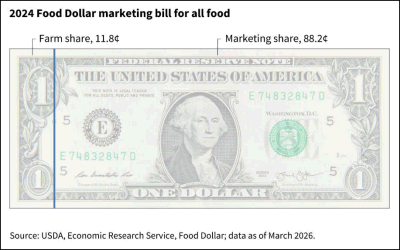
The marketing bill series is based on sales proceeds. The sales from each food dollar are divided into two categories: farm share and marketing share. The farm share measures proceeds of farm commodity sales tied to a food dollar expenditure and sold to non-farm establishments. It does not include sales of farm commodities incorporated into other commodities and resold to a domestic farm industry to avoid double counting. The marketing share is the market value added to farm commodities, which is measured as one dollar minus the food share. The current data shows the food dollar split with 11.8¢ attributable to the farm share and 88.2¢ to the market share.
USDA has tracked this data for many years. The marketing bill expanded the Food Dollar definition in the recent update (March 2026) to include bottled water and soft drinks as well as coffee, tea, and beverage materials. The broader definition of food used in the new methodology reduces the farm share reported by the Food Dollar from 12.3¢ to 11.8¢ in 2024. The farm share measures are lower as the supply chains for these newly included items use few farm commodities.
Industry Group Bill
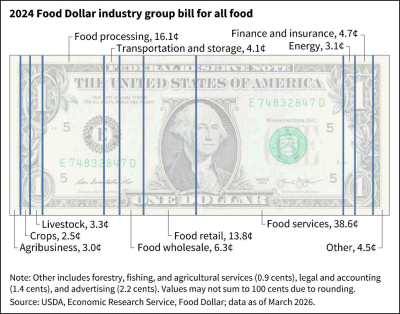
The industry group series measures the value added by groups of industries engaged in similar production activities along the food supply chain. Each industry receives a share of consumer food spending in proportion to its value contribution to the domestic food supply chain, then all shares sum to one dollar. The largest industry was the food services at 38.6¢ cents per food dollar. Food services includes full-service, limited-service and other restaurants and eating places. The share increased 1.1¢ per food dollar from the previous year. This indicates the continuing shift toward food-away-from home spending.
The industry group bill provides detail on farm production by separating the total value added by farms (6.7 cents per food dollar in 2024) into crops (2.5 cents); livestock (3.3 cents); and forestry, fishing, and agricultural services (0.9 cents). These farm production shares of the food dollar are net of any input costs from other industry groups in the supply chain.
Primary Factor Bill
The primary factor bill divides a food dollar by source of value added (salaries and benefits, property income, output taxes and imported inputs). The recently released data shows workers received 54.1¢ of the food dollar, which is 2.1¢ higher than the previous year. Property income decreased 1.8¢ and output taxes decreased 0.5¢ per food dollar compared to the previous year.
The data even goes a step further in comparing food consumed at home and food consumed away from home. The most noticeable difference is food consumed away from home uses 12.0¢ more labor per dollar.
For more details and data see the entire USDA report at https://www.ers.usda.gov/publications/113904.
Source: Mary Sobba, Field Specialist in Ag Business
This Month in Ag Connection | Ag Connection - Other Issues Online
Wheat storage pest management is something producers deal with every year when storing winter wheat in grain bins. As winter wheat gets harvested in June and July, warm summer temperatures help to drive insect problems throughout the rest of the year and can lead to grain being rejected when taken to the elevator. Wheat taken to on-farm bin storage does not have the insect management advantages of corn and soybeans. One of the driving factors of this is fall harvested crops are put into bin storage when cold temperatures can be used to aid in insect management.
Wheat storage begins in the summer months and has a long period of time before ambient temperature drops low enough to slow insect activity and even longer until ambient temperatures drop low enough to kill insects. There are some practices that can be followed to help reduce and eliminate insect pest problems in stored wheat. These include sanitation, residual surface sprays to the interior and exterior of the bin, at harvest application of grain protectants and top dressing (capping), monitoring for insect pests in the stored grain mass, and rescue treatments.
Sanitation is the key when it comes to insect management in grain bins. Insects like grain bins because 1) grain bins are warmer in the winter months and 2) there is a viable food source stored in grain bins that requires less energy to obtain when it is colder. Being thorough when sanitizing a bin is the most important of all pest control steps. Skipping corners or not being frequent with cleaning, typically leads to problems. Keeping wheat free of insect pests begins with sanitization of all grain handling equipment, from the combines and grain carts to the grain augers, bins, and fans.
This sanitization process involves removing intact or broken kernels and removing grain dust from grain handling and storage areas. There are several insect pests that target both intact and damaged kernels and thrive in grain dust. In general, producers should strive to remove as much dockage from the grain before storage as possible. Fines will typically accumulate in the center column of the grain mass. It is a good idea to pull grain cores to remove these fines, which helps deter insects and mold. For more detailed information on types and species of stored grain pests in the United States, please see the USDA Stored Grain Insect Reference.
If possible, when cleaning bins, it is beneficial if the flooring is easily removed to clean the subfloor areas. When subfloor areas are removed, this is an excellent time to apply a residual surface spray to an area that is not typically treated with insecticide. Grain bins with non-removable floors may benefit from an empty bin fumigation, if insect infestation has been an issue in the grain bin previously. It is advisable to cleanup processed and unprocessed grain residues from nearby feed bunks and from around the outside of bins as well. Do not store livestock feed around grain bins. It is good practice to keep whole grain storage areas and processed feedstuffs storage areas separate to help mitigate some pest pressure. Also, it is important to keep weeds and other plants under control around bins to aid in reduction of rodent and insect infestation issues.
Once a bin has been thoroughly cleaned, an application of a residual surface insecticide should be made to all interior surfaces, around the exterior of the bin, and on all surfaces where residues were removed. A six-to-eight-week lead application prior to filling the bin with grain will give optimal control, though a shorter lead is much better than no application at all. It is worth noting grain moisture should be kept in the range of 12-13% after filling, as most grain dwelling insects require a grain moisture of 13-15% for maximized feeding and reproduction. It is important the label is always followed on all storage related insecticides, whether empty bin or bulk grain applied.
Once a bin has been treated, it is then time to look at treating the grain itself as it is loaded into the bin. Grain protectants are applied typically at the auger. This allows for the whole grain mass to be treated effectively. Grain protectants can help suppress both beetle and caterpillar pests. A second insecticide application is often made to the leveled grain surface at the top of the bin, called capping, which is helpful in preventing infestation of pests from the top of the grain mass. A common infester of the upper grain mass is Indian meal moth.
After grain has been treated, it should be checked a couple times a month for insect infestation throughout the summer season. Checking both the surface of the grain mass via visual inspection from the roof access door and the interior of the grain mass via the side access panel by utilizing plastic tube traps, probe traps, and sticky pheromone traps are the most efficient ways of doing this. Untreated grain can become completely infested in less than a month.
If an infestation is detected, grain protectants can also serve as rescue treatments, though this requires movement of the grain from one bin to another. If control fails using this method, insect pests can be spread more evenly throughout the grain mass. Once the grain has been moved to a new bin during this treatment process, the original bin will then need to be sanitized. It is critical to follow label directions very closely when utilizing this treatment method to avoid over accumulation of insecticide residues in the grain mass, which could lead to an unmarketable grain product that may not be able to be fed to livestock either.
Often the better, more cost-effective option for a rescue treatment is to utilize a fumigant. Fumigants are highly toxic gas-based poisons and require special handling techniques and personal protective equipment such as the utilization of a self-contained breathing apparatus. While Missouri producers can legally apply fumigants if licensed properly, it is highly recommended to hire an experienced pest control professional to handle grain bin fumigations. There are several factors that must be accounted for to ensure an effective fumigation and to prevent unintended poisoning and death of people and animals in the vicinity of a treated structure.
Source: Nick Wesslak, Field Specialist in Agronomy
This Month in Ag Connection | Ag Connection - Other Issues Online
The July Pearls of Production session will be led by Swiss farmer Melanie Ramser. She and her husband, Philipp, co-manage the organic Horbermatt Farm.
The family-run operation focuses on sustainable production while welcoming visitors to experience agriculture. The farm regularly hosts brunches, children's activities, and group visits, giving guests an opportunity to learn about farm life.
Beyond the farm, Ramser is recognized for interest in cooking with local ingredients, appearing on Swiss television, including the program Landfrauenküche, sharing traditional recipes.
Event Details
Date: July 22 @ 12:00 p.m. CDT
Location: Zoom
Registration: https://pears.io/events/mu/3343/
For more information email hconrow@missouri.edu.
Source: Heather Conrow, Field Specialist in Livestock
Publishing Information
Ag Connection is published monthly for Northeast and Central areas of Missouri producers and is supported by the University of Missouri Extension, the Missouri Agricultural Experiment Station, and the MU College of Agriculture, Food and Natural Resources. Managing Editor: Mary Sobba.
Send comments and suggestions to:
Mary Sobba, Agriculture Business Specialist
101 N. Jefferson St., Rm 304
Mexico, MO 65265
(573) 581-3231
sobbam@missouri.edu