
To send a message to an author, click on the author's name at the end of the article.
This Month in Ag Connection | Ag Connection - Other Issues Online
Alfalfa weevil is the most critical early growing season pest to manage in alfalfa stands. Alfalfa weevil larva and adult feeding damage are important to monitor through the first and second cutting, but it is worth noting the largest potential of damage will be observed through the first cutting time frame. Once the growing season progresses into the hotter summer months, weevil feeding damage will decline to a stop as alfalfa weevils enter diapause (summer dormancy). The larval growth stages of alfalfa weevil pose the greatest threat to yield, forage quality, and plant stand density, however adults also feed on foliage.
Feeding damage from alfalfa weevils will concentrate early on at the terminal growing points on alfalfa plants, causing a "pinhole" type feeding damage as the plants continue to mature and unfurl leaves. When infestations are left unchecked, larval populations will continue to skeletonize leaves, which can lead to complete defoliation of an alfalfa stand. This complete defoliation will produce a grayish cast coloration to an alfalfa field when observed from a distance.
Alfalfa weevil adults also skeletonize leaves, though the larvae do the majority of the damage. Both larvae and adults can pose a threat to regrowth following the first cutting as heaving feeding can occur on new regrowth, especially if only early harvest was used as a management tactic. This regrowth feeding can lead to fields failing to green up, as larval and adult alfalfa weevils can consume regrowth at the growing points as fast as plants produce new growth. This damages both yield and stand persistence.
Adult alfalfa weevils are snouted beetles and have a brown body with light brown to grayish scales. A darker brown shield-like stripe runs the length of the dorsal side of the insect. Adult alfalfa weevils are 3/16 of an inch in length. Larvae are slate colored when small in earlier growth stages (instars) but have a bright green appearance when full grown at just 3/8 of an inch long. Larvae have a white stripe down the side and a black head. When targeting suppression of alfalfa weevil populations, it is important to make decisions and take control actions quickly. More mature instar stages of alfalfa weevil larvae are harder to control than earlier developmental stages. Understanding alfalfa weevil's life cycle is important when making pest management decisions.
The life cycles of alfalfa weevils consist of an adult weevil overwintering phase that resides near alfalfa crowns in plant residue and as eggs in stems. Egg laying occurs during warm periods in fall, winter, and spring months. Eggs begin to hatch when heat units accumulate to around 200-300 degree days. Scouting is best started around 180 degree days. Alfalfa weevil larvae grow through instar stages, with each successive instar stage growing larger and greener in color.
The 1st larval instar will crawl to the top of the plant and burrow into and begin feeding on plant terminal materials. The first and second instar stages are the stages responsible for the leaf pin holing damage. Second through fourth instar larva stages will also defoliate alfalfa stands. By the time these later developmental stages begin defoliation, a significant amount of damage may have already occurred.
Larvae transition growth stages approximately every 150 heat units. This can be helpful for management considerations. Heat unit base for development should be 48 degrees F and max should be at 90 degrees F. To calculate daily heat units (beginning January 1), determine the average of the daily maximum and minimum temperatures. If the minimum temperature is below 48°F, use 48°F instead. Then subtract 48°F from this average. Larvae pupate at approximately 750 degree days, and will spin a cocoon on or near alfalfa plants.
Adult beetles will emerge from the cocoon within one to two weeks. After emergence, the weevils feed for a short period of time before leaving the field to marginal areas and entering diapause. Once fall begins, the weevils return to the alfalfa fields and begin to lay a few eggs before cold weather sets in. Adult weevils overwinter in plant debris along fencerows, woodlots, ditch banks, and other such areas. As winter transitions to warmer spring days, alfalfa weevil adults begin laying eggs again.
Late March is a good time in general to begin scouting for alfalfa weevils in Missouri. When scouting, select 30 random stems from across a field, cut gently with scissors (to avoid losing any larvae prematurely), and shake into a bucket. Check the following guide for threshold information, https://extension.psu.edu/alfalfa-weevil to determine if growers should pursue a control strategy, either spraying, early harvest or both.
If alfalfa is tall enough, early harvest can be a valid control option. Early harvest, either by haying or grazing, is an option if the crop is within 7 to 10 days of 1/10 bloom maturity. Early harvest can also be beneficial helping negate some of the collateral damage to beneficial insects that can be associated with insecticide usage. Weevil populations can be reduced up to 98 percent with mechanical harvest and 90 percent with cattle grazing. It is important to examine stubble, the soil surface under alfalfa plants, and under leaf litter following harvest. If there are more than eight larva and new adults per square foot in the stubble or more than 50 % of new growth has observable damage, a spray should be applied as soon as possible. If most regrowth damage is caused by adult weevils, be sure to check product labels for adult control and appropriate rate.
There are several products registered in the state of Missouri labeled for weevil control in alfalfa. It is best to use a carrier volume of 20 gallons per acre to ensure effective coverage. Growers should always follow preharvest intervals, restricted entry intervals, and label directions. Some neighboring states have documented pyrethroid resistance within alfalfa weevil populations, but this has not been confirmed in Missouri yet. If an insecticide control failure is suspected due to pyrethroid resistance, please contact the local field specialist in agronomy. CDMS.net is a good website to utilize to search for Missouri labeled alfalfa insecticides that will control alfalfa weevil populations.
Source: Nick Wesslak, Field Specialist in Agronomy
This Month in Ag Connection | Ag Connection - Other Issues Online
The 2024, Tenure, Ownership, and Transition of Agricultural Land (TOTAL) Survey is a comprehensive study of all land rented out for agricultural purposes, including both land rented out by farmers and ranchers (operator landlords) and land rented out by people not operating a farm (non-operator landlords). The survey was a special study of the 2022 Census of Agriculture program. The survey was a collaboration of USDA National Ag Statistic Service (NASS) and USDA Economic Research Service (ERS). The survey results were released March 12, 2026.
In 2024, nationally more than two million landowners rented out 347.8 million acres of land for agricultural purposes. The landowners consisted of 13% (or approximately 260,000) farmers who owned and operated farms and ranches and also rented out farmland (operating landlords). The remaining 87% (or approximately 1.74 million) landlords do not operate farms (non-operating landlords). Most of the landowners have owned the land for at least 10 years.
The data was released by regions of multiple states: Atlantic, South, Midwest, Plains and West. Missouri is part of the Midwest region which also includes Minnesota, Wisconsin, Michigan, Ohio, Indiana, Illinois, and Iowa. The Midwest region has 73.9 million acres of agricultural land rented or 21% of the total rented acres in the United States. The number of landlord entities in the Midwest is 797,637 or 38% of the total in the United States. Landlord entities include a variety of ownership arrangements including individuals, trusts, family entities, and non-family entities.
In comparison to the previous TOTAL survey, which was in 2014, the total acres of land rented decreased by 1%. The total rented cropland acres (204 m.) decreased by 8%. Rented pasture acres (129 m.) increased by 10%. All other land rented (13 m.) increased by 41%. Other land rented includes orchards, vineyards, forest, farmsteads, ponds, and wasteland.
The survey also included land rights sold and leased. The total rights sold for all types of ownership is 31.7 million acres, including oil and gas, mineral and development. The total rights leased by landlords is 174.5 million acres, which includes oil and gas (55.8 m.), mineral (15.2 m.), solar (12.4 m.), wind (34.9 m.) and recreational (56 m.).
The landowners obtained the land in a variety of methods. Non-operating landlords acquired the majority of land through inheritance, trusts and gifts. Operating landlords acquired the majority of land through purchases from non-relatives, relatives or auctions.
The survey asked land owners of future intentions. The results show that landlords and operating owners of farmland plan to sell or gift a small share of owned acres in the next five years. Less than 5% of owned farmland is expected to transition to others through sales or gifts. Ten percent of owned farmland is expected to be placed in trusts in the next five years. An additional 15% is planned to be written into a will in the next five years. In a separate question, non-operating landlords were asked to report transition plans beyond the five-year horizon. The results included wills, trusts, selling to relatives, selling to non-relatives and gifting. Twenty percent of non-operating landlords indicated no plans for transitioning owned acres.
In summary, there were 2.1 million landlord ownership arrangements. Eighty-seven percent were non-operating landlords who owned 79% of the rented land and 13% were operating landlords who owned 21% of the rented acres. Landlords received $34.1 billion in rental income in 2024. The value of land and buildings rented out was $1.7 trillion. Non-operating landlords owned 93% of the acreage debt-free and operating landlords owned 88% of acres debt free.
The results of the TOTAL survey show many characteristics of agricultural landlords. Regardless of demographics, method of ownership, number of acres or location, it is easy to see landlords play a key role in agriculture. Every type of landlord is important and the results show some of the key components. Landlords will continue a key role in agricultural production in the foreseeable future.
Source: Mary Sobba, Field Specialist in Ag Business
This Month in Ag Connection | Ag Connection - Other Issues Online
May is recognized as Beef Month, a time to celebrate beef producers and the important role of farmers and ranchers in providing nutritious food while supporting local economies and rural communities. May is also Mental Health Awareness Month, offering an opportunity to highlight the well-being of the people behind the cattle.
Beef Month
Beef Month provides an opportunity to recognize beef producers and the contributions agriculture makes to local communities. Missouri's beef industry contributes significantly to the state's agricultural economy, provides jobs across rural areas, and supports multigenerational farm families.
Beef production requires careful management, long hours, and adaptability. Weather, markets, input costs, animal health, and labor demands all influence daily decisions on beef operations. Through dedication and stewardship, beef producers continue to supply high-quality beef while caring for land, livestock, and communities.
Supporting beef producers also means investing in the systems that sustain local agriculture. The Missouri Farm Bureau provides information about purchasing locally raised beef through its program resources. The Missouri Beef Industry Council offers details about the MO Beef Kids program, which connects Missouri-raised beef with school lunch programs, as well as additional information about Missouri's beef industry, recipes, and nutrition education.
Mental Health Awareness Month
May is also Mental Health Awareness Month, providing an opportunity to focus on the mental well-being of people living and working in agriculture. Farming and ranching involve uncertainty, financial pressure, long workdays, and limited time away from work. Over time, these challenges can affect stress levels and overall mental health, and taking care of people is just as important to a successful agricultural operation as caring for livestock or managing natural resources. Prioritizing mental well-being supports safer work environments, clearer decision-making, and stronger farm families.
One resource available through MU Extension is Mental Health First Aid, https://extension.missouri.edu/programs/mental-health-first-aid a program designed to help community members recognize signs of mental health challenges, practice supportive conversations, and connect individuals with appropriate resources.
As Beef Month and Mental Health Awareness Month are observed, remember the value and importance of strong agricultural systems and healthy people supporting the strength of Missouri agriculture and rural communities.
Source: Brenda Schreck, Field Specialist in Livestock
This Month in Ag Connection | Ag Connection - Other Issues Online
The 54th Annual Northeast MO Performance Tested Bull Sale was held in Palmyra on March 28. The overall average on 31 bulls was $7,043.
The high breed average was Angus at $7,480. Other breed averages were Simmental $6,000 and Polled Hereford $3,675.
High selling bulls in the sale were Angus consigned by Graupman Angus, Palmyra, $13,500 and Hudson Angus Farms, Jefferson City, $12,000 purchased by Leon Kenady, Hull, Ill. and Jason Thomas, Pittsfield, Ill. Seven other bulls sold for $8,000 or higher.
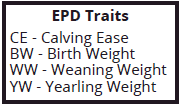
Bulls offered in this sale met certain predetermined standards to be eligible for this sale. Bulls must be in the upper 50th percentile in two out of four EPD (Expected Progeny Difference) traits: CE or BW, WW, YW, or Milk, yearling height 49 inches or above, weight at a year 1100 pounds or above, semen tested and examined for breeding soundness and to be found satisfactory potential breeders. Bulls must also meet certain health requirements: tested and found negative for BVD-PI, vaccinated against Leptospirosis, and must follow state requirements for trichomoniasis. Twenty-one bulls in the sale utilized genomic testing to improve the accuracy of the EPD's for the perspective buyer.
The annual meeting of the Northeast Missouri Beef Cattle Improvement Association (BCIA), which sponsors the bull sale, was held on April 2nd at Fiddlesticks in Hannibal with 80 members and guests attending. Several awards were presented at the banquet.
Plaques were presented to the owners of the high indexing bulls in the sale. Angus went to Hudson Angus Farm and Simmental went to Beach Cattle Co. Other awards presented: included Outstanding Seedstock Producer, Beach Cattle Co., Leonard; Outstanding Commercial Producer, Aaron and Connor Eckman, Paris; and Outstanding Service to Dr. Chad Lehenbauer, Palmyra.
The sale is a cooperative effort between the Northeast Missouri BCIA and University of Missouri Extension. For details on participating, contact the MU Extension Livestock Specialist. The next sale will be March 27, 2027, at F & T Livestock Market, Palmyra.
Source: Daniel Mallory, Field Specialist in Livestock
Publishing Information
Ag Connection is published monthly for Northeast and Central areas of Missouri producers and is supported by the University of Missouri Extension, the Missouri Agricultural Experiment Station, and the MU College of Agriculture, Food and Natural Resources. Managing Editor: Mary Sobba.
Send comments and suggestions to:
Mary Sobba, Agriculture Business Specialist
101 N. Jefferson St., Rm 304
Mexico, MO 65265
(573) 581-3231
sobbam@missouri.edu