
To send a message to an author, click on the author's name at the end of the article.
This Month in Ag Connection | Ag Connection - Other Issues Online
Biosecurity practices prevent the introduction and spread of diseases in livestock. There are many ways diseases are introduced onto the farm such as animals, vehicles, equipment, and visitors. By following biosecurity principles, producers can greatly reduce disease risks, avoid unnecessary expenses, and reduce a lot of stress and headaches.
These principles are also the foundation of the Secure Beef Supply (SBS) Plan, a national effort designed to help cattle operations maintain business continuity during a foreign animal disease outbreak. The plan emphasizes enhanced biosecurity measures that go beyond everyday practices, giving producers a structured approach to protect herds and keep markets moving even in high-risk situations. The SBS Plan was written with input from industry, state and federal officials, and university partners. The plan supports foot-and-mouth disease (FMD) control for infected herds and business continuity for uninfected herds. Officials recognize the need to get rid of FMD without destroying the livestock industry.
U.S. beef exports were over $10 billion in 2023. Exports add about $425 of value per fed steer or heifer (including meat cuts and offal), which is nearly 20% of the value for every fed carcass. One case of FMD found in the U.S. would shut our export market down and cut profits for all cattle producers. Luckily, the United States has not had a case of FMD since 1929. However, with global travel and trade, there is a risk of FMD introduction. The SBS was created to help producers protect herds from FMD. Recently, the United States Department of Agriculture (USDA) funded the National Cattlemen's Beef Association (NCBA) to develop more outreach materials and increase FMD awareness of producers, transporters, and other stakeholders.
Foot-and-mouth disease (sometimes called "hoof" and mouth disease) causes blisters on the feet and in the mouth of two-toed (cloven-hooved) animals like cattle, sheep, pigs, goats, deer, bison, and some wildlife. Cattle with FMD show signs of lameness, drooling, and do not want to move or eat because of the painful food and mouth sores. Foot-and-mouth disease is a very contagious animal disease. It does NOT affect people or food safety. Meat and milk are safe to eat and drink.
To stop the spread of FMD, at the beginning of an outbreak, USDA will recommend at least a 72-hour national movement standstill for cattle, sheep, pigs, goats, deer, elk, bison, and germplasm (semen and embryos). Movement controls will continue after the standstill ends in the areas around infected herds. Restarting movement will require a special permit, issued by state officials, after a producer meets certain requirements. The SBS Plan has producer guidance for herds showing no evidence of FMD infection to meet movement permit criteria (https://www.securebeef.org/permits/).
The SBS Plan offers a framework that can be adapted to protect livestock operations from a wide range of future foreign animal diseases. By emphasizing enhanced biosecurity and controlled movements, it provides producers with tools that strengthen resilience well beyond a single disease scenario. For more information, contact an MU Extension field specialist in livestock.
Source: Chrisse Brandl, Field Specialist in Livestock
This Month in Ag Connection | Ag Connection - Other Issues Online
As spring and planting season approach, it is a good time to complete the annual farm records. Most farmers have likely filed tax returns and completed balance sheets for the bank; now is a good time to take the next step and calculate, analyze and compare farm financial ratios to see how the farm business is doing financially.
The most common financial benchmarks used in comparing ratios were developed by the Farm Financial Standards Council (FFSC). The farm crisis of the 1980's raised awareness of the need to have standardized financial guidelines. The FFSC continues to develop standards to promote consistency and uniformity in financial analysis for agricultural producers. This allows farmers to measure and understand the strengths and weaknesses of the business financial health and benchmark the situation in comparison with other farms. Financial ratios help determine how the farm is doing financially and aid in identifying possible issues.
Financial ratios and benchmarks are useful for people both inside and outside of the farm business. Farm managers can use the information to assist in decisionmaking, goal setting and to compare business performance to similar operations. Lenders may use the same information to evaluate credit risk.
Calculating ratios can be a little cumbersome. Some software packages easily calculate the ratios. Unfortunately, not everyone has that type of software, so it may require using a calculator or paper and pen. Financial statements including the balance sheet, income statement, and cash flow statement will be needed. If all statements are not available, a few ratios may still be calculated. It would be a good idea to visit the farm lender and see which ratios the bank recommends and uses. It may be just three or four ratios, rather than all 21 ratios.
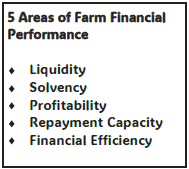
A helpful tool for analyzing ratios is the Farm Financial Scorecard which uses the recommended measures from the FFSC and includes the equations to calculate the ratios. The scorecard is divided into five categories of financial performance: liquidity, solvency, profitability, repayment capacity and financial efficiency.
Liquidity measures current assets and current liabilities to determine the ability to pay short-term expenses without making long-term changes. The numbers needed to calculate the liquidity ratios can be found on the balance sheet, which may also be referred to as the net worth statement.
Solvency is the ability of the farm business to meet all debts if it were sold at the current point in time. The most common solvency ratio is the debt-to-asset ratio, which compares the total farm debt to the total farm assets. The balance sheet is where the numbers can be found to calculate the solvency ratios.
Profitability is the difference between the value of goods produced and the cost of the resources used in the production. Some of the ratios are rate of return on assets, rate of return on equity and asset turnover. The income statement (sometimes referred to as the profit and loss statement) is where the numbers will be found to calculate the ratios.
Repayment capacity is the ability to generate enough cash to pay debt on time. The cash flow statement will be needed to calculate these ratios.
Financial efficiency ratios show where each dollar of income generated is being spent. For example, the operating expense ratio shows the proportion of farm income that is used to pay operating expenses, while excluding depreciation and interest expense. The ratios in this category will require numbers from the balance sheet, income statement and cash flow statement.
After the ratios are calculated, then it is time to analyze. The farm financial scorecard contains benchmark numbers which are helpful in determining if the ratios are weak or strong. The scorecard uses a "stoplight" colored system where numbers in the red mean vulnerable or weak, yellow is stable and green means the numbers are strong. It is helpful to calculate ratios every year to identify trends and determine if financial health is increasing and if not figure out why.
The farm financial scorecard is available free for download from the center for farm financial management at https://www.cffm.umn.edu/wp-content/uploads/2019/02/FarmFinanceScorecard.pdf or is available by contacting the local MU Extension field specialist in ag business.
Source: Mary Sobba, Field Specialist in Ag Business
This Month in Ag Connection | Ag Connection - Other Issues Online
Pearls of Production will host Dr. Salma Sultana as the featured speaker for its March session, part of the Celebration of the International Year of the Woman Farmer. Dr. Sultana is a Ph.D. student in microbiology at Iowa State University focusing on improving the treatment of bacterial diseases and reducing antimicrobial resistance. Sultana studies how a technology called histotripsy may support immune response while lowering the need for antibiotics.
Dr. Sultana is also a pioneer in global livestock development; and is the first female entrepreneur and development worker in the livestock sector in Bangladesh. Sultana founded the Model Livestock Advancement Foundation and the Model Livestock Institute and Veterinary Hospital in Dhaka, which provide education and veterinary services to small-scale farmers.
Dr. Sultana's work has received internationalrecognition. In 2021, Asian Scientist magazine, Sultana was named one of the top 100 Asian scientists. In 2020, Sultana received the Norman Borlaug Award for Field Research and Application from the World Food Prize Foundation for innovative veterinary outreach model.
This session will highlight the role of women in agriculture and livestock systems worldwide.
Event Details
For more information about Pearls of Production, visit https://extension.missouri.edu/programs/pearls-of-production.
To learn more about the Celebration of the International Year of the Woman Farmer, visit https://extension.missouri.edu/programs/pearls-of-production/pearls-of-production-events/international-year-of-the-woman-farmer.
Contact Heather Conrow, field specialist in livestock and statewide poultry specialist with MU Extension at hconrow@missouri.edu with questions.
Source: Heather Conrow, Field Specialist in Livestock
This Month in Ag Connection | Ag Connection - Other Issues Online
University of Missouri Extension invites landowners, hunters, anglers, and outdoor enthusiasts to attend the new Antlers, Anglers, and Ag: Elevating Today's Outdoorsmen for Tomorrow's Harvest program, a fullday Fisheries and Wildlife Management Clinic on Saturday, March 28, 2026, at the Lee Greenley Jr. Memorial Research Farm near Novelty, Missouri.
This hands-on educational event is designed for individuals interested in improving wildlife habitat, enhancing food plots, managing ponds, and maximizing the long-term productivity of land.
Presenters include MU Extension specialists, Missouri Department of Conservation professionals, and respected industry partners such as the National Deer Association, all sharing practical, research-based information whick can be applied immediately.
For more information and to register, visit the MU Extension website (https://extension.missouri.edu/events/antlers-anglers-and-ag-elevating-todays-outdoorsmen-for-tomorrows-harvest or scan the event QR code below.
Source: Nick Wesslak, Field Specialist in Agronomy
This Month in Ag Connection | Ag Connection - Other Issues Online
To register call the number listed with name, phone #, email (if available) and location you plan to attend. Leave a message if no one answers.
Marion / Shelby Counties - Mar. 5 @ 12:30 p.m.
Sesquicentennial Bldg., 621 Johnston Ave., Palmyra, (573) 767-5273
Scotland / Knox Counties - Mar. 12 @ 12:30 p.m.
Rutledge Community Center, 23615 Main St., Rutledge, (660) 465-7255
Moniteau County - Mar. 12 @ 6 p.m.
California H.S. Vo. Ag. Bldg., 1501 W. Buchanan, California (573) 378-5358
Lewis / Clark Counties - Mar. 19 @ 12:30 p.m. St.
Patrick Catholic Church, 2 Erin Circle St., St. Patrick, (660) 465-7255
Ralls / Monroe Counties - Mar. 30 @ 12:30 p.m.
Mark Twain H.S. Ag Bldg, 21622 MO-19, Center, (573) 767-5273
Publishing Information
Ag Connection is published monthly for Northeast and Central areas of Missouri producers and is supported by the University of Missouri Extension, the Missouri Agricultural Experiment Station, and the MU College of Agriculture, Food and Natural Resources. Managing Editor: Mary Sobba.
Send comments and suggestions to:
Mary Sobba, Agriculture Business Specialist
101 N. Jefferson St., Rm 304
Mexico, MO 65265
(573) 581-3231
sobbam@missouri.edu