
To send a message to an author, click on the author's name at the end of the article.
This Month in Ag Connection | Ag Connection - Other Issues Online
The October and November 2025 newsletters contained articles about tax provisions in the One Big Beautiful Bill Act (OB3). This article will focus on ag provisions authorized and funded, which in the past have been in farm bills. The OB3 continues important commodities programs and increases spending for agriculture programs by an estimated $66 billion over ten years. The Congressional Budget Office estimates the Agricultural title will reduce spending by $120 billion mainly through cuts to the nutrition subtitle.
The commodities subtitle covers a variety of agricultural programs.
Statutory Reference Prices
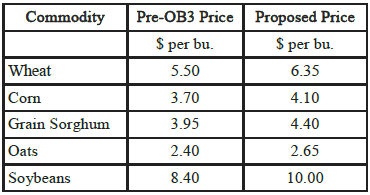 OB3 increases statutory reference prices for all covered commodities, beginning with 2025 crop year. Reference prices are utilized in the USDA agricultural risk coverage (ARC) and price loss coverage (PLC) program. The table below is just a partial list of crops.
Base Acres
OB3 provides farmers with a one-time voluntary opportunity for new base acres beginning with the 2026 crop year. The additional base acre allocations may not exceed 30 million across throughout the U.S. Missouri's current base acre allocation is 10.1 million acres.
Generally, farms are eligible to receive an allocation of base acres if their five-year average for planted and prevented plant covered commodity acres (2019 through 2023) exceeded their current base acres. The farmer can also include in the calculation acres planted to non-covered commodities, in an amount up to 15% of the total farm acres. If the number of allocated acres across the country exceeds 30 million acres, USDA must reduce all allocations on a pro rata basis to stay within the limit (30 million acres).
Producer Election
OB3 provides that USDA will - for each covered commodity for the 2025 crop year - automatically pay farmers the higher of PLC or ARC - county (ARC-CO) for the commodity. Farmers will receive these payments in October of 2026.
OB3 requires producers to make an election for years 2026-2031. Producers will not be eligible to receive a payment for the 2026 crop year if an election is not agreed upon and will receive the 2025 election for crop years 2027-2031.
OB3 allows producers to elect the Crop Insurance Supplemental Coverage Option (SCO) when PLC or ARC is elected. Previous law did not allow SCO coverage for producers who elected ARC.
Program Extensions and Expansion
OB3 extends the PLC, ARC, and Dairy Margin Coverage (DMC) programs through 2031. It also increases the ARC coverage guarantee for a crop year to 90% of the benchmark revenue (up from 86%). In addition, it increases the ARC-CO benchmark revenue cap to 12% (up from 10%).
Equitable Treatment of Certain Entities
OB3 for the first time allows "qualified pass-through entities," including S corporations, and LLCs not taxed as C corporations, to be treated in the same manner that general partnerships are currently treated under the payment limitation attribution rules. For example, S corporation shareholders or LLC members actively engaged in farming would each have a payment limit, not capped by a separate entity payment limit.
Payment Limitations
OB3 increases the general payment limitation for commodity programs from $125,000 to $155,000. This limit will be adjusted annually for inflation.
Adjust Gross Income Limitation
OB3 allows for those who derive 75% or more of average gross income (AGI) from farming, ranching or silviculture (forestry) activities to be exempt from the general $900,000 AGI limit for certain conservation and disaster payment programs.
OB3 newly defines farming, ranching or silviculture activities to include agritourism, direct-to-consumer marketing of agricultural products, the sale of agricultural equipment owned by the person or legal entity, and other agricultural activities as determined by the USDA Secretary.
Source: Mary Sobba, Field Specialist in Ag Business
This Month in Ag Connection | Ag Connection - Other Issues Online
Nitrogen fertility management is the most intensive nutrient management strategy in wheat but has the highest potential for return on fertilizer investment. Management begins at planting in the fall and carries into late winter/early spring. Consider fall nitrogen application rates of 20-40 pounds per acre at planting. Fall nitrogen drives early tillering which is a crucial component of yield.
In particular, fall nitrogen applications can be beneficial to wheat following corn that has exceeded its yield expectations to account for increased nitrogen utilization and corn residue. This is also true for late planted wheat (after the first week of November) in wet falls with low (fewer than 25 plants per square foot) initial stand emergence. It should be noted that nitrogen application is not a fix for untimely planting, but it can help with developing more tillers, to some extent. The most effective and efficient nitrogen application timing occurs in late winter/early spring (Feekes 2-5/Zadoks 21-30), depending on stand and tiller counts. Total spring nitrogen ranges between 80 to 110 pounds, depending on variety, soil, and environmental factors. Nitrogen rates exceeding this range require more intensive management and increase potential risks of negatively impacting yield. See Table below.
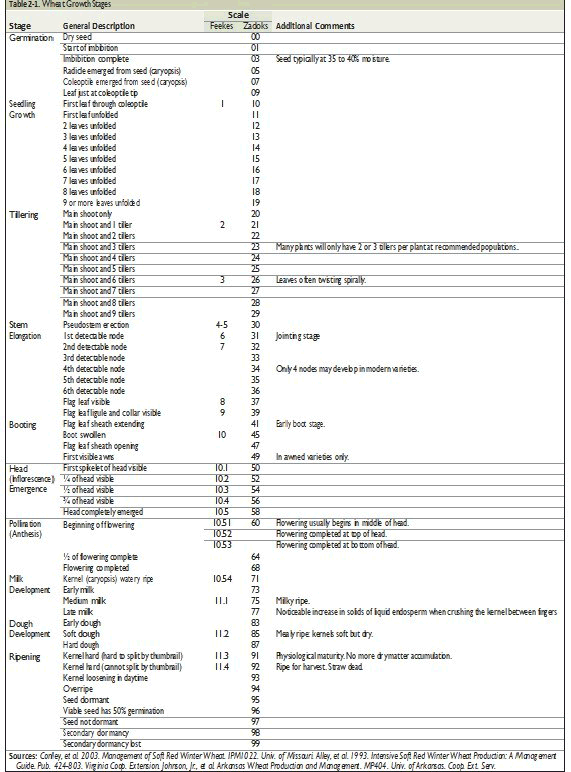
When evaluating nitrogen application timing and amounts, tiller counts should be conducted at greenup (Feekes 2-3, Zadoks 21-29). Stand counts counting whole plants should have already occurred by this point at one to two weeks after emergence and just prior to greenup. Tiller counts include both the main shoot and tillers off that main shoot, and only factor in plants with three or more leaves. To conduct a tiller count, factor in row spacing to calculate how many linear row feet of plants need to be counted to determine tillers per square feet. To determine tillers per square foot, divide 144 by the row spacing in inches and then count the number of tillers (stems) in that calculated length of row. Tiller counts at 70 stems per square foot at Feekes 3/Zadoks 26 are considered adequate.
Typically, with adequate tillering, a singular nitrogen application timing at Feekes 4-5/Zadoks 30 which is just before jointing (Feekes 6/Zadoks 31) is ideal. Tiller counts falling below 70 stems per square foot could potentially benefit from a split application of nitrogen with 30-to-50-units of the total spring nitrogen applied at greenup. Avoid the temptation of applying all spring nitrogen as a singular early application at Feekes 2-3/Zadoks 21-29, even when low tiller or stand density counts are observed.
Singular, earlier nitrogen applications increase risks of denitrification loss, spring freeze damage because of earlier heading, and lush canopies susceptible to diseases like powdery mildew. If an early spring single application is made, it is wise to utilize a controlled release nitrogen source like an encapsulated urea. This timing of application will require an immediate release and slow-release blend of nitrogen fertilizer. If spring nitrogen application is delayed until after the appearance of the first joint on the main stem (Feekes 6/Zadoks 31), yield reductions and nitrogen response declines will likely be observed. A plant tissue test at Feekes 5/Zadoks 30 can help determine a nitrogen rate specific to plant needs, especially when split applying nitrogen.
Source: Nick Wesslak, Field Specialist in Agronomy
This Month in Ag Connection | Ag Connection - Other Issues Online
2026 Missouri Custom Rates Survey is open for responses. The data will be used to update the MU Custom Rates guidesheet, which is a highly used publication.
In addition to data collected in the past, there are new activities: cattle services, machinery rental, aerial application, horticulture services.
To participate: 1) online at muext.us/customagrates or 2) request a paper copy from your local extension center.
Your participation is appreciated!
This Month in Ag Connection | Ag Connection - Other Issues Online
To register call the number listed with name, phone #, email (if available) and location you plan to attend. Leave a message if no one answers.
Audrain County - Jan. 5 @ 6 p.m. Courthouse Basement, 101 N. Jefferson St., Mexico (573) 581-3231
Linn County - Jan. 21 @ 1 p.m. MU Cornett Farm, 21262 Genoa Rd., Linneus (660) 895-5123
Pike County - Jan. 22 @ 6 p.m. Extension Center, 210 W. Main St., Bowling Green (573) 324-5464
Sullivan County - Jan. 22 @ 1 p.m. City Hall Community Bldg., 4 S. Green St., Green City (660) 895-5123
Randolph County - Jan. 28 @ 10 a.m. MU Extension Office, 509 W. Reed St., Moberly (660) 895-5123
Howard County - Jan. 30 @ 1 p.m. MU Extension Office, 600 W. Morrison Ste. 17, Fayette (573) 248-2272
Morgan County - Feb. 3 @ 1 p.m. Morgan County Seed, 18761 Kelsay Rd., Barnett (573) 378-5358
Morgan County - Feb. 4 @ 1 p.m. Extension Center, 100 E. Newton St., #4, Versailles (573) 378-5358
Macon County - Feb. 4 @ 10 a.m. MU Extension Office, 111 N. Rollins St., Macon (660) 895-5123
Putnam County - Feb. 11 @ 1 p.m. 4-H Bldg at the Park, 615 N. 22nd St. Unionville (660) 895-5123
Callaway County - Feb. 11 @ 6 p.m. Callaway Health Dept., 4950 CR 304, Fulton (573) 642-0755
Boone County - Feb. 16 @ 1 p.m. Extension Center, 1012 N. Hwy UU, Columbia (573) 445-9792
Linn County - Feb. 17 @ 6 p.m. MU Cornett Farm, 21262 Genoa Rd., Linneus (660) 895-5123
Schuyler County - Feb. 18 @ 1 p.m. Courthouse Assembly Room, 110 W. Washington St., Lancaster (660) 895-5123
Monroe County - Feb. 19 @ 12:30 p.m. Monroe Extension Center, 229 N. Washington St., Paris (888) 577-4158
Adair County - Feb. 26 @ 1 p.m. MU Extension Office, 503 E. Northtown Rd., Kirksville (660) 895-5123
Marion / Shelby Counties - Mar. 5 @ 12:30 p.m. Sesquicentennial Bldg., 621 Johnston Ave., Palmyra (573)767-5273
Scotland / Knox Counties - Mar. 12 @ 12:30 p.m. Rutledge Community Center, 23615 Main St., Rutledge (660) 465-7255
Moniteau County - Mar. 12 @ 6 p.m. California H.S. Vo. Ag. Bldg., 1501 W. Buchanan, California (573) 378-5358
Lewis / Clark Counties - Mar. 19 @ 12:30 p.m. St. Patrick Catholic Church, 2 Erin Circle St., St. Patrick, (660)465-7255
Ralls / Monroe Counties - Mar. 30 @ 12:30 p.m. Mark Twain H.S. Ag Bldg, 21622 MO-19, Center (573) 767-5273
This Month in Ag Connection | Ag Connection - Other Issues Online
Farmers Tax Guides Now Available
IRS publication 225 is available at Extension Centers throughout Missouri.
These are the new 2025 edition. Stop by and pick up a copy to help with tax planning/preparation.
This Month in Ag Connection | Ag Connection - Other Issues Online

Publishing Information
Ag Connection is published monthly for Northeast and Central areas of Missouri producers and is supported by the University of Missouri Extension, the Missouri Agricultural Experiment Station, and the MU College of Agriculture, Food and Natural Resources. Managing Editor: Mary Sobba.
Send comments and suggestions to:
Mary Sobba, Agriculture Business Specialist
101 N. Jefferson St., Rm 304
Mexico, MO 65265
(573) 581-3231
sobbam@missouri.edu