
Northeast Missouri Ag Connection Newsletter, December 2025
To send a message to an author, click on the author's name at the end of the article.
Northeast Missouri Ag Connection
Volume 12, Number 12 - December 2025
This Month in Ag Connection
This Month in Ag Connection | Ag Connection - Other Issues Online
Chain Saw Features and Safety
A chain saw is an effective tool for cutting fence posts and firewood and for clearing brush, but extreme care must be taken to avoid personal injury and property damage when in use. There are several things to consider when purchasing a new saw.
If the saw is going to be used indoors, such as carving in a workshop, an electric or cordless chain saw is the only safe option. Electric and battery-operated saws are quieter and lighter in weight than gas chain saws and are best suited for small jobs. These saws cannot be used in wet conditions and must be used near an electrical outlet or have adequate battery life to complete the job. A gas chain saw is more powerful and can be used in wet conditions, but the two-cycle engine will require the operator to mix the fuel and perform regular maintenance on the engine.
The guide bar provides the track for the cutting chain. Select the size of the bar based on the jobs most frequently performed. In general, the guide bar should be slightly longer than the diameter of the tree being cut, but not so long that the tip of the saw hits the ground or other branches when in operation.
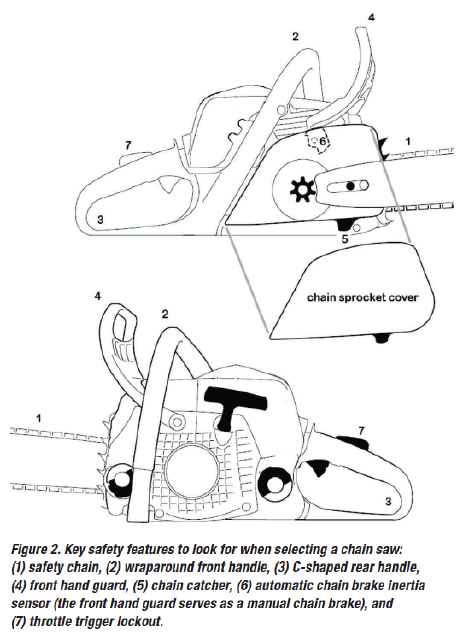
Features to consider include:
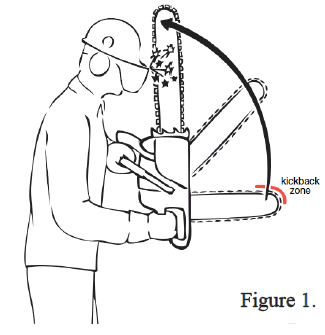
- low kickback safety chain to reduce potential injury to the operator when the chain is pinched (see figure 1.)
- wrap-around front handle to allow for a better grip on the saw
- C-shaped rear handle to protect the hand on the rear of the saw
- front hand guard to protect the hand on the front of the saw
- chain catcher to keep a broken chain from flying back at the operator
- chain brake to stop the chain motion if the saw kicks back
- throttle trigger lockout to prevent accidental operation of the saw
Other safety features to look for include:
- Antivibration handle to reduce fatigue
- Spark arrestor to prevent a spark from being ejected by the exhaust
- Chain oil tank on an electric saw to easily see the chain oil level
- Built-in circuit breaker on an electric saw
- Scabbard to cover the chain bar when the saw is not in use
Personal protective equipment is essential for safe operation of a chain saw. This includes protection for the head, face and legs. Wear a hard hat or helmet to be protected from falling trees and debris. If the hard hat does not have a face shield, wear safety glasses or goggles to protect eyes. Sunglasses or prescription eyeglasses do not provide adequate protection from flying debris. Earmuffs or ear plugs can protect ears from permanent hearing loss.
Wear lightweight leather gloves to protect hands from cuts and abrasions. Avoid wearing loose fitting clothing which could easily catch in a moving saw or falling debris. Chain saw chaps protect legs by stopping a moving chain when it contacts the chaps. Leather boots with high tops are important to protect feet and lower legs.
For more information look for the following MU Guides:
Source: Valerie Tate, Field Specialist in Agronomy
This Month in Ag Connection | Ag Connection - Other Issues Online

This Month in Ag Connection | Ag Connection - Other Issues Online

Conrow Named Statewide Poultry Specialist
Heather Conrow, Field Specialist in Livestock in Howard County, has taken on an additional role as the statewide Poultry Specialist. This role reflects Missouri's growing prominence in the poultry industry. With Missouri ranking in the top ten nationally for both commercial turkey and broiler production, and boasting a vibrant egg industry, the appointment comes at a pivotal time for producers across the state.
In addition to continuing livestock programming in three assigned counties, Conrow will now lead poultry-focused efforts across Missouri. Her work will primarily support medium-sized commercial poultry meat and egg producers, including those operating within both conventional and alternative production systems. Approximately 50% of her efforts will be directed toward these producers, helping them navigate challenges and seize opportunities in a rapidly evolving industry.
The statewide poultry specialist role also includes building relationships with larger integrators to ensure familiarity with the resources and expertise available through MU Extension. While her focus will remain on commercial operations, she will also provide limited reactive support to backyard flock owners and youth programs, primarily through guide sheets and collaborative efforts with other field specialists.
Collaboration is a cornerstone of the new position. She will work closely with other Extension faculty, educators, state agencies, poultry associations, and campus-based experts to deliver impactful programming and support across the state.
For more information about poultry programming or to connect with Heather Conrow, contact the University of Missouri Extension office in Fayette at 660-248-2272 or email hconrow@missouri.edu.
Source: Heather Conrow, Field Specialist in Livestock
This Month in Ag Connection | Ag Connection - Other Issues Online
Four Simple Steps to Financial Preparedness
Being prepared for unexpected financial circumstances is good practice. There are guidelines which can assist families in planning for both large and small emergencies such as tornadoes, floods, broken water lines, personal and farm vehicles breakdowns, all of which require unexpected funds. The following steps provide many ways to compile, review, safeguard and update individual and family financial information.
- Assess and Compile: Gather important financial documents and contacts.
- Date all forms in the financial plan and an example plan can be found at: https://www.fema.gov/emergency-financial-first-aid-kit. This specific plan is called Emergency Financial First Aid Kit (EFFAK)
- The EFFAK contains checklists of what items to collect. If the original version of items on the checklist is not available, contact the appropriate company or agency to obtain a copy.
- Consider requesting direct deposit or prepaid debit cards if paper checks are being used for employer payments or benefits
- Print or download statements of any bills paid automatically, such as rent or mortgage payments, utilities, loan payments, and membership fees.
- Download any banking or bill pay mobile applications to a smart phone or device for any bills paid online. This will allow consideration of these costs without the need to refer or sort through paper statements.
- Take photographs or record a video of the rooms in house and any valuable belongings, as well as the important documents listed in the plan. Include copies of these records with either the paper or electronic version of the plan.
- Keep some cash in the same safe location as the financial preparedness plan to pay for emergency purchases in the event ATMs are not functioning or banks are closed. The amount of cash should be based on basic family needs, including food, gas, and other things used on a day-to-day basis.
- Know your FICO Score, which is a type of credit score lenders use to determine the risk of offering credit to a borrower. Understanding the score and working towards improving, may help when unexpected borrowing may be needed. (Note: Fair, Isaac and Company (FICO) is an American data analytics company focused on credit scoring services.)
- Review: Review insurance policies and financial paperwork to be sure they are accurate and current.
- Ensure homeowners and auto insurance coverage is adequate in the event of an emergency.
- Ensure a home lease reflects the current rent and verify renters' insurance is up to date.
- The EFFAK will help identify any current important personal documents or types of insurance (e.g., a will, living will, life insurance policy, or health insurance plan). Consider taking the steps to set up these items.
- Safeguard: Store paper and electronic copies of all files in safe locations.
- Consider storing paper copies of important documents at home in a fireproof and waterproof box or safe, in a bank safe deposit box, or with a trusted friend or relative. If using a safe deposit box, ask the bank to confirm who can and cannot access the safe deposit box if the owner dies or cannot access it due to illness.
- For electronic copies of important documents, store in a password-protected format on a removable flash or external hard drive in a fireproof and waterproof box or safe. Consider using a secure offsite storage service. Be sure to include the passwords in the plan.
- Print account records of any banking or bills paid electronically and include with the financial preparedness plan or download the bank's banking app to keep track of statements every few months.
- File living wills and advanced directives with hospitals and primary care doctors.
- Consider providing the financial preparedness plan to a close advisor (ex. Lawyer, financial advisor, trusted family member) in a sealed envelope, in the event you cannot make decisions.
- Update: Revisit or update the financial preparedness plan regularly. Updates are especially important when significant life changes occur.
- Change the plan as soon as possible when:
- Insurance provider changes
- Residence changes
- Purchasing a home or renting an apartment
- Opening or closing bank accounts
- Marital status changes
- A child is born or adopted
- Child changes schools
- Planning for retirement
- Death within the household
Source: Darla Campbell, Field Specialist in Business & Communities
This Month in Ag Connection | Ag Connection - Other Issues Online

This Month in Ag Connection | Ag Connection - Other Issues Online

Christmas Trivia
- According to Hallmark, approximately how many Christmas cards are sent annually?
- What is the Hawaiian word for Santa Claus?
- When did Christmas become a national holiday?
- When did Rudolph become Santa's unofficial ninth reindeer?
- T or F: The North Pole has no time zone
- Who invented Christmas lights?
- What is the most popular type of Christmas tree?
- How many real Christmas trees are sold in the U.S. each year?
- In total, how many gifts are give in the "Twelve Days of Christmas"?
- Are Santa's reindeer male or female?
Answers:
- 1.3 billion
- Kanakaloka
- June 24, 1870, Pres. Grant signed a proclamation de-claring Dec. 25 a national holiday
- 1939, when the song "Rudolph the Red-Nosed Rein-deer" was released
- True. All longitudinal lines start at the North Pole, which means there is no time zone.
- Thomas Edison in 1880
- Fraser fir
- 25 to 30 million
- 364
- Female. Male reindeer lose their antlers in November, while female reindeer keep their antlers through the winter.
This Month in Ag Connection | Ag Connection - Other Issues Online